
Thiruparankundram hill dispute: Madras High Court clears lighting of Deepathoon, rejects ‘British survey stone’ claim
What happened: The Madras High Court upheld an order allowing the lighting of a lamp at the Deepathoon atop Thiruparankundram hill. Why it matters now:...
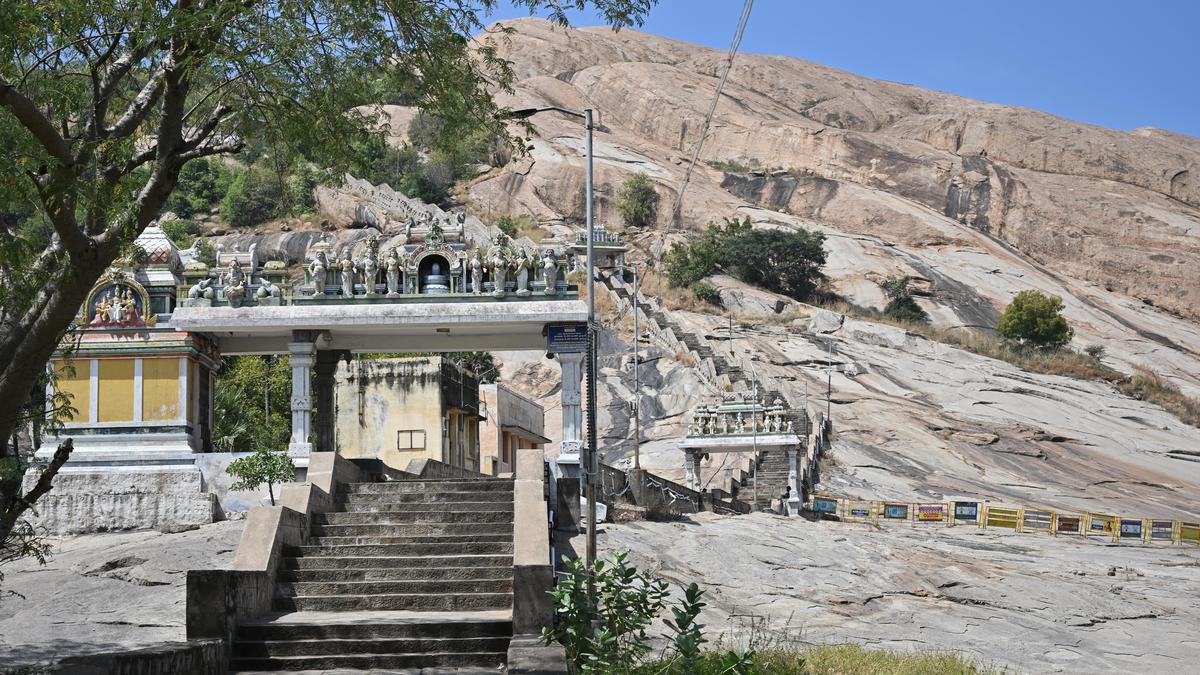
What happened: The Madras High Court upheld an order allowing the lighting of a lamp at the Deepathoon atop Thiruparankundram hill.
Why it matters now: The ruling settles a long-running dispute over the identity and use of the stone pillar, rejecting claims that it was merely a British-era survey stone.
What changes for people: The Devasthanam can light the lamp during Karthigai Deepam, subject to legal and archaeological safeguards.
Who is affected: Devotees, the Devasthanam, HR and CE Department, ASI, and residents around Thiruparankundram, Madurai.
The Madras High Court has dismissed arguments that the Deepathoon, a stone pillar located atop Thiruparankundram hill, was only a survey marker erected during British rule, and upheld directions permitting the lighting of a ceremonial lamp at the site.
A Division Bench of Justice G. Jayachandran and Justice K.K. Ramakrishnan confirmed the earlier ruling of a single judge, concluding that historical and physical evidence clearly distinguished the Deepathoon from survey stones used by the British administration.
Court relies on British-era survey records
The Bench examined a British publication titled “Synopsis of the Results of the Operations of the Great Trigonometrical Survey of India, Volume XXIX”, prepared by the Survey of India’s Trigonometrical Branch.
The judges noted that this document is the most authoritative record of British surveys in India. After comparing the descriptions of survey mark stones in the book with the actual structure on Thiruparankundram hill, the court found clear and visible differences.
The pillar in question, the court observed, has distinct carvings on both ends and a bowl-shaped structure on top, features that are absent in British survey stones.
The Bench said this evidence dismantled what it described as a “calculated campaign” by some private appellants to project the Deepathoon as a colonial survey remnant.
Conflicting official stands noted
The court also took note of contradictory positions taken by government authorities.
The District Collector stated that the pillar was a granite structure of unknown purpose.
The HR and CE Department submitted that it was a lamp post, though not necessarily meant for Karthigai Deepam, suggesting it may have been used by Jain monks for nighttime gatherings.
Despite these differing theories, the court found no credible material to support the appellants’ claim that lighting a lamp there violated religious doctrine.
Devasthanam ownership and past orders crucial
The Bench emphasised that the pillar is located within land declared as Devasthanam property by a competent civil court.
It also relied on a 1994 Madras High Court order, which had granted devotees liberty to light lamps anywhere on the hill belonging to the Devasthanam, provided the site was at least 15 metres away from the nearby Dargah property.
The court held that the appellants failed to show any Agama Shastra prohibition that would bar lighting a lamp at a place not directly above the sanctum sanctorum.
Protected monument, but worship allowed
While permitting the ritual, the court underlined that Thiruparankundram hill is a protected site under the Ancient Monuments and Archaeological Sites and Remains Act and Rules.
It ruled that all activities must strictly comply with the law and clarified that the Archaeological Survey of India (ASI) is free to impose conditions to preserve monuments on the hill.
Strict limits on access
The Bench directed the Devasthanam to light the lamp at the Deepathoon during Karthigai Deepam, but imposed safeguards:
No members of the public are allowed to accompany the team.
The number of personnel permitted to go atop the hill will be decided in consultation with the ASI and the Police.
The court concluded that when a long-standing custom exists and the act is not against morality or public policy, there is no valid reason for authorities to deny devotees their religious practice.
What to watch next
Watch for ASI-issued conditions and the coordination plan between the Devasthanam and police ahead of the next Karthigai Deepam. Any further legal challenge could shape how protected heritage sites balance worship rights and conservation.