
Scientists Model First Viable Quantum Uplink, Redefining Future of Global Secure Communication
A Quantum Leap for Space Communication In a groundbreaking development, researchers have successfully modelled a working quantum uplink — the transmission of quantum information from...
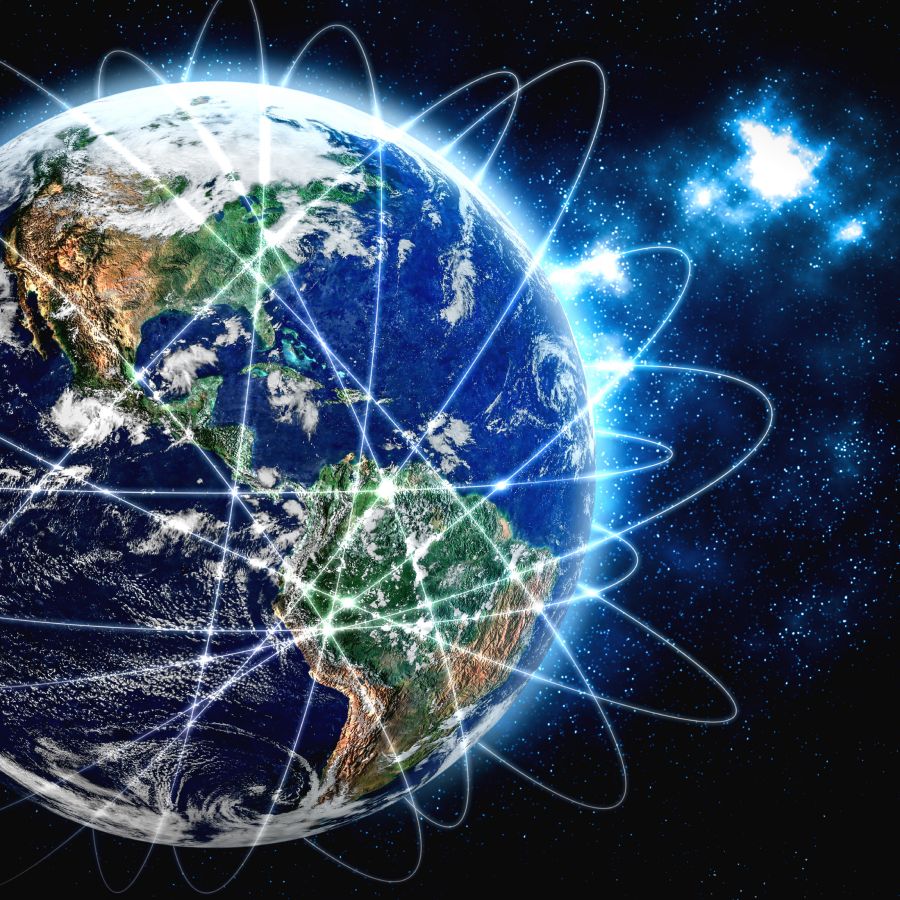
A Quantum Leap for Space Communication
In a groundbreaking development, researchers have successfully modelled a working quantum uplink — the transmission of quantum information from Earth to orbiting satellites. This advance, published in Physical Review Letters, challenges decades-old assumptions that sending fragile quantum signals upward through Earth’s atmosphere was impossible.
Until now, most quantum communication experiments relied on downlinks, where signals were transmitted from satellites to ground stations. Atmospheric turbulence and photon scattering were believed to make the reverse — sending quantum data upward — too unstable to achieve. The new model demonstrates otherwise.
How the Quantum Uplink Works
The research team designed a theoretical model showing that entangled photons, particles linked in such a way that a change to one instantaneously affects the other, can maintain their quantum state even as they travel from Earth to space.
In their proposed setup, two ground-based stations would simultaneously fire photons toward a satellite moving at high speed. The photons, meeting in orbit, would interfere in precise synchrony — a phenomenon that confirms quantum entanglement over vast distances.
This process could enable the satellite to act as a secure relay, connecting multiple stations on Earth through quantum key distribution (QKD) — a technology that allows encryption keys to be exchanged with absolute security, immune to interception or hacking.
Breaking Long-Held Barriers
The findings challenge traditional thinking in the field of quantum optics. Previous research focused on downlink systems because photons traveling upward face greater atmospheric distortion and absorption. By carefully modelling photon trajectories, timing synchronization, and orbital mechanics, the researchers proved that an uplink is not only possible but may also achieve higher fidelity under certain conditions.
“This discovery flips the conventional direction of quantum communication,” said a senior researcher involved in the study. “It shows that Earth-to-space links can perform as effectively as space-to-Earth, and in some cases, even better.”
Implications for Global Security
If realized in practice, quantum uplinks could revolutionize how nations, corporations, and research institutions exchange data across the globe. Current internet encryption relies on mathematical algorithms that may eventually be broken by quantum computers. Quantum communication, by contrast, uses the laws of physics — not mathematics — to ensure that any attempt to intercept information immediately destroys the signal.
This breakthrough brings the vision of a quantum-secure internet a step closer to reality, enabling real-time, tamper-proof communication across continents and into orbit.
What Comes Next
The next stage for scientists will involve experimental validation, requiring advanced satellite hardware capable of detecting and synchronizing quantum signals in real-world conditions. Several international space agencies, including the European Space Agency (ESA) and NASA, have already expressed interest in developing quantum communication payloads for future missions.
If successful, quantum uplinks could form the backbone of a global quantum network, linking terrestrial and orbital systems into a unified, ultra-secure web of information.