
Samsung’s Galaxy Watch8 Redefines Health Tracking With World’s First Real-Time Antioxidant Index
A New Era of Nutritional Intelligence What if your smartwatch could tell you how healthy your diet truly is — not through calories or steps,...
A New Era of Nutritional Intelligence
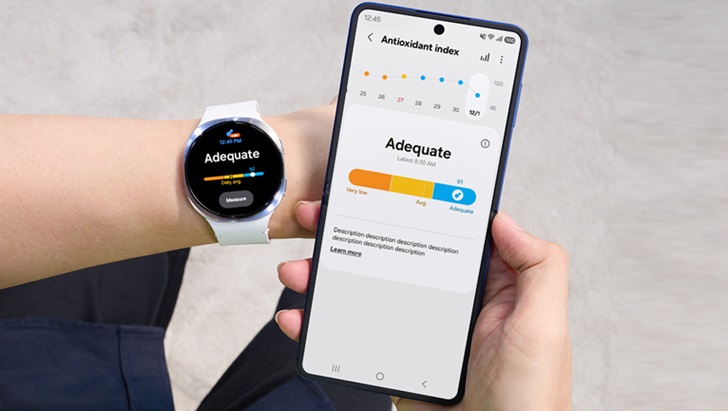
What if your smartwatch could tell you how healthy your diet truly is — not through calories or steps, but by measuring antioxidants in your body? That’s the question that sparked Samsung’s latest health breakthrough.
With the launch of the Antioxidant Index on the Galaxy Watch8, Samsung has achieved a first in wearable technology — a real-time, non-invasive measurement of carotenoid levels, a proven marker of fruit and vegetable intake. In just five seconds, a simple thumb scan delivers precise results, transforming nutrition tracking from abstract theory into daily practice.
The innovation marks the culmination of seven years of R&D, multiple prototypes, and collaboration between engineers, medical experts, and nutrition scientists.
From Counting Steps to Measuring Nutrition
When Samsung began exploring the concept in 2018, most wearables could track physical activity and heart rate — but none could quantify how diet influences health. Nutritional biomarkers were confined to clinical laboratories, requiring costly and time-consuming tests.
“As people live longer, attention is shifting from simply extending lifespan to improving the quality of those extra years,” said Dr. Hyojee Joung, a public health nutrition expert at Seoul National University, who advised on the project.
“Antioxidant management is critical for slowing down aging. When neglected, reactive oxygen species (ROS) accumulate, increasing the risk of chronic diseases such as cardiovascular disease, diabetes, and cancer,” she explained.
This insight led Samsung to focus on carotenoids — plant-based antioxidants that serve as reliable indicators of fruit and vegetable consumption. By turning carotenoid measurement into a wrist-based feature, Samsung has created a powerful new tool for everyday health awareness.
Engineering the Impossible: Shrinking the Lab to a Watch
Traditional Raman spectroscopy, the gold standard for carotenoid measurement, relies on bulky, laser-based machines. The Samsung team’s first challenge was to compress this technology into a sensor small enough to fit on a smartwatch.
After years of experimentation, engineers succeeded by developing a miniaturized spectroscopy sensor using multi-wavelength LEDs and a custom photodetector array. This setup, powered by advanced algorithms, analyzes how light interacts with the skin to estimate carotenoid levels with clinical precision.
“Our breakthrough came when we integrated reflectance spectroscopy with LEDs,” said Jinyoung Park, from Samsung’s Digital Health team. “It allowed us to maintain high accuracy while drastically reducing sensor size.”
Unlike laser-based systems, LEDs emit a broader range of wavelengths. By measuring how much light is absorbed by the skin at different wavelengths, the sensor determines antioxidant levels in seconds — all calibrated dynamically to individual users.
Designed for Everyone: Inclusive Health Tech
Creating an accurate sensor was only half the mission. The next challenge: ensuring reliable performance across diverse skin tones.
Because melanin can interfere with optical readings, Samsung’s engineers opted to take measurements from the fingertip, where melanin levels are lower and consistent across ethnicities. Gentle fingertip pressure during scans reduces blood flow and hemoglobin interference, further improving accuracy.
Extensive trials at Samsung Medical Center, involving hundreds of participants, validated the feature’s reliability. The result is an inclusive, globally adaptable health tool designed for all users.
Understanding the Antioxidant Index
Carotenoids — the natural pigments that give fruits and vegetables their red, yellow, and green colors — are vital for protecting cells from oxidative stress. Since the human body cannot produce them, carotenoid levels provide a direct reflection of dietary quality.
The Antioxidant Index translates these readings into an easy-to-understand scale:
-
Very Low: Less than 50% of the World Health Organization’s daily recommendation (400g of fruits and vegetables).
-
Low: Between 50% and 100%.
-
Optimal: 100% or more.
Because carotenoids accumulate gradually, the Index is best suited for tracking long-term dietary habits rather than short-term changes.
“We found that increases in fruit and vegetable intake raise skin carotenoid levels within one to two weeks,” said Dr. Joung. “That makes this Index an excellent tool for monitoring consistent, healthy behavior.”
Lifestyle factors like sleep, stress, and physical activity also influence the Index, making it a comprehensive measure of overall well-being. Combined with other Galaxy Watch8 features — such as sleep tracking, activity analysis, and vascular monitoring — users get a holistic health profile at a glance.
From Data to Daily Action
For Professor Yoonho Choi at Samsung Medical Center, the feature’s potential extends far beyond fitness.
“Wearable sensors like the Antioxidant Index can guide people toward healthier eating habits,” he said. “Consistent monitoring can help reduce the risk of cancers and age-related diseases, supporting long-term health in a very practical way.”
This convergence of nutrition science and wearable technology is a turning point for preventive healthcare. By providing users with measurable feedback about their diet, Samsung has transformed the smartwatch into a personal health laboratory.
A Benchmark for the Future of Wellness Tech
Experts describe the Galaxy Watch8’s Antioxidant Index as a scientific milestone and a blueprint for next-generation health wearables.
The feature’s precision — validated through clinical studies — sets a new benchmark for real-time nutritional tracking. It opens doors for future innovations in metabolism, dietary assessment, and personalized health monitoring.
Ultimately, Samsung’s achievement reflects a broader shift in how technology can empower individuals to take control of their wellness — not by guessing, but by measuring the invisible.
As Dr. Joung put it, “Antioxidants have always been important. Now, for the first time, they’re measurable — anytime, anywhere.”