
Nvidia CEO Jensen Huang says next-generation AI chips are now in full production
What happened: Nvidia CEO Jensen Huang confirmed that the company’s next-generation AI chips have entered full production and will launch later this year. Why it...
-
What happened: Nvidia CEO Jensen Huang confirmed that the company’s next-generation AI chips have entered full production and will launch later this year.
-
Why it matters now: The announcement comes as global competition in AI chips intensifies, with rivals and even Nvidia’s own customers building alternatives.
-
What changes for people: Faster, more efficient AI services such as chatbots, cloud computing, and autonomous systems are expected.
-
Who is affected: Tech giants, cloud providers, AI developers, automakers, and governments relying on advanced computing.
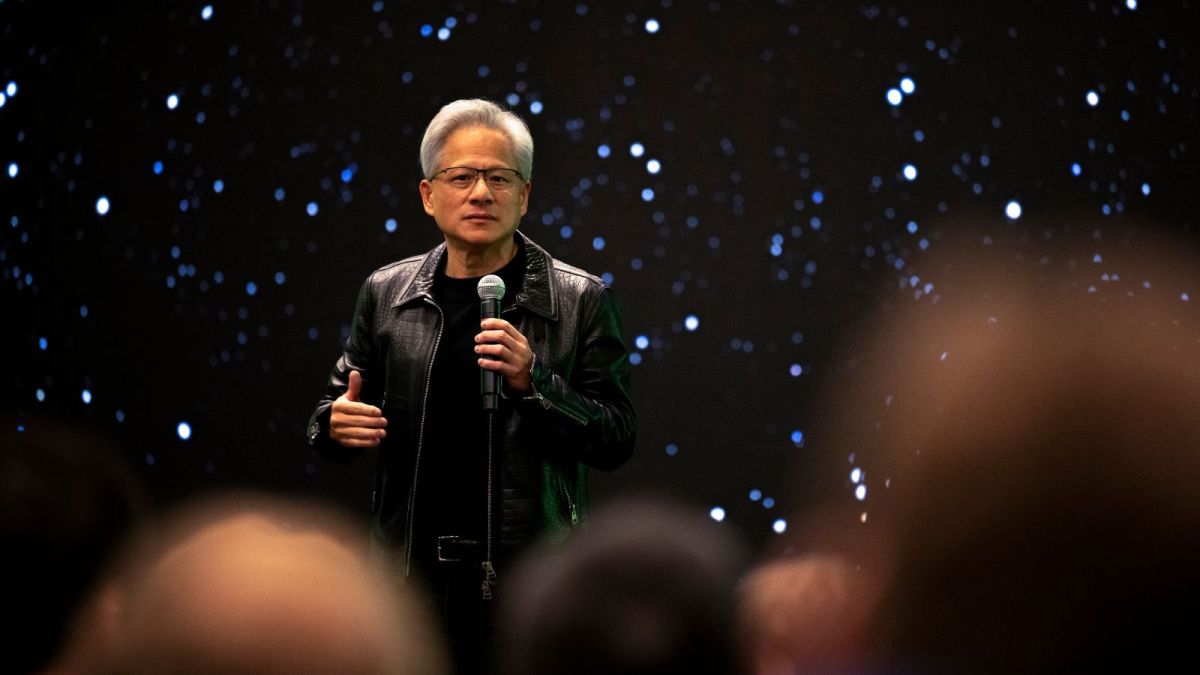
Nvidia, the world’s most valuable semiconductor company, has moved its next wave of artificial intelligence hardware into full-scale production, signalling confidence in demand even as competition heats up. Speaking at the Consumer Electronics Show (CES) 2026 in Las Vegas, CEO Jensen Huang said the new chips can deliver up to five times more AI computing power than Nvidia’s previous generation when running chatbots and other AI applications.
What Nvidia revealed at CES
Huang introduced the Vera Rubin platform, Nvidia’s upcoming AI computing system scheduled to debut later in 2026.
The platform combines six separate Nvidia chips, with a flagship server configuration packing 72 graphics processing units (GPUs) and 36 central processing units (CPUs).
According to Nvidia, these systems can be connected into large-scale clusters or “pods” containing more than 1,000 Rubin chips, dramatically boosting efficiency in generating AI tokens, the basic units used by language models.
Huang said these pods could improve token generation efficiency by up to ten times, a major leap for AI services that serve millions of users simultaneously.
How Nvidia is boosting performance
To achieve the performance gains, Nvidia is using a proprietary data format, which Huang said enables far better results even though the chips have only about 1.6 times more transistors than the prior generation.
He added that Nvidia hopes this data approach will eventually be adopted more widely across the industry, helping standardize high-performance AI computing.
Rising competition in AI chips
While Nvidia continues to dominate AI model training, it faces growing pressure in the deployment phase, where AI models are delivered to users.
Competitors include Advanced Micro Devices (AMD) and major customers such as Alphabet’s Google, which has developed its own in-house AI chips. These alternatives are increasingly being used by cloud platforms and large AI developers.
Much of Huang’s CES keynote focused on serving this deployment market more efficiently, including a new feature called “context memory storage”, designed to help chatbots respond faster and more accurately during long conversations.
Networking and cloud adoption
Nvidia also unveiled a new generation of networking switches featuring co-packaged optics, a technology critical for linking thousands of machines into massive AI data centers.
This puts Nvidia in direct competition with networking heavyweights such as Broadcom and Cisco Systems.
The company confirmed that CoreWeave will be among the first customers to deploy the Vera Rubin systems. Nvidia also expects adoption from Microsoft, Amazon, Oracle, and Alphabet, underscoring strong interest from major cloud providers.
Autonomous vehicles and open-source push
Beyond data centers, Nvidia announced expanded releases of self-driving software, including a system called Alpamayo. The software helps autonomous vehicles make decisions and provides a transparent decision trail for engineers.
Huang said Nvidia will open-source both the AI models and the training data, allowing automakers to independently evaluate safety and performance.
He emphasized that transparency is essential for trust in AI-driven systems.
Strategic moves and geopolitical backdrop
Last month, Nvidia acquired talent and chip technology from startup Groq, including engineers who previously helped Google design its AI chips. Huang said the deal would not disrupt Nvidia’s core business, but could lead to new products.
Meanwhile, Nvidia continues to navigate export restrictions. The company said demand remains strong in China for its older H200 chips, which the US government has allowed to be sold under certain conditions.
Nvidia’s CFO Colette Kress confirmed the company has applied for licenses to ship these chips and is awaiting approvals from US and other regulators.
Why this matters right now
AI infrastructure is becoming a cornerstone of economic growth, national competitiveness, and technological leadership. Nvidia’s move into full production signals that the next phase of AI scaling is imminent, with faster services and heavier global reliance on advanced chips.
At the same time, intensifying competition and export controls mean the AI chip race is no longer just about technology, but also geopolitics and supply chains.
What to watch next
-
Customer deployments of the Vera Rubin platform later this year
-
Regulatory decisions on AI chip exports to China
-
How rivals like AMD and Google respond in the AI hardware race