
India's Rs 289 Cr Archaeology Institute: A 'Ghost Campus' With 15 Students?
A lavishly funded archaeology institute stands largely empty despite its grand ambitions.
Top Summary
- What happened: A reporter visited the Pandit Deendayal Upadhyaya Institute of Archaeology in Greater Noida, finding a near-deserted campus despite significant investment.
- Why it matters: Questions arise about the effectiveness of government spending and the utilization of resources in higher education.
- What changes for people: The report highlights potential issues in the institute's operational model, raising concerns for prospective students and faculty.
- Who is affected: Current students, potential applicants, archaeology professionals, and taxpayers are affected by the underutilization of the institute.
A Grand Vision, An Empty Reality
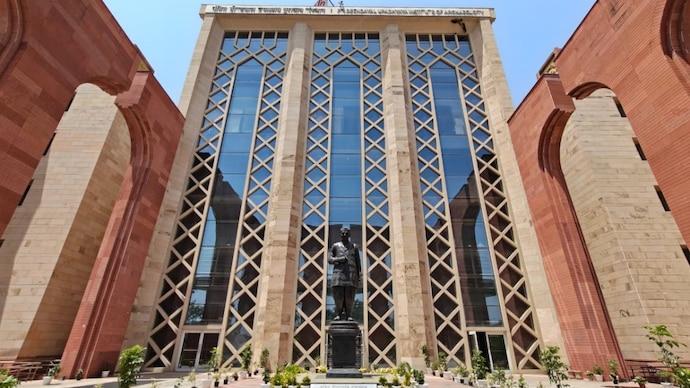
The Pandit Deendayal Upadhyaya Institute of Archaeology, inaugurated in 2019 by PM Modi, was envisioned as a premier institution. The foundation stone was laid in 2016 by Rajnath Singh. However, a recent ground report paints a drastically different picture. The campus, sprawling across 25 acres, feels eerily deserted.
The reporter's initial impressions were telling. The institute's name display had missing letters. This detail foreshadowed the incomplete nature of the experience within the campus.
Struggling to Enter: A Sign of Things to Come?
Gaining access to the campus proved challenging. Security initially denied entry, requesting administrative contact. After a 10-15 minute wait, the reporter was finally allowed in, escorted by a guard.
Inside, the scale of the campus was evident. Wide roads, tall buildings, and well-built walls contrasted starkly with the absence of life. No students, faculty, or administrative personnel were visible.
Inside the Institute: Echoes of Silence
The walk to the main building took nearly five minutes. The guard, when asked about the number of rooms, responded vaguely, highlighting a general lack of awareness about the institute's structure. The main building is a four-story structure.
The guard stated that the first and second floors are mostly closed. Only one lift is functional. Surprisingly, there is no reception area, adding to the sense of abandonment.
Architecture Alive, But Institution Stagnant
The building's architecture is impressive, featuring traditional designs and a sunlit courtyard. However, this visual appeal is overshadowed by the lack of activity. Only one security guard was found on the fourth floor.
He stated he had been working there for three years but did not know how many rooms were in the building. This raised questions about the overall management and operational efficiency of the institute.
Empty Spaces, Locked Doors, and Unanswered Questions
Further exploration revealed empty corridors, locked rooms, and dust-covered surfaces. Washrooms were not functional. There was no visible staff or academic activity. The fourth floor appeared largely vacant.
After waiting nearly 20 minutes, the reporter was able to meet with an official. This official requested anonymity.
No Permanent Faculty: A Deliberate Choice?
The official stated,
"There has not been any faculty since it was inaugurated as it is not the concept of this institute."
The institute focuses on field training rather than traditional classroom instruction. Visiting faculty from ASI and state-level experts provide guest lectures.
When asked about degree delays, the official said,
"There must be some issue."
No further explanation was provided.
A Syllabus Based on Experience?
According to the official, the institute does not follow a fixed syllabus.
"Everything is based on practical exposure and fieldwork experience,"
he said. Students participate in field visits, sometimes lasting up to 60 days, and then write reports.
This raises concerns about how exams are conducted and students are assessed without a structured syllabus.
Limited Intake, Vast Campus
Student intake is fixed at 15 students from across India. The current batch consists of 10 girls and 5 boys. This number appears disproportionately small for a 25-acre campus with large-scale infrastructure.
The campus reportedly houses 6-7 offices, including excavation, NMMA, BSP, science branch, underwater archaeology, and a separate head office. The ASI Science Branch director’s office is also located here.
What to Watch Next
The future of the Pandit Deendayal Upadhyaya Institute of Archaeology remains uncertain. Further investigation is needed to determine the long-term viability of its current operational model and its impact on archaeological education in India. Monitor government responses and potential policy changes.