
Google Quantum Scientists Among 2025 Nobel Physics Laureates
Alphabet CEO Sundar Pichai congratulated the winners of this year’s Nobel Prize in Physics, highlighting that the accolade includes a current Google scientist and a...
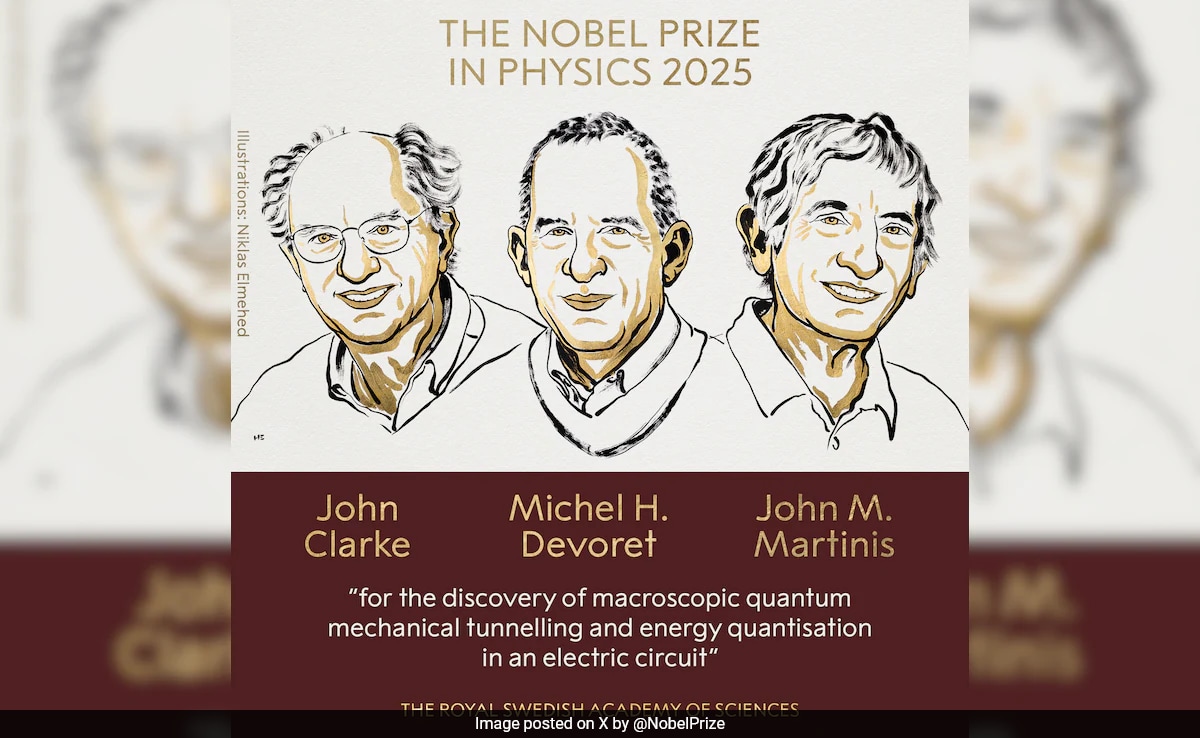
Alphabet CEO Sundar Pichai congratulated the winners of this year’s Nobel Prize in Physics, highlighting that the accolade includes a current Google scientist and a former employee. In a social media post on X, Pichai emphasized the company’s growing legacy in Nobel-winning research, noting that Google now counts five Nobel laureates among its ranks, with three awards in the past two years.
Recognizing Quantum Pioneers
The 2025 Nobel Prize in Physics was awarded to Michel H. Devoret, John M. Martinis, and John Clarke for experiments demonstrating quantum tunnelling on a macroscopic scale. Their work transformed abstract quantum phenomena into observable effects in systems large enough to be handled, marking a major step toward practical quantum computing.
Pichai specifically acknowledged the contributions of Devoret and Martinis:
“Congrats to Michel Devoret, John Martinis, and John Clarke on the Nobel Prize in Physics. Michel is chief scientist of hardware at our Quantum AI lab, and John Martinis led the hardware team for many years. Their pioneering work in quantum mechanics in the 1980s made recent breakthroughs possible, and paved the way for error-corrected quantum computers to come.”
Martinis, who left Google in 2020, co-founded the quantum startup Qolab in 2022. Devoret currently serves as the Chief Scientist of Hardware at Google’s Quantum AI lab.
Quantum Mechanics in Action
The laureates’ experiments centered on superconducting electrical circuits, allowing them to observe quantum tunnelling and energy quantization with billions of particles—so-called Cooper pairs—rather than just a few, as had previously been possible. The chip used in their experiments was roughly one centimetre in size, making quantum effects visible at a macroscopic scale for the first time.
Experts say this work represents a crucial advance in error-corrected quantum computing, bridging the gap between theoretical physics and scalable, functional quantum systems.
“Seeing these quantum phenomena manifest at a scale we can hold in the hand is groundbreaking,” said Dr. Ayesha Khan, a quantum computing researcher unaffiliated with Google. “It provides a blueprint for the next generation of quantum technologies.”
Pichai Celebrates Google’s Scientific Legacy
Reflecting on the achievement, Pichai shared that he had visited Google’s Santa Barbara quantum lab just a day prior and was impressed by the ongoing progress:
“I hope they are celebrating today. Feeling lucky this morning to work at a company that has had five Nobel Laureates among our ranks — three prizes in two years!”
The recognition underscores the growing intersection of corporate research and fundamental science, highlighting the role of tech companies like Google in advancing physics from theory to application.