
120 Bahadur Review: A Fierce, Faithful, and Emotional Tribute to Rezang La’s Heroes
Much like our political leadership, Bollywood too often remains silent about our battles with the northern neighbour. This week breaks that silence in spectacular fashion....
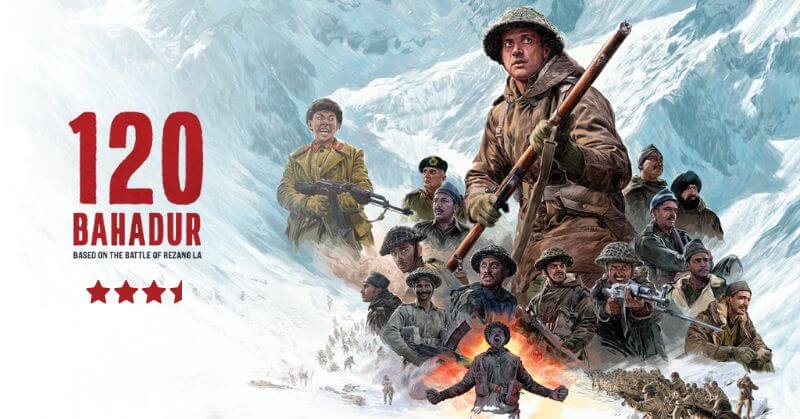
Much like our political leadership, Bollywood too often remains silent about our battles with the northern neighbour. This week breaks that silence in spectacular fashion. Director Razneesh “Razy” Ghai brings to screen the breathtaking valour of the Battle of Rezang La, where 120 Indian soldiers from the plains held back China’s advance toward the Chushul Airfield on November 21, 1962.
On its 63rd anniversary, 120 Bahadur revisits the historic last stand of the Charlie Company, 13 Kumaon Regiment, led by the indomitable Major Shaitan Singh Bhati (Farhan Akhtar). Their resistance inflicted severe casualties on the Chinese, forcing a unilateral ceasefire. India may have lost the wider war, but Rezang La remains one of the purest expressions of courage and military resolve. Refusing to retreat, the Ahir soldiers fought to their last bullet—and last breath.
120 Bahadur (Hindi)
Director: Razneesh Ghai
Cast: Farhan Akhtar, Rashii Khanna, Vivan Bhatena, Ankit Siwach, Ajinkya Deo, Eijaz Khan
Duration: 137 minutes
Storyline: The true story of the 120 soldiers of Charlie Company, led by Major Shaitan Singh, who made a legendary final stand at the freezing Rezang La pass during the 1962 Sino-Indian War.
A War Film With Heart and Intelligence
Unlike the usual chest-thumping jingoism Bollywood often deploys in war dramas, 120 Bahadur is remarkably sincere, grounded, and technically sharp. It delivers modern swagger without compromising the military specifics or the brutal conditions of Rezang La’s cold desert.
One of the film’s biggest strengths is its focus on the social makeup of the Indian Army, something mainstream cinema rarely highlights. The battle was fought by Ahir soldiers from Haryana and Rajasthan—sons of farmers whose folklore, valour, and Krishna devotion shaped their fighting spirit. Their war cry, “Dada Kishan Ki Jai,” echoes through the film, capturing their identity without preaching.
The narrative, delivered partly through the eyes of a genial radio operator, reflects a deeper truth: the film arrives at a time when the Ahir (Yadav) community is seeking recognition for its historic contribution and demanding a separate regiment. Without being political, Ghai’s film acknowledges their pride and legacy.
Even within caste distinctions—Major Shaitan Singh was a Rajput—the film subtly shows how identity and nationhood can coexist, with soldiers fighting for a collective cause. Young, energetic characters like Dahiya the singer and the chocolate-loving Yadav add warmth and authenticity.
Farhan Akhtar Delivers One of His Most Controlled Performances
Years after Dharmendra immortalised Shaitan Singh in Haqeeqat (1964), Farhan Akhtar steps into the role with a rare combination of quiet authority, strategic brilliance, and emotional restraint.
Farhan’s Shaitan Singh is not a loud, swaggering commander; he is a leader who inspires through composure and intellect. His dialogue delivery has a rhythmic cadence, rising and softening with the emotional temperature of each moment. His trademark flair is present, but refined—he gives the character a sharp, modern edge without sacrificing historical dignity.
The standout moment is a tense showdown where a cornered Shaitan defeats a smug Chinese general through sheer presence of mind. It’s a sequence staged with remarkable clarity and tension.
Razneesh Ghai’s Best Work Yet
After showing flair in Dhaakad, Ghai finds his true calling here. Supported by Japanese cinematographer Tetsuo Nagata, he crafts visceral, immersive combat sequences set against the stark beauty of the Himalayas.
Artillery fire, icy winds, bayonet charges, and hand-to-hand combat are filmed with brutal precision. You feel the bruises, smell the blood, and sense the suffocating altitude. Interestingly, the film also gives the Chinese army its due: towering low-angle shots emphasize their height advantage and looming presence.
Where the Film Trips
-
The accent inconsistency among supporting actors is distracting.
-
Some emotional beats—especially those involving Rashii Khanna—veer into cliché.
-
The narrative occasionally stumbles in pacing, especially in softer home-front moments.
These flaws keep 120 Bahadur from becoming a genre-defining classic, but they don’t diminish its sincerity or its impact.
Verdict
120 Bahadur is not just another war film—it is a moving, well-researched tribute to one of the greatest last stands in Indian military history. With powerful performances, stunning visuals, and an emotionally grounded narrative, it honours the legacy of Rezang La without resorting to noisy patriotism.
It may not be perfect, but it deserves your time, attention, and applause.
Now playing in theatres.