
UNSC Endorses Trump’s Gaza Roadmap; Hamas Rejects International Oversight
Global tensions rise as the UN Security Council approves Washington’s most ambitious proposal yet for Gaza’s political future. The UN Security Council on Monday adopted...
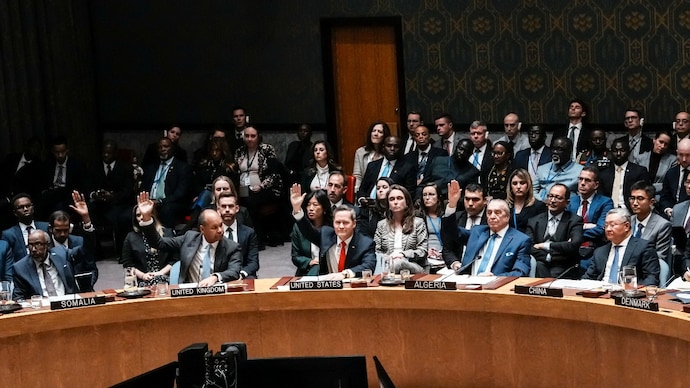
Global tensions rise as the UN Security Council approves Washington’s most ambitious proposal yet for Gaza’s political future.
The UN Security Council on Monday adopted a US-drafted resolution endorsing President Donald Trump’s 20-point peace framework for Gaza, marking a significant shift in international involvement in the conflict’s aftermath. The plan, which introduces an international stabilisation force and a new transitional governance mechanism, aims to consolidate the fragile pause in fighting between Israel and Hamas.
The measure passed with the support of 13 Council members, while Russia and China abstained. No member voted against the text—an outcome diplomats say reflects both broad concern over Gaza’s humanitarian crisis and a reluctance to oppose a rare moment of Israeli-Palestinian progress.
A New International Blueprint for Gaza
The adopted resolution formalises what Washington describes as the first integrated roadmap for ceasefire implementation, governance reforms, and long-term reconstruction in Gaza. Central to the plan is the creation of a Board of Peace, a proposed interim authority composed of participating UN member states, tasked with supervising institutional rebuilding and economic recovery.
The text also authorises the deployment of an international stabilisation force, which is expected to support demilitarisation efforts by dismantling weapons stockpiles and disabling military infrastructure. According to the resolution, these steps are essential for preventing renewed hostilities and paving a structured path toward self-rule for Palestinians.
A draft circulated earlier emphasised that these developments could “create the conditions” for Palestinian self-determination—contingent on governance reforms by the Palestinian Authority and demonstrable progress in Gaza’s reconstruction.
Why the Vote Matters Now
The Council’s approval comes only weeks after Israel and Hamas accepted the initial stage of the US plan, leading to a mutual halt in hostilities and a hostage-release agreement that diplomats viewed as a turning point. Monday’s endorsement transforms what was a political proposal into an internationally backed directive, giving Washington greater leverage to push the parties toward compliance.
Experts note that the vote signals a growing international appetite for a structured, multilateral role in stabilising Gaza after two years of devastating conflict. It also reflects global concern that without coordinated oversight, Gaza’s reconstruction risks being derailed by political gridlock or renewed violence.
Hamas Rejects Resolution, Calls It an Attempt to Seize Control
Hamas harshly criticised the Security Council’s decision, saying the resolution disregards key Palestinian demands and seeks to impose “external guardianship” over Gaza. In comments reported by Reuters, the group argued that assigning an international force powers related to disarmament “compromises neutrality” and effectively positions foreign troops as participants in the conflict rather than monitors.
Political analysts say Hamas’ objection highlights long-standing resistance among Palestinian factions to any arrangement that diminishes local authority or empowers outside actors, especially in matters relating to security.
Trump Hails Vote as a Diplomatic Breakthrough
President Trump celebrated the Security Council’s approval, calling it a landmark moment for global diplomacy. In a statement shared on his social media platform, he said the formation of the Board of Peace—an entity he announced he would personally chair—represented “one of the most significant endorsements in the history of the United Nations.”
US officials argue that the new framework finally creates a workable structure for political dialogue between Israelis and Palestinians, something that has stalled repeatedly in past negotiations.
Israel Maintains Firm Position on Security and Statehood
Israeli Prime Minister Benjamin Netanyahu reaffirmed his government’s hard line on Palestinian statehood the day before the vote, stating that Israel would not accept any arrangement leading to sovereignty for Palestinians. Netanyahu insisted that Gaza would be fully demilitarised “by cooperation or by force” if necessary, underscoring the challenges ahead for any international effort seeking long-term stability.
Broader Implications
Monday’s resolution deepens international engagement in one of the world’s most protracted conflicts and may shape regional political dynamics for years. If implemented successfully, it could stabilise Gaza, reopen political pathways, and reduce security risks throughout the Middle East. However, with Hamas rejecting the plan and Israel resisting core political provisions, the path forward remains uncertain—and potentially volatile.
Social Media Summary (2–3 Sentences)
The UN Security Council has approved the US-backed 20-point Gaza peace framework, clearing the way for international troops and a new transitional authority. While Washington calls it a historic step, Hamas rejects the plan, warning it imposes foreign control. Israel maintains it will demilitarise Gaza on its own terms.