
UK Prime Minister Keir Starmer Arrives in Mumbai with Record Trade Delegation to Strengthen Post-FTA Ties with India
Starmer’s Landmark Visit Marks New Era in UK-India Trade Relations British Prime Minister Keir Starmer landed in Mumbai on Wednesday at the head of a...
Starmer’s Landmark Visit Marks New Era in UK-India Trade Relations
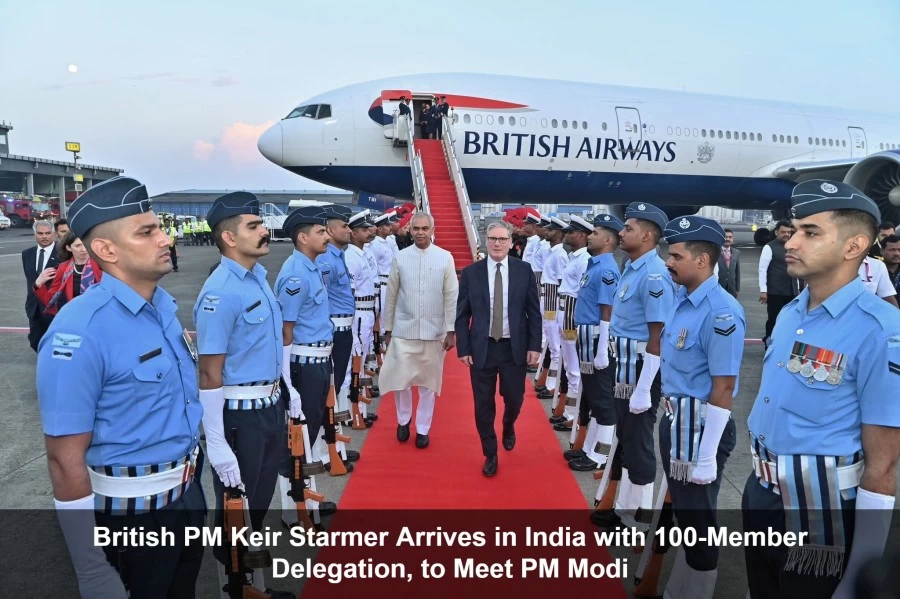
British Prime Minister Keir Starmer landed in Mumbai on Wednesday at the head of a 125-member delegation of business executives, university leaders, and cultural representatives, underscoring the United Kingdom’s renewed focus on strengthening economic ties with India.
The visit comes shortly after London and New Delhi signed a comprehensive Free Trade Agreement (FTA) in July, capping three years of complex negotiations. The deal eliminates tariffs on over 90 percent of British exports, including key sectors such as pharmaceuticals, machinery, and spirits—making it one of the UK’s most ambitious post-Brexit trade arrangements.
“This is your Prime Minister speaking from the cockpit,” Starmer said cheerfully in a video shared on Instagram before take-off. “It’s fantastic to have you all on board as we explore new opportunities and make the most of our free trade agreement with India.”
UK’s Largest Trade Mission to India
According to Downing Street, this is the biggest trade mission the UK has ever sent to India, reflecting Starmer’s strategy to position Britain as a global trading powerhouse in the Indo-Pacific region.
The delegation includes senior figures from finance, technology, manufacturing, education, and renewable energy—industries expected to benefit most from the FTA. University vice-chancellors are also part of the trip, with plans to discuss deeper academic collaboration, talent mobility, and research partnerships with Indian institutions.
British officials describe the visit as a “practical step” to ensure that businesses and universities can begin realizing the FTA’s potential benefits—expected to boost wages, lower consumer prices, and increase bilateral trade volumes.
Why the Visit Matters
The UK’s outreach to India forms a cornerstone of its post-Brexit global strategy. India is now Britain’s 12th-largest trading partner, with annual bilateral trade valued at over £38 billion. Experts say the FTA could help both nations diversify supply chains, expand digital trade, and accelerate investment in clean energy and infrastructure.
“India represents both an economic and strategic opportunity for the UK,” said Dr. Meera Singh, a senior fellow at Chatham House, noting that stronger trade ties could also bolster cooperation in technology and defense.
The FTA is also politically significant for Starmer, who has sought to differentiate his government from its predecessors by pursuing stable, pragmatic partnerships with key democracies.
Deepening Bilateral Cooperation
Beyond commerce, Starmer’s delegation is expected to engage with Indian officials on issues including climate resilience, education exchange programs, and digital innovation.
The visit will also include business roundtables in Mumbai and New Delhi, where discussions are likely to center on investment facilitation, startup collaboration, and enhancing the ease of doing business for UK firms in India.
“India and the UK have a long history of partnership, but this FTA creates a foundation for a future-oriented relationship,” said a senior UK trade envoy accompanying the delegation.
Looking Ahead
Analysts believe the visit could set the tone for a series of high-level engagements leading up to the Commonwealth Heads of Government Meeting next year. Both nations are expected to explore cooperation under the Roadmap 2030 initiative, which aims to expand collaboration across five key pillars: trade, defense, climate, health, and people-to-people links.
For Starmer, this two-day trip is more than ceremonial—it is a test of how effectively Britain can translate trade diplomacy into tangible growth at home.