
Thai Air Strikes Hit Cambodia as Border Conflict Flares Again; Thousands Evacuated
Four Cambodian civilians, one Thai soldier killed as both sides trade accusations amid long-running territorial dispute Tensions between Thailand and Cambodia surged on Monday after...
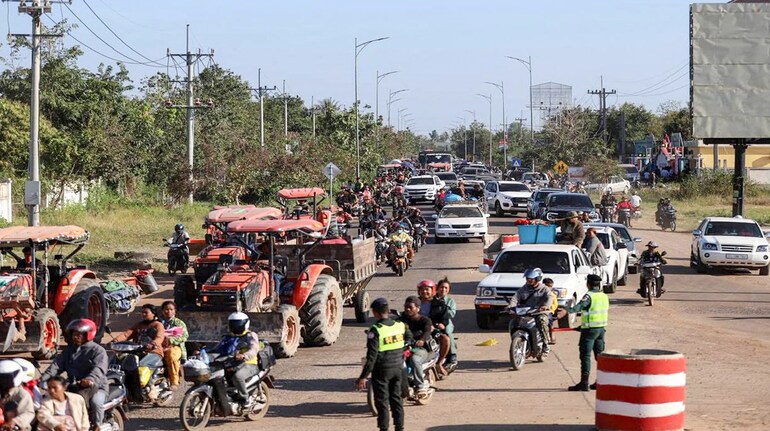
Four Cambodian civilians, one Thai soldier killed as both sides trade accusations amid long-running territorial dispute
Tensions between Thailand and Cambodia surged on Monday after Thai forces launched air strikes along the disputed border, triggering a fresh round of clashes that left four Cambodian civilians and one Thai soldier dead. The renewed violence has forced thousands of families on both sides to flee, rekindling fears of a larger conflict.
Thailand’s Second Army Region confirmed that more than 35,000 residents in Thai border districts have been evacuated to emergency shelters since fighting escalated late Sunday. Cambodia’s information ministry reported that at least 1,157 families fled their homes in Oddar Meanchey province alone.
Fighting Rekindles After Fragile Ceasefires
The border has witnessed repeated flare-ups over the past year. Five days of intense combat in July killed 43 people and displaced nearly 300,000 before a truce took hold. A follow-on agreement, backed by then–U.S. President Donald Trump, stalled in October after Thailand blamed Cambodia for a landmine blast that injured several soldiers.
Since then, both governments have accused each other of violating ceasefire terms through sporadic skirmishes—tensions that culminated in this week’s deadly confrontation.
Villagers Flee Again: “It Shouldn’t Have Happened Again”
Pannarat Woratham, a 59-year-old farmer from Thailand’s Surin province, said she immediately evacuated when officials warned of renewed fighting.
“Given what happened in July, I complied immediately,” she said, speaking from a temple shelter. “Of course many of us thought the conflict was finally over. It shouldn’t have happened again like this.”
For villagers like her, this marks the second mass evacuation in just a few months.
What Triggered Monday’s Escalation?
Both sides described a similar sequence—brief clashes on Sunday followed by a dramatic intensification on Monday morning—but offered starkly different accounts of responsibility.
Thailand’s Position
Thai Army spokesman Winthai Suvaree said Cambodian troops launched attacks early Monday, killing one Thai soldier and injuring eight others.
He said Thailand launched air strikes in self-defence, deploying precision strikes “solely at Cambodian military objectives along the clash line.”
“The Thai air power is being used only against Cambodian military targets,” he said. “There is no impact on civilians.”
Cambodia’s Position
Cambodia rejected the claim of self-defence and accused Thailand of initiating the assault.
Defence ministry spokeswoman Maly Socheata said Thai forces targeted Cambodian troops in Preah Vihear and Oddar Meanchey provinces, including firing tank shells toward the historic Tamone Thom temple.
She said an F-16 jet struck Cambodian positions around 9 a.m., injuring civilians, burning homes, and prompting widespread evacuations.
A Cambodian journalist was reportedly wounded by shrapnel from a Thai rocket.
Local officials in Oddar Meanchey said gunfire was reported near the centuries-old Tamone Thom and Ta Krabei temples, both long-disputed heritage sites.
Meanwhile, Thailand accused Cambodia of firing BM-21 rockets toward civilian areas in Thailand’s Buri Ram province—claims Cambodia has not acknowledged.
International Concern Grows
The renewed violence has drawn swift international attention. Malaysia, as the current ASEAN chair, joined the United States and China in urging restraint.
“Our region cannot afford to see long-standing disputes slip into cycles of confrontation,” Malaysian Prime Minister Anwar Ibrahim said.
The conflict centres on overlapping claims rooted in colonial-era maps drawn during French rule, particularly areas surrounding ancient temples that sit along the frontier.
A Dispute With No Clear End
Despite multiple ceasefires and international mediation, the border remains one of Southeast Asia’s most volatile flashpoints. With both armies trading blame and civilians again bearing the brunt, the latest escalation highlights the fragility of peace along a boundary where history, nationalism, and geopolitics collide.