
Tensions Escalate Across Uttar Pradesh Following ‘I Love Mohammad’ Campaign
Violence and unrest erupted across Uttar Pradesh in the wake of the controversial ‘I Love Mohammad’ campaign, triggering protests, police crackdowns, and multiple arrests in...
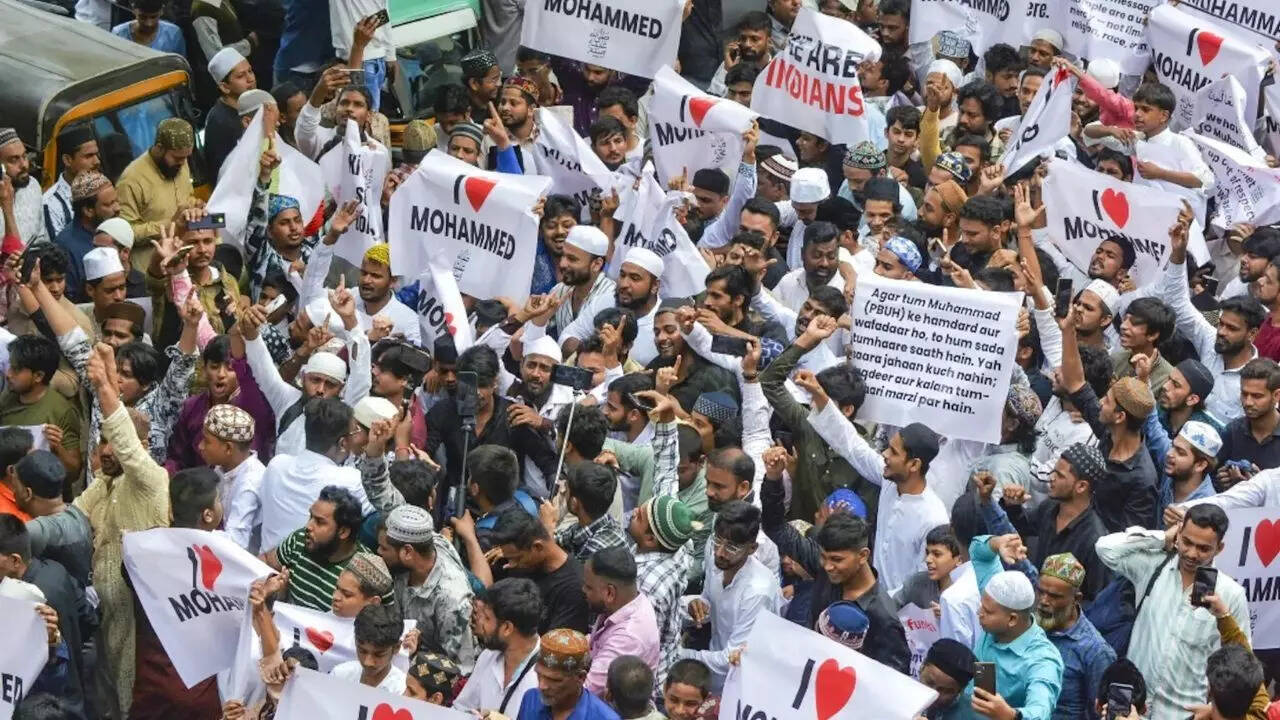
Violence and unrest erupted across Uttar Pradesh in the wake of the controversial ‘I Love Mohammad’ campaign, triggering protests, police crackdowns, and multiple arrests in districts including Bareilly, Barabanki, Kanpur, and Modinagar. The unrest originated in Kanpur, where police had registered cases on September 9 against nine individuals for placing posters and lightboards bearing the slogan.
The campaign sparked widespread protests in Kaushambi, Pilibhit, Bareilly, Bhadohi, Lucknow, Unnao, and Kanpur, with clashes reported in Bareilly and internet services suspended in several areas. In Barabanki’s Faizullaganj locality, tensions flared when a village watchman, Dhaniram, tore down a campaign banner. About 150 residents retaliated, attacking him, vandalizing his home, and looting valuables. Police intervened, arresting eight individuals and registering multiple FIRs for rioting, stone-pelting, and promoting enmity.
In Bareilly, over 1,000 protesters carrying religious banners clashed with police near Islamia Ground. Stone pelting and firing in the air left at least ten officers injured, prompting the use of tear gas and lathi charge, which caused a stampede. Authorities arrested 39 people, including cleric Maulana Tauqeer Raza Khan, who had called for a protest march. In total, 50 individuals were detained amid ongoing investigations and FIRs.
To prevent further unrest, authorities banned unauthorized protests under Section 163 and strengthened security ahead of Dussehra. Chief Minister Yogi Adityanath issued a stern warning, emphasizing that attempts to create anarchy in the name of Ghazwa-e-Hind would have severe consequences. “Whoever tries to take the law into their own hands, attacks pedestrians, or compromises public safety will face strict action,” he stated.
The violence in Bareilly on September 26 followed clashes outside a mosque in the Kotwali area after the cancellation of a proposed demonstration called by Raza Khan. The controversy spread to Muradnagar and Modinagar, where Hindu groups, including Bajrang Dal, objected to posters. Police swiftly removed banners and detained suspects. Protests also occurred in Sitapur, following allegations that a school forced Hindu students to write the slogan, leading to arrests of the school manager and teacher.
Similar disturbances and arrests were reported in Mau, Varanasi, Moradabad, and other states including Uttarakhand, Gujarat, Karnataka, Bihar, and Maharashtra. In Beed, Maharashtra, police filed a case against a cleric for inflammatory remarks. Authorities conducted flag marches and house-to-house raids in Bareilly, registering ten FIRs against over 180 named and 2,500 unidentified rioters, while internet services were suspended for 48 hours.
Tensions also echoed in Karnataka, where stone pelting broke out in Bengaluru’s Karl Marx Nagar after police removed a campaign banner, leading to injuries and FIRs. In Kanpur’s Rawatpur area, FIRs were filed against individuals who erected banners and tents with the slogans on public roads, drawing objections from local groups.
Political leaders weighed in on the controversy. AIMIM chief Asaduddin Owaisi criticized the hostility toward the campaign, highlighting India’s large Muslim population. Congress leader Pawan Khera condemned polarizing reactions, defending the campaign as a legitimate form of expression within India’s rich cultural tradition.