
Supreme Court Eases Ban, Allows Limited Sale and Use of Green Firecrackers in Delhi-NCR
In a major shift from its earlier stance, the Supreme Court of India on Wednesday (October 15, 2025) partially lifted its year-long prohibition on firecrackers,...
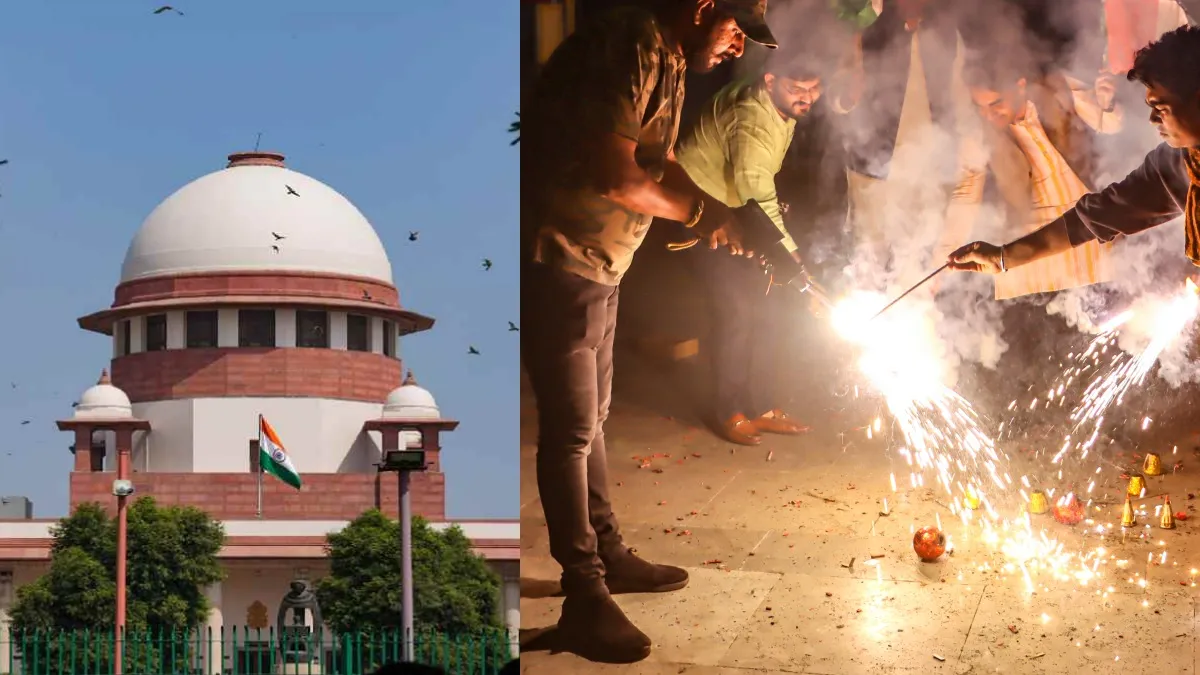
In a major shift from its earlier stance, the Supreme Court of India on Wednesday (October 15, 2025) partially lifted its year-long prohibition on firecrackers, allowing the sale and use of certified “green firecrackers” in the Delhi–National Capital Region (NCR) during the upcoming festive period.
A Bench comprising Chief Justice of India B.R. Gavai and Justice K. Vinod Chandran said the relaxation was necessary to strike a balance between environmental protection and citizens’ cultural rights, while ensuring tighter regulatory oversight.
Key Conditions for Sale and Use
Under the new directive, green firecrackers — which emit significantly lower levels of pollutants — can be sold only between October 18 and 21. Sales are restricted to designated physical locations, with online or e-commerce sales strictly banned.
The Bench also limited the permissible hours for use to:
-
6–7 AM and
-
8–10 PM
Any violation of these conditions, the court warned, would invite stringent penal action under environmental laws.
Court’s Rationale: Ban Led to Smuggling, Greater Harm
Explaining its reasoning, the Supreme Court said the blanket ban imposed earlier had encouraged the smuggling of conventional firecrackers, which caused greater damage to Delhi’s already fragile air quality.
“Conventional firecrackers are smuggled, which causes more damage. We have to take a balanced approach,” the Bench observed.
The judges emphasised that a regulated allowance for cleaner, certified products was more realistic than an outright ban that was impossible to enforce effectively.
Background: Revisiting the April 2025 Order
Wednesday’s order marks a significant revision of the Court’s April 3, 2025, decision that had imposed a comprehensive, year-long ban on the manufacture, storage, sale, and use of all firecrackers in Delhi-NCR.
That earlier verdict, delivered by a Bench of Justices Abhay S. Oka and Ujjal Bhuyan, had reasoned that even temporary relaxations would be ineffective since unregulated sales would continue beyond the restricted period.
However, following multiple petitions from industry associations, including the Federation of Fireworks Traders, the Association of Fireworks (Haryana), and the Indic Collective Trust, the Supreme Court agreed to reconsider the matter.
The petitioners argued that the ban was arbitrary and unsupported by scientific evidence, claiming that vehicular emissions and stubble burning were far greater contributors to Delhi’s post-Diwali smog than limited firecracker use.
Certified Green Firecrackers and Compliance Concerns
In September 2025, the Court had allowed manufacturers with valid certification from the National Environmental Engineering Research Institute (NEERI) and the Petroleum and Explosives Safety Organisation (PESO) to resume production of green firecrackers, but continued to bar their sale within the NCR pending regulatory review.
At the time, the Court noted that a “blanket ban without robust enforcement” was impractical and directed the government to propose a balanced regulatory mechanism.
The Commission for Air Quality Management (CAQM) later submitted that enforcement challenges persisted, citing instances where manufacturers sold QR codes—intended to authenticate certified firecrackers—to unauthorised producers, making it difficult to verify whether only approved products were reaching consumers.
What Lies Ahead
Following the latest order, both state pollution control boards and district administrations in Delhi-NCR will be responsible for monitoring sales outlets and ensuring compliance. Authorities have been instructed to deploy flying squads and real-time air quality monitoring during the festive window.
Environmental experts have welcomed the move as a “pragmatic compromise”, though they caution that even green firecrackers release particulate matter that can worsen pollution if used excessively.
The ruling signals a shift toward regulatory realism—acknowledging that enforcement, not prohibition, will determine Delhi’s air quality during the festive season.