
Poetry Camp in Indore: Poets Raise Voices of Resistance Against Palestinian Struggle
In Indore, a two-day poetry camp focused on social justice, the struggles of the oppressed, and resistance.
Indore | आशीष नेमा
Voices of Resistance Echo at Indore Poetry Camp
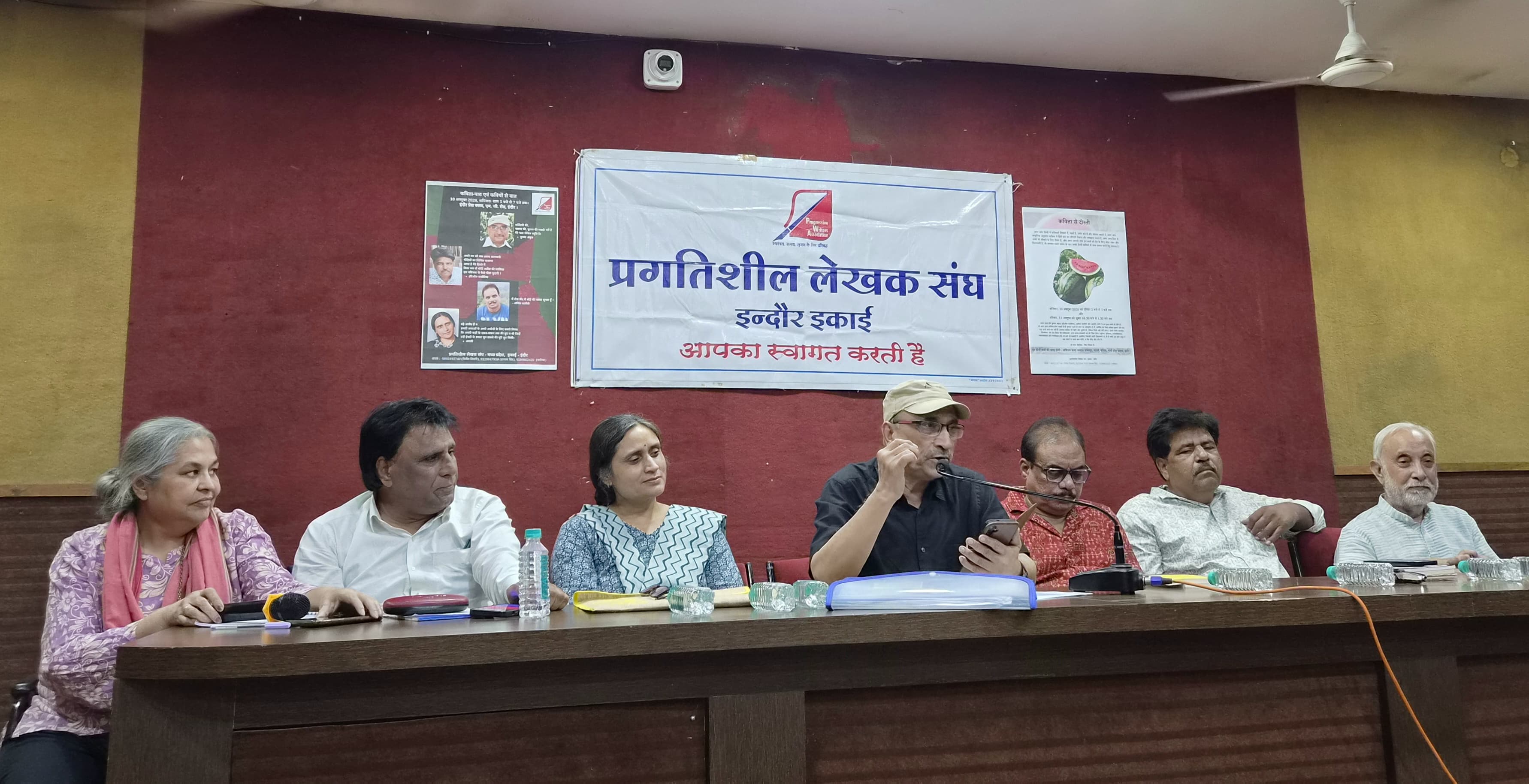
In a special two-day poetry camp held on October 7th, commemorating the Israeli invasion of Palestine, poets in Indore raised voices of social justice, the struggles of the oppressed, and resistance against the establishment. The literary event, themed 'Friendship with Poetry,' was organized at the Abhinav Kala Samaj Auditorium and the Indore Press Club.
The primary objective of this program was to foster dialogue with senior litterateurs on the process of poetry creation, its ideology, and social concerns. Poets from Bhopal, including Kumar Ambuj, Aarti, and Anil Karmale, along with Hariom Rajoriya from Ashoknagar, mesmerized the audience with their compositions. Kumar Ambuj recited his renowned poems 'Yachika,' 'Shrinkhala,' and 'Alikhit Khatra,' while Hariom Rajoriya presented works like 'Haisiyat,' 'Paisa Jo Hai So Hai,' and 'Dar-dar kar Rahne ka Samay.' Poetess Aarti offered poignant expressions through poems such as 'Mrityu Shaiya Par Ek Stri Ka Bayan' and 'Ramrajya Ki Taiyari Ka Program.'
On this occasion, Vineet Tiwari recalled the historical context of the watermelon, a symbol of the Palestinian struggle, and presented a translation of a Palestinian poem that deeply impacted the listeners.
Palestinian Struggle and Social Justice Themes Dominant
A majority of the poems presented at the camp prominently depicted the immense struggles of women, laborers, youth, and the most marginalized sections of society. These works raised serious questions about the current social system, which is based on injustice, inequality, and exploitation. The poets expressed their deep solidarity with the alleged genocide by the United States and Israel in Palestine.
The sentiment of disagreement and resistance towards the establishment was strikingly clear in the poems, inspiring the audience to reflect deeply on the anomalies of contemporary times. This resistance was not confined to words but represented a vocal outcry against the deep-seated inequalities and human suffering prevalent in society. Many compositions poignantly portrayed the plight of the Palestinian people, underscoring the demand for justice on the global stage.
Discussions on Poetry Creation and Ideology
The poetry session was presided over by Dr. Zakir Hussain, with Sarika Srivastava skillfully moderating. At the conclusion of the program, Harnam Singh expressed gratitude to all attendees. Poets from Dewas, Ujjain, and Ashoknagar, along with many young creators from Indore, recited their new works during various sessions of the event. Following the readings, senior poets offered detailed and insightful commentary on the young writers' poems.
Kumar Ambuj and other experts emphasized that poetry is not merely a form of entertainment but a powerful expression of society's inherent unease and deep aspirations. They also clarified that poetry can never be devoid of thought, and it is crucial for poets to understand the subtle difference between history and myth. The aim of this discussion was to not only inspire young poets to refine their creativity but also to encourage them to make their works more relevant with a deeper understanding of social and historical contexts.
Deep Reflection on Contemporary Anomalies
In this two-day literary event, named 'Friendship with Poetry,' litterateurs engaged in profound reflection on the complexities and anomalies of contemporary society. Speakers stressed that literature, especially poetry, is a powerful medium for awakening social consciousness. They asserted that it is the responsibility of poets to give voice to those who often go unheard.
The compositions based on the Palestinian struggle demonstrated how poems can become a symbol of solidarity against global injustice. Furthermore, many young poets shed light on local issues such as the impact of urbanization, environmental degradation, and social inequality through their works, making the event even more multifaceted. The experts' comments highlighted how symbols, imagery, and language used in a poem can deeply affect the reader's mind.
Literary Dialogue and Honouring Young Talent
Many distinguished citizens and literature enthusiasts from the city, including Ram Asrey Pandey, Javed Alam, Chunnilal Wadhwani, Abhay Nema, Neha Dubey, Ravindra Vyas, Anuradha Tiwari, Father Pius Lakra, Prakash Pathak, Amey Kant, Shirin Bhavsar, Vinod Purohit, and Raj Kumar Yadav, were present at this significant literary gathering. Their presence lent a dignified aura to the program.
The two-day symposium provided a new and impactful perspective on the deep and unbreakable interconnections between poetry and society, injecting new energy into the literary community. Notably, the critical, yet positive and constructive, comments made by senior poets on the works of young creators inspired budding talents. This event was not merely limited to literary presentations but provided a platform where poets and litterateurs from different generations could connect with each other's ideas and engage in meaningful discourse on the contemporary literary landscape. This dialogue also illuminated how poems stand the test of time and play their role in social change.