
PM Modi’s Proposals at G20 Summit: A Vision for Global Collaboration on AI Ethics and UN Reforms
The 2025 G20 Leaders’ Summit took place in Johannesburg, hosted by South African President Cyril Ramaphosa. Prime Minister Narendra Modi, who arrived a day ahead...
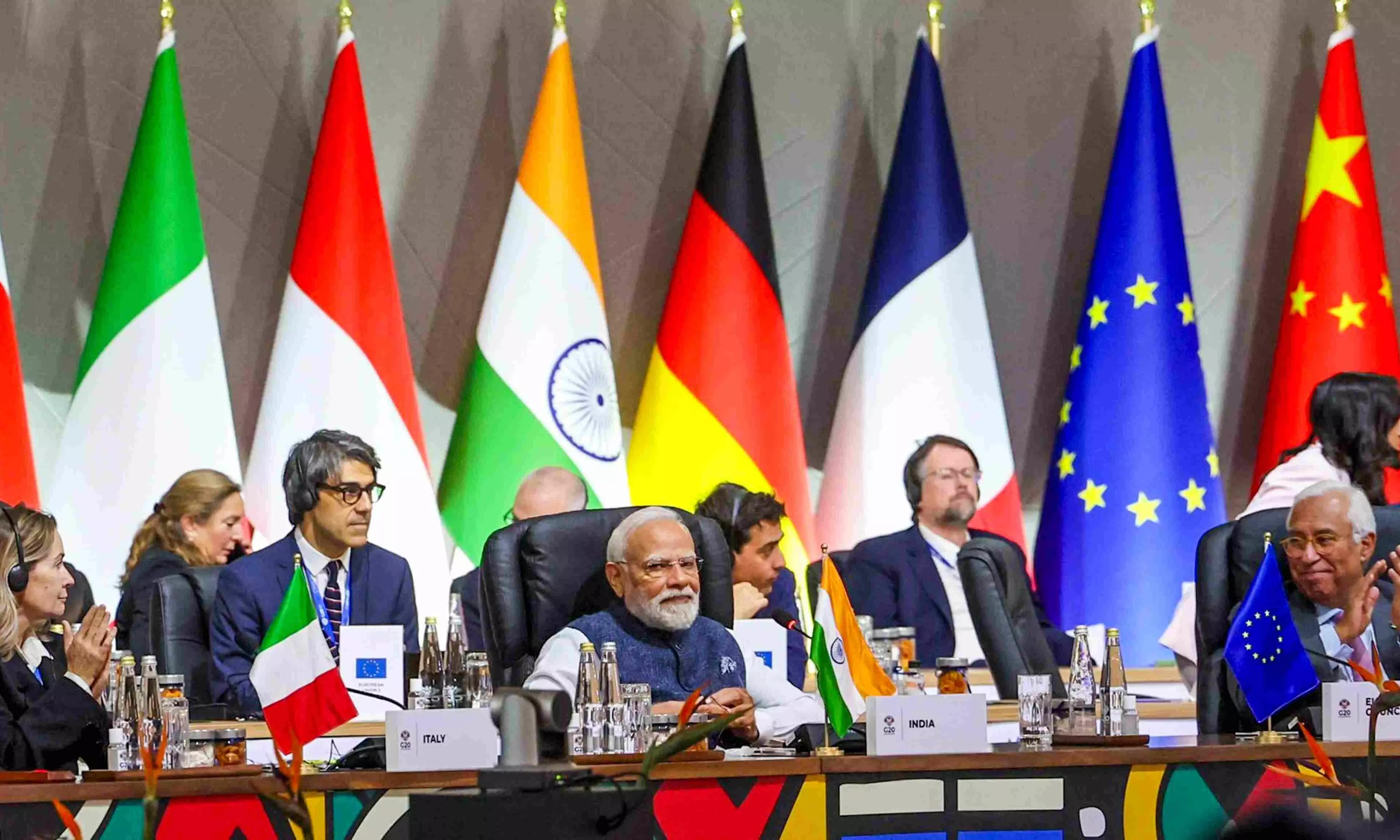
The 2025 G20 Leaders’ Summit took place in Johannesburg, hosted by South African President Cyril Ramaphosa. Prime Minister Narendra Modi, who arrived a day ahead of the summit, held several key bilateral discussions, including talks with Australian Prime Minister Anthony Albanese. His speech at the summit emphasized India’s commitment to global cooperation and presented six vital proposals aimed at shaping the future of the world.
PM Modi’s Six Major Proposals for Global Action
In his address, PM Modi outlined India’s six-point agenda, calling for collective action on several crucial issues:
Countering the Drug-Terror Nexus
PM Modi urged the G20 countries to take swift action against the growing menace of drug trafficking, proposing a dedicated initiative focused on disrupting the nexus between drug trade and terrorism.
Global Healthcare Response Team
He called for the creation of a G20 Global Healthcare Response Team, comprising skilled medical professionals from member nations, ready to assist in crisis situations and health emergencies worldwide.
Empowering Africa’s Workforce
In support of Africa’s development, Modi proposed the G20 Africa-Skills Multiplier Initiative, aimed at fostering a stronger, more adaptable workforce across the continent to meet the challenges of the future.
Traditional Knowledge Repository
Highlighting the importance of preserving diverse cultural heritage, PM Modi recommended the establishment of a Global Traditional Knowledge Repository, aimed at safeguarding indigenous knowledge systems.
Open Satellite Data Partnership
Aimed at enhancing global cooperation in space technology, Modi proposed the creation of a G20 Open Satellite Data Partnership to share critical data for advancing sustainability and technological development.
Critical Minerals Circularity
Lastly, the Prime Minister called for a G20 Critical Minerals Circularity Initiative, designed to promote sustainability, value addition, and the efficient use of critical minerals, which are vital for green technologies and industries.
Global AI Ethics: A Human-Centered Approach
At a session titled "A Fair and Just Future for All - Critical Minerals; Decent Work; Artificial Intelligence," PM Modi placed significant emphasis on the ethical challenges surrounding artificial intelligence (AI). He stressed the need for a global compact on AI, one that ensures the technology remains human-centric, transparent, and accountable.
Modi highlighted that AI systems, particularly those that influence public trust, should be designed to be auditable and free from manipulation, particularly in areas such as deepfakes and cybercrime. He further stressed that decision-making powered by AI should ultimately be in the hands of humans, with a focus on mitigating risks and ensuring AI’s positive impact on society.
Reforming the UN Security Council: A Call for Justice
In his address to the India-Brazil-South Africa (IBSA) Leaders’ Summit, Modi reiterated the urgent need for reform in the United Nations Security Council (UNSC), calling it an essential reform for fairer global governance. He argued that UNSC reform is no longer an option but a necessity for achieving a more equitable global system.
In addition to UNSC reform, Modi proposed the institutionalization of an IBSA-level National Security Advisor (NSA) meeting and the creation of an IBSA Digital Innovation Alliance. He also suggested the formation of an IBSA Fund for Climate-Resilient Agriculture, positioning the group to take a leadership role in tackling global challenges such as climate change, digital innovation, and sustainable agriculture.
IBSA’s Role in Bridging Global Gaps
PM Modi emphasized that IBSA, representing three major democracies across three continents, is uniquely positioned to act as a bridge for fostering global cooperation. He highlighted several potential areas of collaboration, including green energy, disaster resilience, digital public infrastructure, and natural farming.
As part of his vision for the future, Modi invited IBSA leaders to India to explore the potential of AI technologies and their transformative impact on society, positioning India as a key player in shaping the global AI landscape.