
Jaishankar, U.S. Secretary of State Marco Rubio Discuss Ukraine War and Indo-Pacific Amid Putin’s Upcoming India Visit
Diplomatic Balancing Ahead of Putin’s India Visit NEW DELHI — With Russian President Vladimir Putin expected to visit India early next month, External Affairs Minister...
Diplomatic Balancing Ahead of Putin’s India Visit
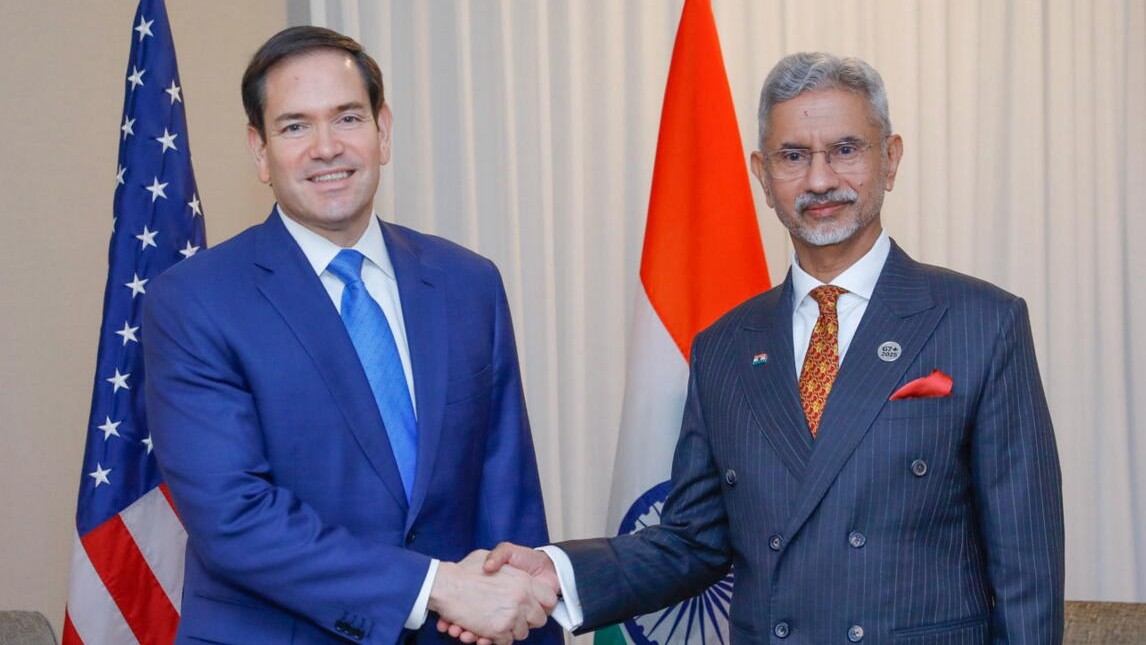
NEW DELHI — With Russian President Vladimir Putin expected to visit India early next month, External Affairs Minister S. Jaishankar and U.S. Secretary of State Marco Rubio held wide-ranging discussions on Wednesday on the sidelines of the G7 outreach meeting in Niagara, Canada.
According to official statements, the two diplomats discussed Russia’s ongoing “special military operation” in Ukraine, the Middle East crisis, and the evolving security landscape in the Indo-Pacific. The meeting took place as India navigates delicate diplomatic ground — maintaining ties with Moscow while deepening strategic cooperation with Washington.
Rubio also expressed condolences over the recent blast in New Delhi that left several people dead.
Ukraine War and India’s Oil Policy Under Spotlight
The dialogue came as U.S. President Donald Trump continued to assert that India has significantly reduced oil imports from Russia, a move he described as “a positive step toward restoring fair trade practices.” Trump had earlier imposed steep tariffs — totaling 50% — on Indian exports in response to India’s continued purchase of discounted Russian crude.
In recent weeks, Trump has claimed that Washington is “pretty close” to finalizing a “fair trade deal” with New Delhi, contingent upon progress in energy and agricultural negotiations.
Commerce Minister Piyush Goyal, however, reiterated that Prime Minister Narendra Modi’s government “will not compromise the interests of Indian farmers and dairy producers” to secure a deal. Trade officials in New Delhi have described agricultural access as the “primary sticking point” in talks with the U.S. administration.
Focus on Strategic Coordination and Supply Chains
After the meeting, Jaishankar wrote on X (formerly Twitter):
“Exchanged views on the Ukraine conflict, the Middle East/West Asia situation, and the Indo-Pacific. Also discussed strengthening India-U.S. bilateral relations, trade, and supply chains.”
Diplomatic observers said the tone of the engagement reflected continuity in New Delhi’s approach — avoiding alignment with either bloc while preserving space for strategic dialogue.
“India’s challenge is maintaining neutrality without isolating itself from either Washington or Moscow,” said Dr. Ruchika Bansal, a South Asia policy expert at the Observer Research Foundation. “Jaishankar’s diplomacy is about ensuring that India’s energy security and geopolitical partnerships remain insulated from the larger power rivalry.”
Geopolitical Crosscurrents: Quad and China Factor
The meeting came amid uncertainty surrounding the future of the Quad — the four-nation grouping of India, Japan, Australia, and the United States. Originally scheduled to meet in New Delhi later this year, the summit has now been postponed following President Trump’s talks with Chinese President Xi Jinping in South Korea, which signaled a tentative thaw in Washington-Beijing relations.
Analysts warn that this rapprochement could reshape the Indo-Pacific’s strategic equation. “Any U.S.-China reset will inevitably test the Quad’s coherence,” said Dr. Bansal. “India will need to recalibrate its role to maintain regional influence without alienating any major power.”
India’s Position on Gaza and Global Conflicts
New Delhi has publicly endorsed the U.S.-led peace initiative for Gaza, aligning itself with efforts to end the humanitarian crisis while calling for a “two-state solution” through dialogue. The position underscores India’s evolving foreign policy posture — one that seeks to balance moral diplomacy with pragmatic national interest.
Looking Ahead
Putin’s visit to India in December is expected to focus on energy cooperation, defense production, and payment systems that bypass Western sanctions. His arrival will coincide with an ongoing U.S.-India trade negotiation and heightened scrutiny over New Delhi’s ties with Moscow.
Meanwhile, Trump’s statement that he plans to visit New Delhi “early next year” suggests a potential reset in U.S.-India relations, even as trade frictions persist.
With both Washington and Moscow vying for influence in South Asia, India’s diplomatic choreography in the coming months could define its strategic autonomy in a multipolar world.