
India Can Be a ‘Steady Lighthouse’ Amid Global Turbulence, Says PM Modi at India Maritime Week
PM Modi Positions India as Global Maritime Anchor Prime Minister Narendra Modi on Wednesday projected India as a stabilizing force in an increasingly uncertain world,...
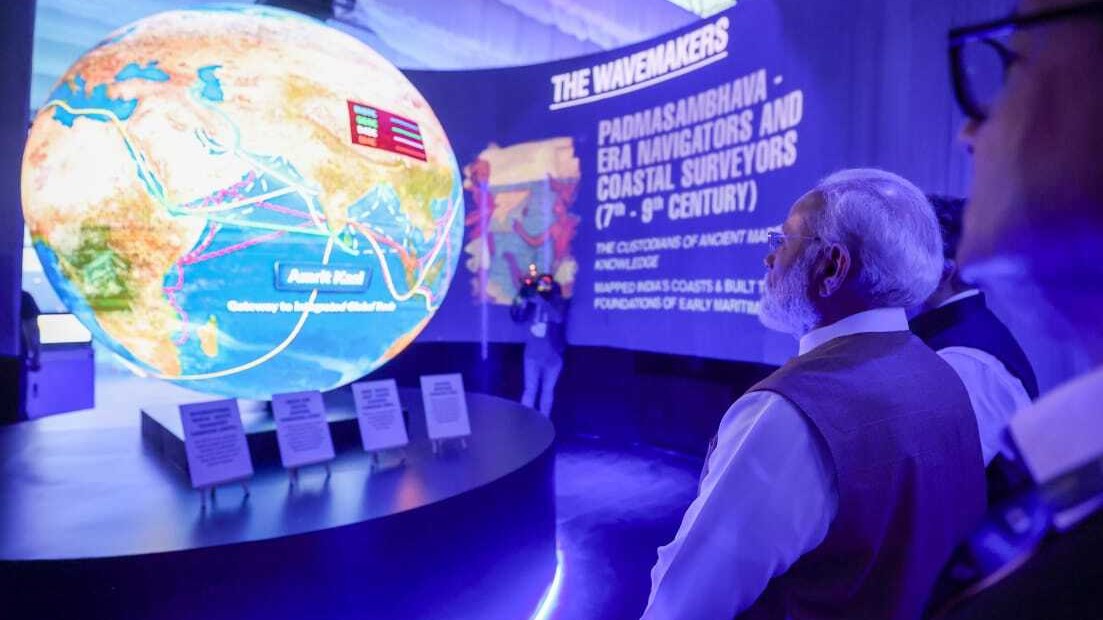
PM Modi Positions India as Global Maritime Anchor
Prime Minister Narendra Modi on Wednesday projected India as a stabilizing force in an increasingly uncertain world, asserting that the country could serve as a “steady lighthouse” guiding global trade and connectivity through turbulent times.
Speaking at the Maritime Leaders’ Conclave during India Maritime Week 2025 in Mumbai, the Prime Minister said, “When global seas are rough, the world looks for a steady lighthouse. India can play that role very strongly.”
He highlighted the India–Middle East–Europe Economic Corridor (IMEC) as a defining initiative that will “redefine trade routes and promote clean energy and smart logistics,” reinforcing India’s role in shaping a new, resilient global supply chain.
₹2.2 Lakh Crore Maritime Push
During the event, Modi unveiled a ₹2.2 lakh crore investment package for India’s shipping and shipbuilding sectors, including the acquisition of 437 new vessels. The initiatives aim to strengthen India’s maritime infrastructure and boost its standing as a global logistics hub.
Several Memorandums of Understanding (MoUs) were signed covering areas such as port-led industrialization, sustainable port development, and shipbuilding collaboration with international partners. “The scale of participation—85 countries—is a testament to global confidence in India’s maritime growth story,” Modi said.
This year marked the fourth edition of India Maritime Week, which began as a national event in 2016 and has since grown into a global platform bringing together policymakers, shipping companies, startups, and investors.
Ports Outperforming Global Benchmarks
Emphasizing India’s transformation in maritime governance, the Prime Minister said that several Indian ports now outperform those in developed nations on efficiency and throughput.
He noted that India has replaced colonial-era shipping laws with “modern, futuristic legislation” designed to meet 21st-century needs. “Our ports are among the most efficient in the developing world—and in many aspects, even ahead of those in developed economies,” he said.
Among the milestones cited were:
-
Cargo movement on inland waterways up by 700%, with operational waterways increasing from 3 to 32.
-
Major port capacity nearly doubled, with a sharp drop in vessel turnaround times.
-
Cruise tourism witnessing record growth in 2024–25.
At Vizhinjam Port, India’s first deep-water international transshipment hub, the world’s largest container vessel recently docked—a moment Modi said made “every Indian proud.”
He also highlighted India’s first megawatt-scale indigenous green hydrogen facility at Kandla Port, and the expansion of JNPT’s Bharat Mumbai Container Terminal, which has now become India’s largest container port.
New Maritime Laws for a Modern Economy
Modi underscored that India’s maritime reforms are designed to simplify trade and enhance efficiency. The newly enacted Coastal Shipping Act, he said, reduces government intervention and ensures greater autonomy for State Maritime Boards.
The reforms include:
-
One Nation, One Port Process, standardizing documentation and digital systems across ports.
-
Granting infrastructure asset status to large ships to enable easier financing, lower interest rates, and improved credit access.
-
Streamlined safety and sustainability measures aligned with international standards.
“These next-generation reforms will turn our coastline into a hub of opportunity, sustainability, and innovation,” Modi said.
Call for Global Cooperation
Addressing global maritime challenges, Modi urged collective action to tackle climate change, supply chain disruptions, economic volatility, and maritime security threats. “India stands for strategic autonomy, peace, and inclusive growth,” he said, reinforcing the nation’s vision for a secure and cooperative Indo-Pacific.