
I.N.D.I.A. Bloc Faces Turbulence in Bihar as RJD–Congress Talks Stall Over Seat-Sharing
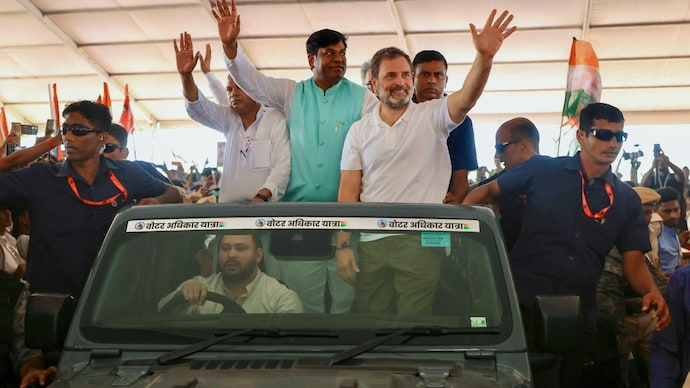
RJD–Congress Rift Widens Ahead of Bihar Polls The I.N.D.I.A. bloc’s attempt to project unity ahead of the Bihar elections faltered on Monday, with the Rashtriya...
RJD–Congress Rift Widens Ahead of Bihar Polls
The I.N.D.I.A. bloc’s attempt to project unity ahead of the Bihar elections faltered on Monday, with the Rashtriya Janata Dal (RJD) and Congress unable to reach consensus on seat-sharing. Despite back-to-back meetings in Delhi involving top leaders from both sides, no final formula emerged, exposing deep fissures within the opposition alliance.
RJD leader Tejashwi Yadav first met Congress general secretary (organisation) K. C. Venugopal and Bihar Congress functionaries for nearly two hours before a follow-up meeting with Congress president Mallikarjun Kharge. Hopes were high that the discussions would yield a final agreement by evening, but the talks ended in stalemate.
Seat Numbers at the Core of the Dispute
At the heart of the impasse is the number of seats Congress should contest. According to Congress insiders, the RJD has offered around 54–55 seats, while the party is demanding 60. RJD sources countered that the Congress insists on contesting 70 seats, as it did in 2020. The RJD, they said, is willing to increase its offer to 58, but the Congress remains unsatisfied.
Congress leaders argue that their poor 2020 performance—winning only 19 of 70 seats—was due to being allocated unwinnable constituencies. RJD leaders, however, believe Congress should scale down its expectations to reflect electoral realities and the presence of new partners.
Smaller Allies Grow Impatient
The prolonged deadlock has frustrated smaller allies such as the CPI(ML)L, CPI, and CPI(M). The CPI(ML)L, which performed strongly in 2020 by winning 12 of the 19 seats it contested, has already begun distributing B-Forms to its candidates and preparing for nominations. The party, initially demanding 45 seats, has reduced its ask to around 30, but the RJD has offered only 19, matching its 2020 allocation.
Left leaders say their grassroots strength and strong local presence justify a larger share, while RJD leaders insist the alliance must balance between established players and new entrants such as the Vikassheel Insaan Party (VIP), India Inclusive Party, JMM, and LJP (Paras).
NDA’s Unity Adds Pressure
Adding to the opposition’s woes, the NDA finalized its seat-sharing arrangement smoothly on Sunday, with the BJP, JD(U), and LJP (Ram Vilas) managing to strike a deal without public discord. The BJP’s decision to allot 29 seats to LJP (Ram Vilas) despite trimming JD(U)’s quota has sparked comparisons within the I.N.D.I.A. bloc, where RJD is being accused of inflexibility.
Legal Cloud Over RJD Leadership
Complicating matters further, the day’s negotiations coincided with a Delhi court framing charges against RJD patriarch Lalu Prasad Yadav, Tejashwi Yadav, and Rabri Devi in connection with the alleged IRCTC scam. While the case is unrelated to the alliance talks, it added political pressure on the RJD’s leadership amid ongoing negotiations.
Outlook
With nomination deadlines approaching and allies growing restless, the I.N.D.I.A. bloc faces mounting pressure to resolve its internal disputes swiftly. Political observers warn that prolonged infighting could weaken the alliance’s electoral prospects in Bihar—one of India’s most politically decisive states.
For now, despite assurances of unity, the opposition’s seat-sharing saga suggests that harmony within the I.N.D.I.A. bloc remains a distant goal.