
Forty-Three Minutes of Brilliance, Then Collapse: India’s Asian Cup Dream Ends in Heartbreak Against Singapore
A Glimpse of Greatness That Slipped Away For 43 minutes on a humid Tuesday evening at Goa’s Fatorda Stadium, Indian football seemed to rediscover its...
A Glimpse of Greatness That Slipped Away
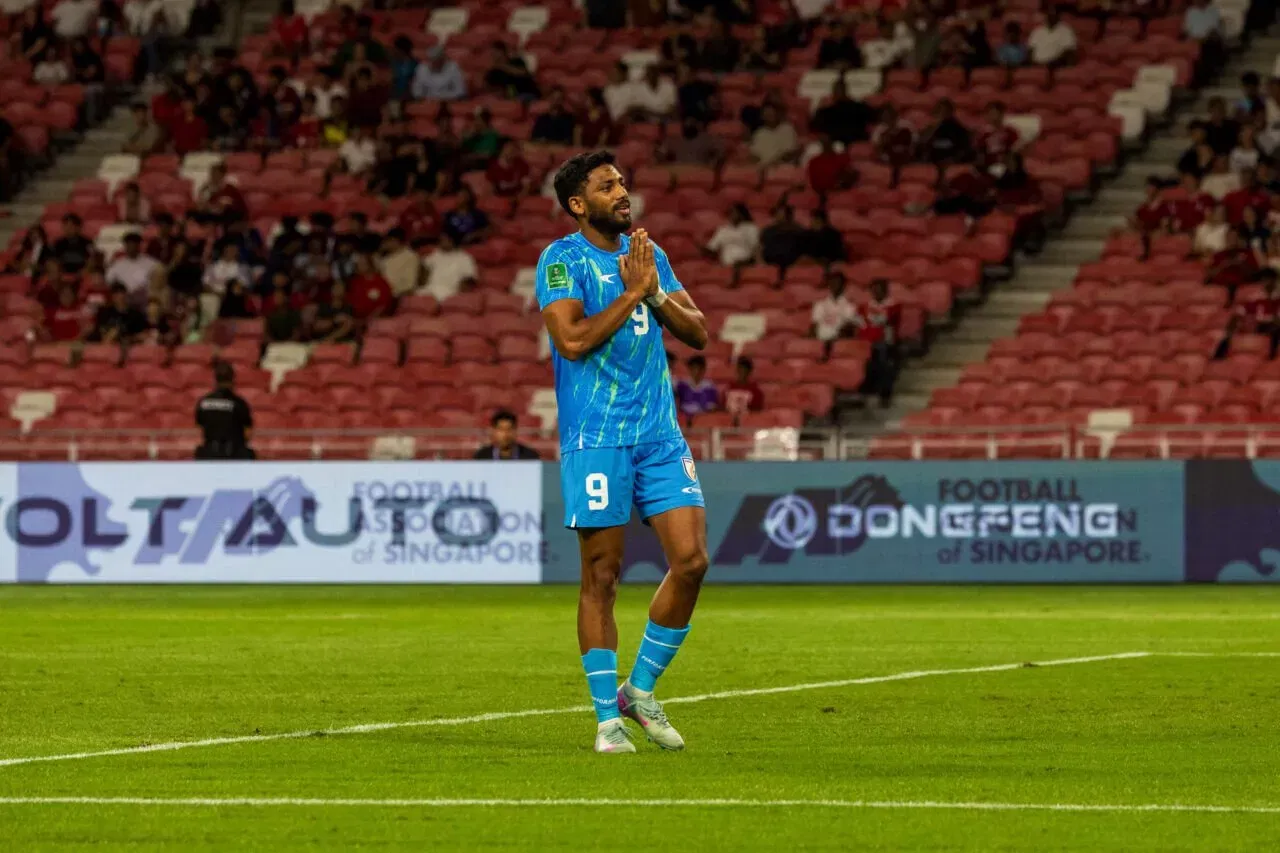
For 43 minutes on a humid Tuesday evening at Goa’s Fatorda Stadium, Indian football seemed to rediscover its spark. Khalid Jamil’s men pressed with intensity, passed with purpose, and played with a confidence rarely seen at international level. Lallianzuala Chhangte’s long-range rocket ignited hopes of a commanding win.
Yet, when the whistle blew 90 minutes later, it was Singapore who walked away with a 2–1 victory — and with it, India’s chances of qualifying for the 2027 AFC Asian Cup were extinguished.
The night will be remembered not just for the defeat, but for what it revealed: flashes of promise buried under systemic problems that continue to haunt Indian football.
A Dream Start That Turned Sour
Chhangte’s strike, a stunning effort from distance, capped a spell of complete Indian control. The team’s high defensive line suffocated Singapore’s rhythm, with Apuia orchestrating play and Sunil Chhetri linking beautifully with Mahesh Singh and Liston Colaco. India looked unrecognizable — bold, modern, and hungry.
But the intensity waned. Singapore, coached by Gavin Lee, adapted quickly. Exploiting gaps left by India’s aggressive setup, forward Song Ui-young began finding space behind the midfield line. A loose clearance from Rahul Bheke led to Glenn Kweh feeding Song, who calmly slotted past Gurpreet Singh Sandhu.
The equalizer changed everything. India’s tempo dipped, their pressing grew ragged, and Singapore’s confidence soared.
Singapore’s Tactical Turnaround
Lee’s halftime tweak — pushing Kweh to full-back and introducing Ilhan Fandi on the flank — was decisive. Singapore began attacking in waves, turning India’s earlier press against them. The winner arrived through a slick counterattack: Ikhsan Fandi broke down the center, Shawal Anuar squared the ball, and Song hammered home his second with clinical precision.
It was a move built on structure and composure, two qualities that deserted India as desperation took over.
From Composure to Chaos
In the final 20 minutes, India threw caution — and shape — to the wind. Jamil deployed five forwards, but the fluidity of the first half was gone. Crosses failed to beat the first defender; through balls went astray. Fatorda fell silent as the hosts ran out of ideas.
After the match, head coach Khalid Jamil accepted responsibility. “We attacked well but defended poorly,” he admitted, hinting that pragmatism might return in his future tactics. “In the end, the result is what matters.”
Larger Problems Beyond the Pitch
India’s exit from Asian Cup contention raises broader questions about the direction of the sport in the country. The lack of competitive game time for national players—due to delays in domestic league scheduling—was cited by Jamil as a key reason for the team’s fading intensity.
Off the field, the All India Football Federation (AIFF) remains mired in internal disputes. Hours before kickoff, the federation was reportedly seeking legal advice over a controversial clause in its constitution that restricts dual membership between national and state bodies.
That bureaucratic uncertainty, many experts argue, has trickled down to the pitch — reflected in inconsistent planning, frequent coaching changes, and limited international exposure.
What Lies Ahead
The defeat marks another painful setback for Indian football’s aspirations to consistently compete at the continental level. Despite glimpses of technical evolution and tactical awareness, the inability to sustain pressure and finish chances underscores how far the national team remains from Asia’s elite.
For fans, those 43 minutes will linger — a reminder of what Indian football could be if potential meets consistency.