
Congress Signals Nationwide Protest Over MGNREGA Repeal, Flags Electoral Roll Revision as Democratic Threat
The Congress party’s top leadership met on Saturday to chart its political response to a series of developments it says have far-reaching implications for employment...
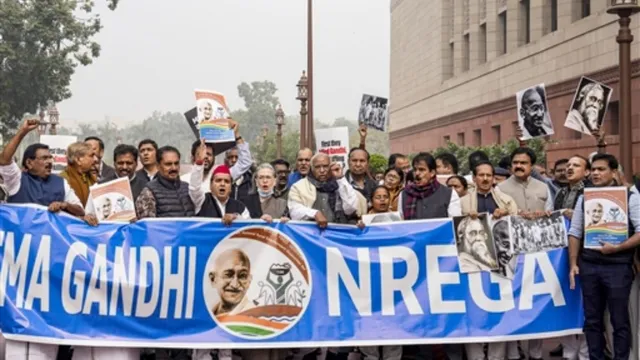
The Congress party’s top leadership met on Saturday to chart its political response to a series of developments it says have far-reaching implications for employment security, federal finances and electoral integrity. At the centre of deliberations were the replacement of the Mahatma Gandhi National Rural Employment Guarantee Act (MGNREGA) with a new law, and the ongoing Special Intensive Revision (SIR) of electoral rolls across multiple states.
The meeting of the Congress Working Committee (CWC), the party’s highest decision-making forum, was attended by senior leaders including party president Mallikarjun Kharge, former president Sonia Gandhi, Leader of Opposition Rahul Gandhi and MP Shashi Tharoor, among others.
Protest Plan Against MGNREGA Replacement
Addressing reporters after the meeting, Kharge said the repeal of MGNREGA has triggered widespread public dissatisfaction, particularly in rural areas where the scheme has long been a key source of livelihood security.
According to him, the CWC has decided to launch a nationwide agitation titled “MGNREGA Bachao Andolan” beginning January 5, 2026. The campaign, he said, will focus on mobilising rural workers and state units against what the party describes as the dilution of legally guaranteed employment rights.
The new legislation — the Viksit Bharat–Guarantee for Rozgar and Ajeevika Mission (Gramin) Act — was passed during Parliament’s winter session and has since received presidential assent. The government has positioned the law as a restructured rural employment and livelihoods framework aligned with its “Viksit Bharat” vision.
Congress leaders, however, argue that replacing a statutory rights-based programme with a mission-mode scheme risks turning employment guarantees into discretionary welfare. Kharge said the party believes states will face higher financial pressure under the new framework, as cost-sharing arrangements and administrative responsibilities remain unclear.
Historical Significance of MGNREGA
Introduced in 2005 under the UPA government, MGNREGA legally guaranteed up to 100 days of wage employment to rural households. Over the years, it has been credited by economists and development experts with acting as a safety net during economic downturns, droughts and the COVID-19 pandemic. Its repeal, therefore, marks a major shift in India’s rural welfare architecture and has implications for labour rights, migration patterns and rural consumption.
Congress leaders said the party would frame its protests around constitutional values, workers’ dignity and the legacy of Mahatma Gandhi, after whom the original scheme was named.
Electoral Roll Revision Under Scrutiny
The CWC also reiterated its strong objections to the Special Intensive Revision (SIR) of electoral rolls currently underway in nine states and three Union Territories. Kharge alleged that the exercise could lead to large-scale disenfranchisement if not conducted transparently.
Calling the revision “systematic and deliberate,” he claimed it could be used to curtail voting rights under the guise of administrative correction. Senior Congress figures pointed to past instances where voter list revisions have disproportionately affected migrant workers, minorities and economically weaker sections.
Rahul Gandhi, the party noted, has previously raised concerns about alleged irregularities in electoral processes, urging greater institutional accountability.
Broader Political and Democratic Implications
Election officials have maintained that SIR exercises are routine processes aimed at removing duplicate or ineligible entries and ensuring accurate voter rolls. However, opposition parties argue that the timing and scale of the current exercise warrant heightened scrutiny, especially ahead of key state and national elections.
Political analysts say the Congress’s twin focus on rural employment and voting rights reflects an attempt to consolidate its narrative around social justice and democratic safeguards. “MGNREGA and voter enrolment both touch the everyday lives of citizens — one affects livelihoods, the other political voice,” said a Delhi-based political commentator. “By linking the two, the Congress is positioning itself as a defender of constitutional entitlements.”
What Comes Next
With the new rural employment law already in force and electoral roll revisions ongoing, the coming weeks are likely to see sharper political contestation. The Congress’s proposed nationwide agitation could mobilise rural constituencies, while debates over electoral integrity may intensify in Parliament and the courts.
For now, the government has not officially responded to the CWC’s resolutions, but officials have previously stated that both the new employment framework and SIR exercises are designed to improve efficiency, transparency and governance outcomes.