
China Claims It Mediated India–Pakistan Tensions, New Delhi Reiterates Ceasefire Was Bilateral
China on Tuesday claimed it played a mediating role in easing tensions between India and Pakistan following their military confrontation in May, a claim that...
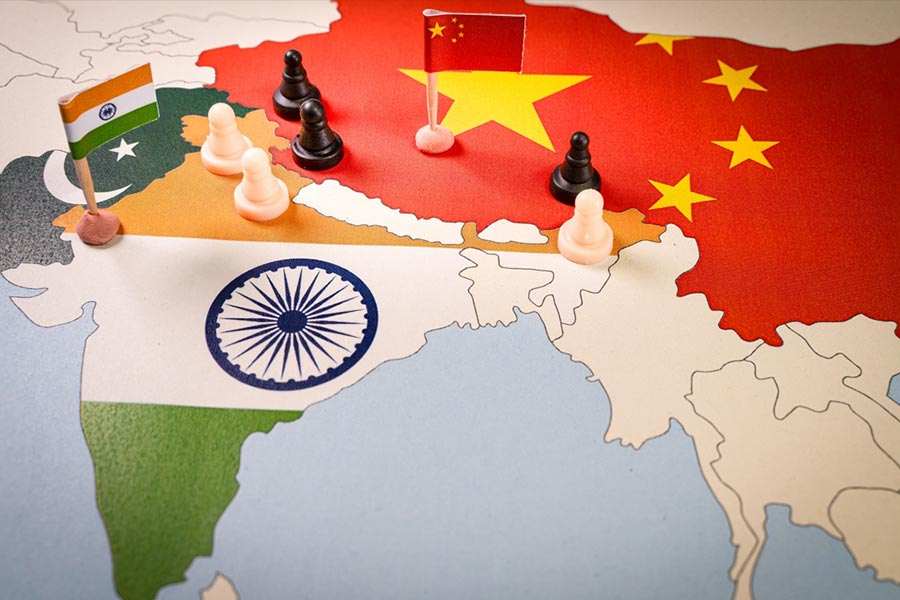
China on Tuesday claimed it played a mediating role in easing tensions between India and Pakistan following their military confrontation in May, a claim that New Delhi has previously and firmly denied.
Speaking at a conference on China’s foreign relations in Beijing, Chinese Foreign Minister Wang Yi said 2025 had witnessed an unusually high number of conflicts worldwide. “Local wars and cross-border conflicts flared up more frequently than at any time since the end of World War II,” Wang said, adding that global geopolitical instability had continued to intensify.
Against this backdrop, Wang asserted that China had adopted what he described as an “objective and just” approach to resolving international disputes. “We have focused on addressing both immediate tensions and their root causes,” he said.
Listing what Beijing considers its diplomatic interventions, Wang claimed China had mediated in northern Myanmar, the Iranian nuclear issue, tensions between Pakistan and India, the Palestine–Israel conflict, and the recent Cambodia–Thailand standoff.
India Rejects Mediation Narrative
India’s Ministry of External Affairs (MEA) has not issued a fresh response to Wang’s remarks. However, New Delhi has consistently maintained that the cessation of hostilities with Pakistan in May was the result of direct military-to-military communication, not third-party mediation.
Indian officials have stated that the decision to stop firing followed a phone call initiated by Pakistan’s Director General of Military Operations (DGMO) to his Indian counterpart. India has repeatedly rejected similar claims by US President Donald Trump, who had earlier suggested Washington played a mediating role.
India’s position has long been that issues with Pakistan are strictly bilateral, in line with the Simla Agreement and subsequent understandings.
Background: May Escalation Between India and Pakistan
Tensions between New Delhi and Islamabad escalated sharply in May 2025 after India carried out precision strikes, codenamed Operation Sindoor, targeting what it described as terrorist infrastructure in Pakistan and Pakistan-occupied Kashmir (PoK).
The strikes were launched in response to a terror attack in Pahalgam, Jammu and Kashmir, on April 22, in which 26 people were killed. India blamed Pakistan-based terror groups for the attack.
Pakistan responded by intensifying artillery shelling along the Line of Control (LoC), leading to several days of cross-border military exchanges before firing eventually stopped.
China’s Role Under Scrutiny
In July, the Indian Army publicly alleged that China had provided Pakistan with real-time intelligence during the four-day conflict in May. Lieutenant General Rahul R. Singh, Deputy Chief of Army Staff (Capability Development and Sustenance), said India was effectively facing a multi-front challenge.
“Pakistan was leading on the front, China was providing extensive support, and Turkey also played a role by supplying drones along with trained personnel,” Singh said at a military forum.
He further noted that 81 per cent of Pakistan’s military hardware acquired over the past five years is of Chinese origin, suggesting that Beijing views Pakistan as a testing ground for its weapons systems. “For China, it is like a live laboratory,” he said, referring to the opportunity to observe how Chinese weapons perform against other military technologies.
India–China Relations: Mixed Signals
Despite the strategic mistrust, Wang claimed that India–China relations have shown “good momentum”, pointing to China’s invitation to Prime Minister Narendra Modi to attend the Shanghai Cooperation Organisation (SCO) summit in Tianjin in August.
Analysts note that while diplomatic engagement between New Delhi and Beijing continues, deep disagreements remain over border tensions, regional security, and China’s close military partnership with Pakistan.
Broader Implications
China’s assertion of a mediator role in the India–Pakistan conflict underscores Beijing’s efforts to project itself as a global peacemaker amid rising international instability. For India, however, such claims cut against its long-standing rejection of external involvement in disputes with Pakistan—especially when those claims come from a country it accuses of actively supporting its adversary.
As regional and global rivalries sharpen, the gap between diplomatic narratives and strategic realities in South Asia appears set to widen further.