
Chandrayaan-3 Propulsion Module’s ‘Moon Encounter’ Sends It Into a New, Unstable Orbit
The abandoned propulsion module from India’s Chandrayaan-3 mission has undergone a dramatic change in its orbit after a close gravitational encounter with the Moon, highlighting...
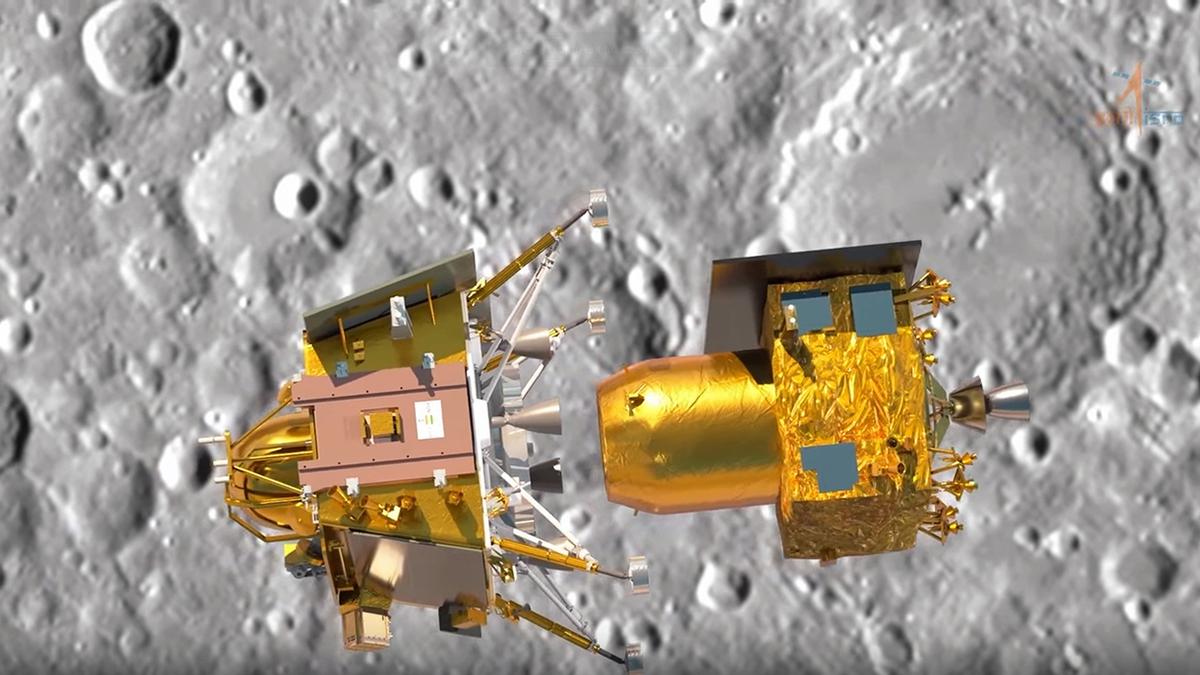
The abandoned propulsion module from India’s Chandrayaan-3 mission has undergone a dramatic change in its orbit after a close gravitational encounter with the Moon, highlighting the complex and often unpredictable nature of deep-space dynamics.
Space scientist and orbital tracker Jonathan McDowell revealed on December 30, 2025, that the module—left in a highly elongated Earth orbit in 2024—had a “tussle with the Moon” in November. As a result, it is now travelling in a vastly expanded and tilted orbit around Earth, stretching from roughly 365,000 km to nearly 983,000 km, inclined at about 22 degrees.
What Happened to the Propulsion Module
After Chandrayaan-3 successfully soft-landed near the Moon’s south pole in August 2023, the Indian Space Research Organisation (ISRO) repurposed the mission’s propulsion module for extended experiments. In October 2023, ISRO placed it into a highly elliptical Earth orbit with a perigee (closest point) of about 125,000 km and an apogee (farthest point) of around 305,000 km.
This trajectory brought the spacecraft close to the Moon’s orbital path. According to McDowell, objects in such “Moon-orbit-crossing” orbits are particularly vulnerable to gravitational disturbances from the Moon.
A Gravitational Tug of War
ISRO confirmed in November that the propulsion module entered the Moon’s sphere of influence between November 4 and November 14. During this period, it made two relatively close flybys—passing within about 3,740 km of the lunar surface on November 6 and 4,537 km on November 11.
These close approaches resulted in a significant gravitational “kick.” Unlike a collision or mechanical force, such a kick is purely gravitational but can dramatically alter a spacecraft’s energy and trajectory. After the encounter, the module’s orbit expanded sharply, no longer dipping close to Earth and instead remaining at very high altitudes.
Why the Orbit Became Unpredictable
In low-Earth orbit, Earth’s gravity overwhelmingly dominates, keeping satellite motion fairly regular. But at distances approaching the Moon, spacecraft enter a three-body environment, where both Earth’s and the Moon’s gravity exert comparable influence.
In these conditions, small differences in timing or position can lead to large changes over time—a phenomenon scientists describe as “chaotic.” The motion still follows the laws of physics, but predicting it precisely over long periods becomes extremely difficult. This is the same classical “three-body problem” that has fascinated physicists for centuries and inspired popular science fiction such as The 3 Body Problem.
How the Orbit Changed
According to ISRO and McDowell’s independent tracking, the lunar encounter altered the propulsion module’s orbit in three major ways:
-
Much larger size: The apogee now extends well beyond the Moon’s average distance of about 384,000 km, reaching between 727,000 km (ISRO estimate) and 983,000 km (McDowell’s calculation).
-
New shape: The perigee rose dramatically, meaning the module no longer returns anywhere near its earlier low point of 125,000 km.
-
Tilted orientation: The orbit is now inclined by about 22 degrees relative to Earth’s equator, a result of the Moon pulling the spacecraft out of its original orbital plane.
How It Was Tracked
ISRO said the event was closely monitored using the Indian Deep Space Network (IDSN) near Bengaluru, with support from international tracking data. Such monitoring is essential not only for scientific understanding but also for maintaining accurate catalogs of artificial objects in space.
Jonathan McDowell, who maintains the widely referenced General Catalog of Artificial Space Objects and publishes Jonathan’s Space Report, is among the most respected independent analysts tracking such changes.
Why This Matters
While the Chandrayaan-3 propulsion module poses no immediate risk, the episode illustrates how spacecraft left in high, Moon-crossing orbits can evolve unpredictably. For future lunar and deep-space missions, it underscores the importance of long-term orbital planning, space situational awareness, and international data-sharing to track objects that wander into complex gravitational environments.
In short, even after a mission’s primary objectives are completed, space remains dynamic—and sometimes chaotic—long after the engines are switched off.