
BJP–Congress Clash Intensifies Over New Rural Jobs Law as G RAM G Replaces MGNREGA
The political battle between the Bharatiya Janata Party (BJP) and the Congress over India’s new rural employment law escalated on Monday, with the ruling party...
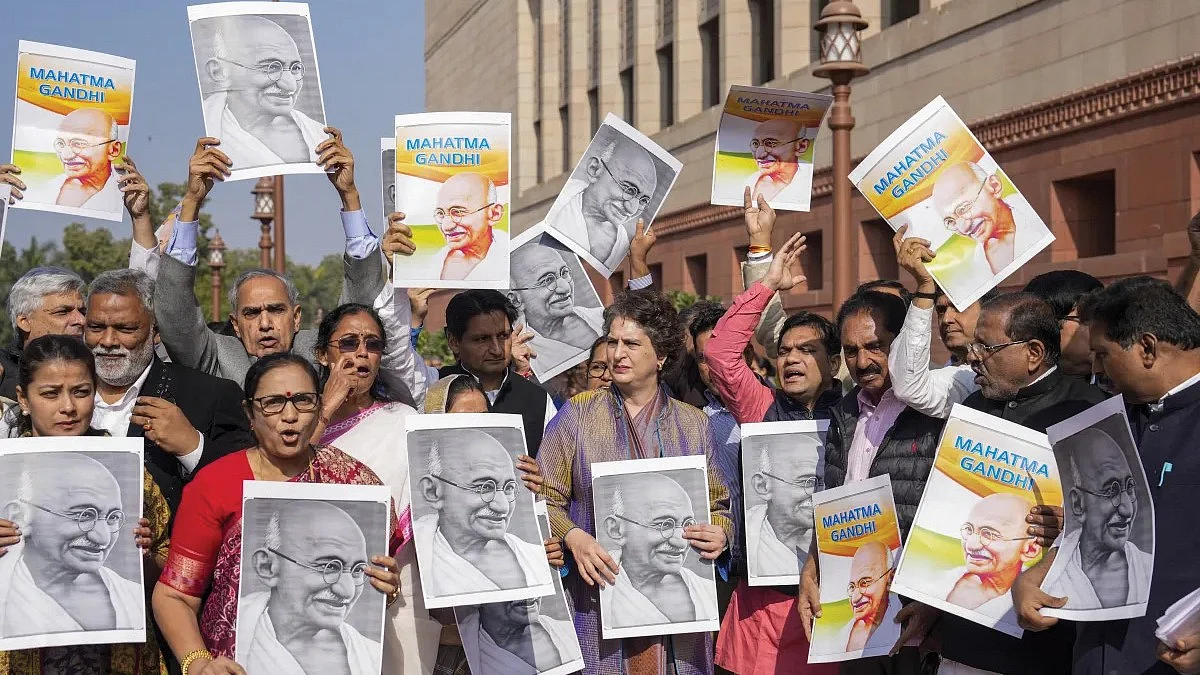
The political battle between the Bharatiya Janata Party (BJP) and the Congress over India’s new rural employment law escalated on Monday, with the ruling party firmly rejecting former Congress president Sonia Gandhi’s criticism of the legislation as misleading and factually incorrect.
The controversy centres on the Viksit Bharat Guarantee for Rozgar and Ajeevika Mission (Gramin)—popularly called G RAM G—a rural employment and livelihoods programme passed by Parliament last week. The law is designed to replace the Mahatma Gandhi National Rural Employment Guarantee Act (MGNREGA), which has been in force since 2005.
What the New Law Changes
According to the government, G RAM G modernises India’s rural safety net by expanding guaranteed employment from 100 to 125 days per household annually and aligning the programme with current rural economic realities. A key structural shift is a revised funding model under which states are required to contribute 40% of programme costs, compared with what the Congress describes as a more generous central funding pattern under MGNREGA.
The bill cleared Parliament amid strong protests from the Congress-led opposition, which argues that the new framework dilutes the legal guarantee of employment and places an unsustainable financial burden on states.
Sonia Gandhi’s Objections
In a video statement released on Saturday, Sonia Gandhi accused the BJP-led government of pushing the legislation through Parliament without adequate debate. She described the law as an attack on the rural poor and alleged that it effectively dismantles MGNREGA, a flagship programme of the Congress-led United Progressive Alliance (UPA).
Gandhi said the changes would harm farmers and labourers across the country and warned that Congress workers would oppose what she termed the “repeal” of a hard-won employment guarantee. She reiterated these arguments in an opinion piece published in The Hindu.
BJP Pushback: “Mischaracterisation and Selective Memory”
The BJP responded sharply, with party IT department head Amit Malviya using social media platform X to dismiss Gandhi’s remarks as politically driven and disconnected from the contents of the law.
Malviya said Gandhi’s criticism reflected a failure to engage with the actual provisions of the G RAM G Act, arguing that her claims were based on “mischaracterisations” and ignored structural weaknesses that had developed under MGNREGA over two decades.
He also challenged the Congress narrative around MGNREGA’s origins, noting that the scheme was shaped by the National Advisory Council during the UPA years—an unelected body that critics at the time accused of exercising disproportionate influence over policy-making.
Employment Guarantee Still Intact, Says BJP
Rejecting claims that the new law ends demand-based employment, Malviya said the government has merely shifted from an open-ended budgeting model to a “normative allocation framework” to improve predictability and efficiency.
He stressed that the employment guarantee has been strengthened rather than weakened, pointing to the increase in minimum guaranteed workdays from 100 to 125 under G RAM G.
The BJP leader acknowledged that MGNREGA played a role in addressing rural distress in the past, but argued that it no longer reflects present-day rural conditions. Citing official data, he said rural incomes and consumption have risen significantly, formal credit dependence has increased, and poverty levels have declined sharply over the past decade.
“Public policy cannot remain frozen in 2005,” Malviya said, adding that rural poverty has fallen dramatically and that expanded access to MSME credit has boosted self-employment and non-farm livelihoods.
Dispute Over State Funding Burden
One of the opposition’s central criticisms is the revised cost-sharing formula, which requires states to bear 40% of programme expenditure. Malviya rejected the claim that this represents a drastic shift, arguing that states were already absorbing significant costs under MGNREGA, including material expenses, administrative overheads, and unemployment allowances.
According to the BJP, the new funding structure formalises existing responsibilities and gives states a clearer, more predictable role as partners in implementation rather than mere executors of centrally designed schemes.
Concerns on Work Limits and Decentralisation
Sonia Gandhi has also raised concerns about restrictions on the number of continuous workdays and the alleged weakening of Panchayats and Gram Sabhas. Malviya countered that the 60-day work limit is flexible and state-notified, designed to prevent labour shortages during peak agricultural seasons while allowing workers to earn higher farm wages.
On decentralisation, the BJP said the reforms aim to reduce fragmentation and opacity rather than dilute local decision-making.
Allegations of Misuse Under MGNREGA
Malviya further accused the Congress of overlooking long-standing governance issues under MGNREGA. He cited official figures pointing to alleged financial misappropriation, low recovery rates, fake or paper-only projects, and irregularities in attendance and labour usage across several states.
The BJP claims that reforms under the Modi government have addressed many of these concerns through digitisation and monitoring, including Aadhaar-linked payments, near-universal electronic transfers, and large-scale geo-tagging of assets.
A Larger Political Divide
The dispute over G RAM G reflects a broader ideological divide between the BJP and Congress on welfare policy—between what the government describes as reform-oriented modernisation and what the opposition sees as the erosion of statutory social guarantees.
As states prepare to implement the new law, the debate is expected to continue both in Parliament and on the ground, with rural employment once again emerging as a central political and policy issue ahead of future elections.