
Bengal Voter Roll Controversy: Millions Removed Before Elections
Millions of West Bengal voters removed from rolls ahead of state elections.
Top Summary
- What happened: Approximately nine million voters (12% of the electorate) in West Bengal have been removed from the 2026 electoral rolls during a Special Intensive Revision (SIR) exercise.
- Why it matters: The removal of such a large number of voters raises concerns about potential disenfranchisement and the fairness of the upcoming elections.
- What changes for people: Many individuals, like former army technician Muhammad Daud Ali and his family, find themselves unable to vote despite possessing valid documentation. Their fate remains uncertain pending tribunal decisions.
- Who is affected: The removals disproportionately affect Muslims and Dalit Hindus in border districts, triggering accusations of selective targeting and undermining the democratic process.
Controversial Voter Roll Revision
West Bengal's upcoming state elections are shadowed by controversy. Nine million voters have been removed from the electoral rolls. This represents roughly 12% of the state's 76 million electorate.
The Election Commission says the Special Intensive Revision (SIR) aims to create a "pure electoral roll." The ruling Trinamool Congress (TMC) alleges the exercise is politically motivated. They claim it disenfranchises minorities to benefit the Bharatiya Janata Party (BJP).
The Scale of Removals
Over six million names were removed due to reported absence or death. The fate of the remaining 2.7 million, including families like Muhammad Daud Ali's, is pending.
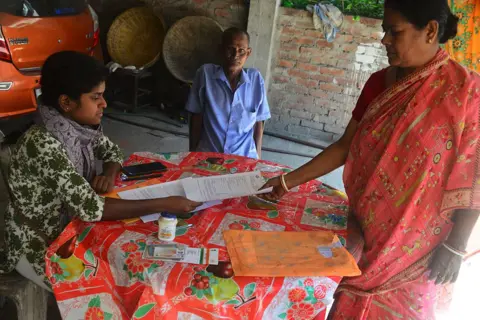
Muhammad Daud Ali, a former army technician, discovered he and his children were removed from the voter list. His wife is the only family member remaining.
These 2.7 million voters submitted enumeration forms linking them to the 2002 electoral roll. The Election Commission used AI to flag "logical discrepancies." This led to their exclusion despite re-verification.
Political Reactions and Legal Challenges
The situation is politically charged. Prime Minister Narendra Modi's remarks about "illegal Bangladeshi infiltrators" have fueled tensions.
The TMC views the term as a veiled reference to Muslims. The BJP denies these allegations.
After legal challenges, the Supreme Court allowed the elections to proceed. The fate of the 2.7 million voters remains unresolved.
Disproportionate Impact
Data suggests Muslims are disproportionately affected. They constitute approximately 34% of those removed, significantly higher than their 27% share of the state's population.
Constituency data suggests 65% of the 2.7 million voters in limbo are Muslim. Border districts like Murshidabad and Malda saw significant Muslim exclusions.
Conversely, Dalit Hindus were heavily impacted in North 24-Parganas and Nadia.
Voices of the Disenfranchised
Muhammad Daud Ali expressed his frustration:
"I am dumbstruck. I feel deeply hurt and insulted. How can they conduct the elections without solving our disputes? I simply have no idea who to seek justice from."
Political scientist Sibaji Pratim Basu called the situation a "shame for democracy." He stated that there is no precedent for an election occurring in India with voters' rights suspended.
BJP leader Sukanta Majumdar defended the revision. He stated that purging non-citizens was crucial. He also blamed the state government for delaying the process.
Uneven Impact Across Districts
The impact varies across districts. Kolkata saw nearly 30% of voters removed in the north. Paschim Bardhaman district experienced a 16.9% reduction in its electorate.
80% of those deleted in Kolkata are Hindus, primarily from Hindi-speaking communities. Border districts also saw substantial deletions.
North 24-Parganas lost 1.26 million voters (15%). Murshidabad saw 749,000 names (13%) struck off.
The Supreme Court's Role
Mamata Banerjee has vowed to appeal to the Supreme Court again. She questioned the fairness of holding elections with 2.7 million cases unresolved.
The Supreme Court is scheduled to hear the case on April 13.
Anthropologist Mukulika Banerjee suggests "selective targeting" of certain populations. She emphasizes the importance of voting, especially for marginalized communities.
Hasnara Khatun, a voter from Malda district, expressed her anger:
"We have been effectively turned into non-citizens. Who knows what comes next?"
What to Watch Next
The Supreme Court's hearing on April 13 will be critical. It could provide a path forward for the 2.7 million voters currently in limbo. The outcome will significantly impact the fairness and legitimacy of the upcoming West Bengal elections.