
Quantum Surprise: Scientists Discover New Rules Governing Atomic Nuclei
Researchers reveal that short-range nucleon pairing depends heavily on specific quantum orbitals rather than nuclear mass.
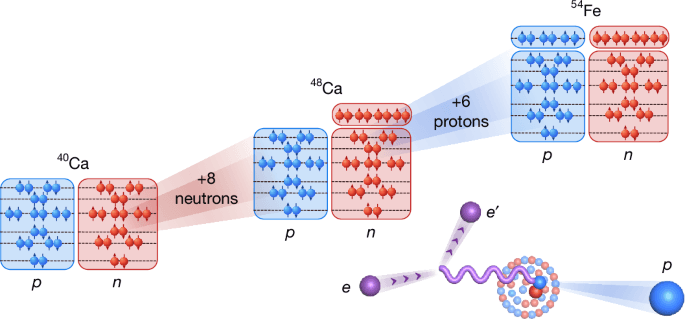
Top Summary
- What happened: Scientists analyzed high-energy electron scattering to study how proton-neutron pairs form within atomic nuclei.
- Why it matters: The study reveals a deep connection between long-range nuclear shell structure and short-range interactions.
- What changes: Existing theoretical models must be updated to account for new, unpredicted orbital dependencies.
- Who is affected: Nuclear physicists and researchers studying the fundamental strong nuclear force.
Probing the Strong Nuclear Force
Atomic nuclei are intricate quantum systems where protons and neutrons are bound together by the strong nuclear force. At extremely short distances, these nucleons can momentarily form high-momentum pairs.
These formations, known as short-range-correlated pairs, shape the high-momentum structure of nuclear matter. Studying how these pairs form provides a rare experimental window into the short-distance behavior of strong interactions.
Unveiling Unexpected Quantum Behaviors
To investigate this phenomenon, researchers utilized the scattering of high-energy electrons. They selected 40Ca, 48Ca, and 54Fe targets due to their distinct shell structures to probe the formation of these pairs.
Unexpectedly, the experiment revealed that pairing depends far more on the specific quantum orbitals occupied by protons and neutrons than on other factors.
"Unexpectedly, we find that short-range-correlated pairing depends far more on the specific quantum orbitals occupied by protons and neutrons than on the nuclear mass or neutron–proton imbalance."
The study highlighted key differences in what drives nucleon pairing:
- Quantum Orbitals: Highly dominant factor shaping how nucleon pairs are formed.
- Nuclear Mass: Shows far less influence on pairing than previously assumed.
- Neutron-Proton Imbalance: Has a weaker impact compared to orbital structures.
What to Watch Next
These findings indicate a critical need for new angular-momentum quantum selection rules to govern short-range nucleon pairing. Researchers must now work to reconcile these results with theoretical models, which previously underestimated this orbital dependence.