
Young Sun-like Star HD 61005's Astrosphere Imaged: Insights Into Our Sun's Past
Scientists have imaged the astrosphere of a young, Sun-like star, offering a glimpse into our Sun's early life.
Top Summary
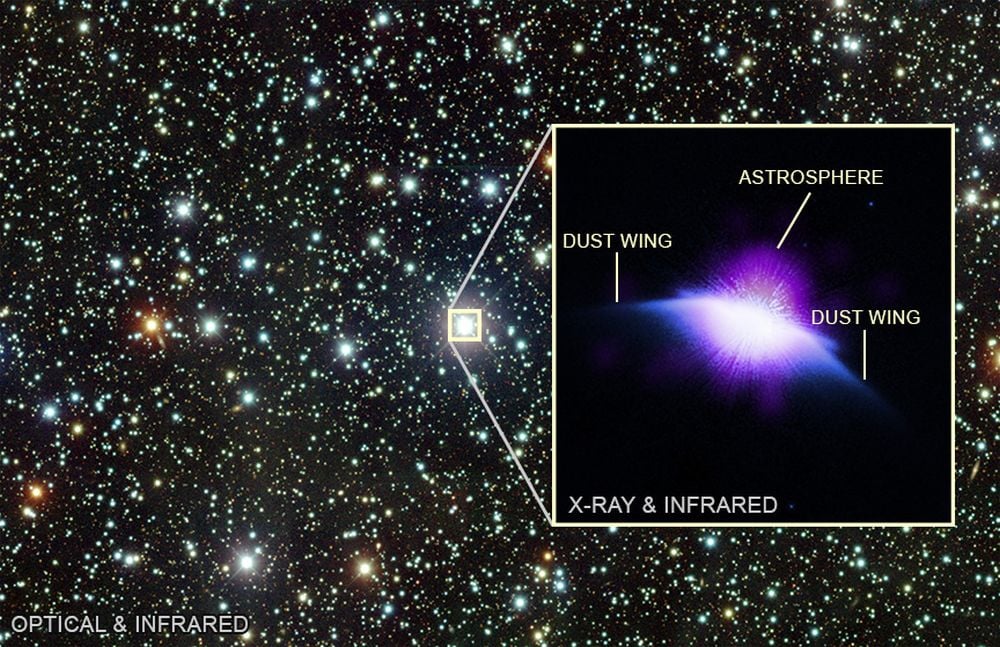
- What happened: Astronomers imaged the astrosphere of the young, Sun-like star HD 61005 using Chandra X-ray observations and Hubble infrared data.
- Why it matters: Studying HD 61005 provides a unique external perspective on astrospheres, structures that are difficult to observe from within, like our own Sun's heliosphere. It helps trace their evolution.
- What changes for people: Understanding astrospheres can improve our knowledge of space weather and its impact on satellites and future missions to the Moon or Mars.
- Who is affected: Satellite operators, astronauts, space agencies, and anyone reliant on space-based technology are affected by space weather.
Observing a Young Sun
Young stars emit powerful radiation and winds, shaping their surroundings. These winds create gaseous bubbles called astrospheres. Our Sun's astrosphere is known as the heliosphere.
New research focuses on HD 61005, a young star with an inflated bubble. It presents an exciting observational opportunity.
Observing this young star externally allows scientists to trace the evolution of these features.
X-ray Emissions and the Astrosphere
The research, titled "First Resolution of a Main Sequence G-Star Astrosphere Using Chandra," is led by Carey Lisse of Johns Hopkins University Applied Physics Laboratory.
Stars emit X-rays from hot plasmas in their coronal atmospheres. Additionally, X-rays are generated as the astrosphere expands and its wind collides with the interstellar medium (ISM).
The Chandra ACIS-S imaging spectroscopy, aided by Hubble's infrared instrument, helped piece together the activity of HD 61005.
The "Moth": A Star with Wings
HD 61005's astrosphere isn't a perfect sphere; it's comet-shaped due to the star's motion. The particle wind is three times faster and 25 times more dense than our Sun's.
Infrared observations have earned HD 61005 the nickname "The Moth" due to the massive amounts of dust resembling moth wings surrounding the star. This dust is 1,000 times denser than the material around our Sun.
"We have been studying our Sun's astrosphere for decades, but we can't see it from the outside," said Carey Lisse. "This new Chandra result about a similar star's astrosphere teaches us about the shape of the Sun's, and how it has changed over billions of years as the Sun evolves and moves through the galaxy."
Understanding Space Weather and Our Sun
The Sun's weather can damage satellites. Understanding the Sun's astrosphere is key to mitigating these risks.
"We are impacted by the Sun every day, not only through the light it gives off, but also by the wind it sends out into space that can affect our satellites and potentially astronauts traveling to the Moon or Mars," said co-author Scott Wolk. "This image of the astrosphere around HD 61005 gives us important information about what the Sun's wind may have been like early in its evolution."
Unraveling the Mysteries of Astrospheres
Researchers are exploring why more young stars aren't observed with similar astrospheres. The density of the local interstellar medium (ISM) is a critical factor.
HD 61005's detectable astrosphere is due to its location within a region of enhanced neutral density in a dense interstellar cloud.
The denser ISM not only enables the formation of the x-ray astrosphere but also the development of the “moth wings”.
The Sun's Past and Future Research
The Sun likely passed through a similar stage in its early life, offering valuable insights through the observation of HD 61005.
"Our Sun was likely in a similar state at one point in its young life, when it was ~10^8 yrs old and transiting through a dense part of the ISM," the researchers write.
This research underscores the importance of combining spacecraft measurements with these new observations to better understand our heliosphere. The research will be published in The Astrophysical Journal.
What to Watch Next
Future research will focus on studying the evolution of other young, Sun-like stars and their astrospheres. This will help refine models of our heliosphere and its interaction with the interstellar medium, hopefully leading to a greater understanding of space weather and its potential impacts.