
Webb Telescope Finds Strongest Evidence Yet of an Atmosphere on a Rocky Exoplanet
In a breakthrough that reshapes scientists’ understanding of how planets evolve under extreme conditions, researchers using NASA’s James Webb Space Telescope (JWST) have found the...
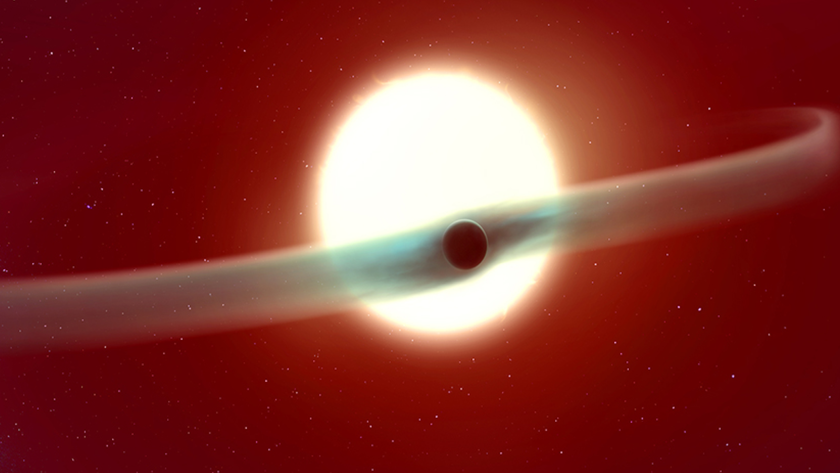
In a breakthrough that reshapes scientists’ understanding of how planets evolve under extreme conditions, researchers using NASA’s James Webb Space Telescope (JWST) have found the most convincing evidence so far of an atmosphere surrounding a rocky world beyond our solar system. The discovery challenges long-held assumptions that small, star-hugging planets are inevitably stripped bare by intense radiation.
The findings centre on TOI-561 b, an ultra-hot “super-Earth” located outside our solar system, and were published this week in The Astrophysical Journal Letters.
A Lava World That Defies Expectations
TOI-561 b is a rare type of exoplanet known as an ultra-short period planet. It is about 1.4 times the size of Earth but completes a full orbit around its star in less than 11 hours. The planet orbits at a distance of under one million miles from its host star—so close that it is likely tidally locked, with one side permanently facing intense starlight.
Temperatures on the dayside are extreme, high enough to melt rock and create what scientists believe is a global magma ocean. Under such conditions, astronomers have long believed that any atmosphere would be rapidly blown away into space.
However, TOI-561 b appears to be an exception.
Clue Hidden in an Unusual Density
What first caught scientists’ attention was the planet’s unexpectedly low density. Measurements suggested it was lighter than a rocky planet with an Earth-like composition should be.
“This planet isn’t a gas giant or a ‘super-puff,’ but it is significantly less dense than expected,” said Johanna Teske of Carnegie Science’s Earth and Planets Laboratory, the study’s lead author. She noted that the planet orbits an unusually old, iron-poor star in a different region of the Milky Way than our Sun, hinting that it formed in a very different chemical environment.
While an unusual interior composition could explain part of the puzzle, it did not fully account for the observations.
Webb’s Temperature Test
To probe deeper, the research team turned to JWST’s Near-Infrared Spectrograph (NIRSpec). By observing TOI-561 b as it passed behind its star—a method known as secondary eclipse spectroscopy—scientists measured how much infrared light the planet emits.
If the planet were a bare rock with no atmosphere, its dayside temperature should be close to 2,700 degrees Celsius. Instead, Webb measured a significantly cooler temperature of around 1,800 degrees Celsius.
“That difference is too large to ignore,” said Anjali Piette of the University of Birmingham, a co-author of the study. “The most plausible explanation is a thick, volatile-rich atmosphere.”
A Thick Atmosphere Above a Magma Ocean
According to the researchers, a dense atmosphere could redistribute heat from the dayside to the nightside through powerful winds, lowering the observed temperature. Gases such as water vapour could also absorb infrared radiation, making the planet appear cooler to the telescope. Reflective silicate clouds may further help shield the surface from starlight.
The data suggest TOI-561 b is not a naked lava world, but one wrapped in a substantial envelope of gases—despite enduring radiation levels far beyond what Earth experiences.
How Does the Atmosphere Survive?
One of the biggest remaining mysteries is how such an atmosphere can persist. Scientists believe there may be a balance between gases escaping into space and new material being released from the magma ocean below.
“There appears to be a constant exchange between the molten surface and the atmosphere,” explained Tim Lichtenberg of the University of Groningen, another co-author. “The planet may be extremely rich in volatile materials—far more than Earth—which allows it to sustain this cycle.”
Why the Discovery Matters
The findings open a new window into the study of rocky exoplanets and suggest that atmospheres may be more resilient than previously thought. This has broad implications for understanding planet formation in the early universe and for identifying which types of worlds might retain atmospheres under extreme conditions.
“These observations are answering one question and raising many more,” Teske said. “That’s what makes this so exciting.”
The research is part of JWST’s General Observers Program 3860, which monitored the system for more than 37 hours. Scientists are now analysing additional data to map temperatures across the planet and better identify the gases in its atmosphere.