
US Launches ‘Pax Silica’ Tech Alliance, Leaving India Out of Founding Group
The United States has unveiled a new high-technology and supply chain partnership, dubbed Pax Silica, aimed at securing critical semiconductor and artificial intelligence ecosystems—but India...
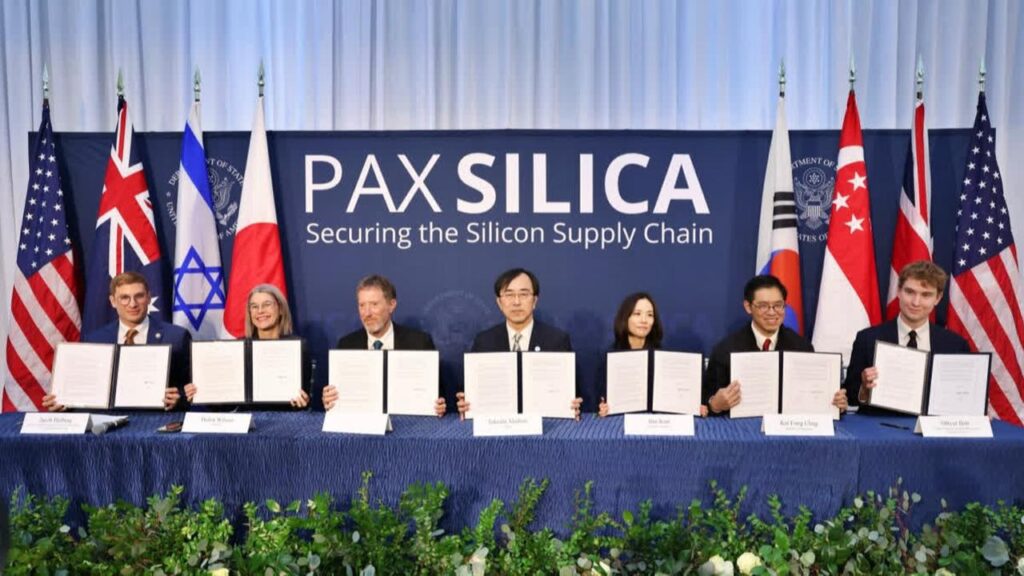
The United States has unveiled a new high-technology and supply chain partnership, dubbed Pax Silica, aimed at securing critical semiconductor and artificial intelligence ecosystems—but India has been left out of the initiative’s founding members. The move has sparked concern in New Delhi about the future direction of India–US strategic and technology cooperation, especially as other key Indo-Pacific partners have been included.
The US-led grouping brings together Japan, South Korea, Singapore, the Netherlands, the United Kingdom, Israel, the United Arab Emirates and Australia. Notably, while the framework includes all other members of the Quad—Japan, Australia and the US—India is absent from the inaugural lineup.
What Is Pax Silica?
According to the US State Department, Pax Silica is designed to build a secure, resilient and innovation-driven global supply chain for semiconductors, artificial intelligence and other critical technologies. The initiative spans the full technology stack, from critical minerals and energy inputs to chip fabrication, data centres, advanced AI models and global logistics networks.
US officials described the framework as a new economic security model that prioritises cooperation among countries hosting advanced technology firms, investors and research ecosystems. The emphasis, they said, is on ensuring that “trusted partners” can develop and deploy transformative technologies at scale, while reducing exposure to coercive or vulnerable supply chains.
Although Washington has stressed that Pax Silica is a “positive-sum partnership” and not directed at excluding any particular country, it is widely seen as part of a broader strategy to counter China’s dominance in high-technology and critical supply chains. The name itself—Pax Silica—is being read by analysts as a deliberate contrast to the idea of “Pax Sinica”, signalling a coalition-led economic order for the AI era.
India’s Absence Raises Strategic Questions
India’s exclusion has drawn attention given its stated ambition to become a global semiconductor and electronics manufacturing hub, backed by substantial government incentives and partnerships with global firms. It also comes at a time when New Delhi plays a central role in multiple US-backed Indo-Pacific initiatives.
Participants in Pax Silica have committed to joint projects aimed at addressing vulnerabilities in AI and semiconductor supply chains, promoting co-investment and joint ventures, safeguarding sensitive technologies from foreign control, and building trusted digital infrastructure such as fibre-optic networks and large-scale data centres.
For Indian policymakers and strategic experts, the concern is less about immediate economic fallout and more about long-term positioning in emerging technology governance and supply chains that are expected to define global power balances.
Political Reactions at Home
The opposition Congress has seized on the development to criticise the government’s handling of ties with Washington. Party general secretary Jairam Ramesh said reports of India being excluded from the nine-nation grouping were “perhaps not very surprising”, linking the decision to what he described as a downturn in relations between Prime Minister Narendra Modi and US President Donald Trump since May 2025.
Ramesh argued that inclusion in Pax Silica would have clearly benefited India, particularly as the initiative is widely perceived as a counter to China’s technological rise. He also pointed to the timing of the announcement, which came shortly after the Prime Minister publicly referred to a recent phone conversation with President Trump, contrasting it with the earlier phase of high-profile engagement between the two leaders.
Government Response and the Road Ahead
The Indian government has not yet issued an official response to the announcement. However, diplomatic sources suggest the development is likely to prompt quiet engagement with Washington and other partners, especially given India’s investments in semiconductor manufacturing, critical minerals cooperation and advanced technology research.
Analysts note that while exclusion from the founding group is a setback, it does not necessarily close the door to future participation. Much will depend on how Pax Silica evolves, how India positions itself within parallel frameworks, and whether New Delhi can leverage its market size, talent base and strategic relevance to remain indispensable in the global technology ecosystem.