
Trump, AI Leaders Ink Voluntary Safety Accord
President Donald Trump and top artificial intelligence executives have signed a voluntary accord aimed at addressing public fears and potential risks associated with AI technology...
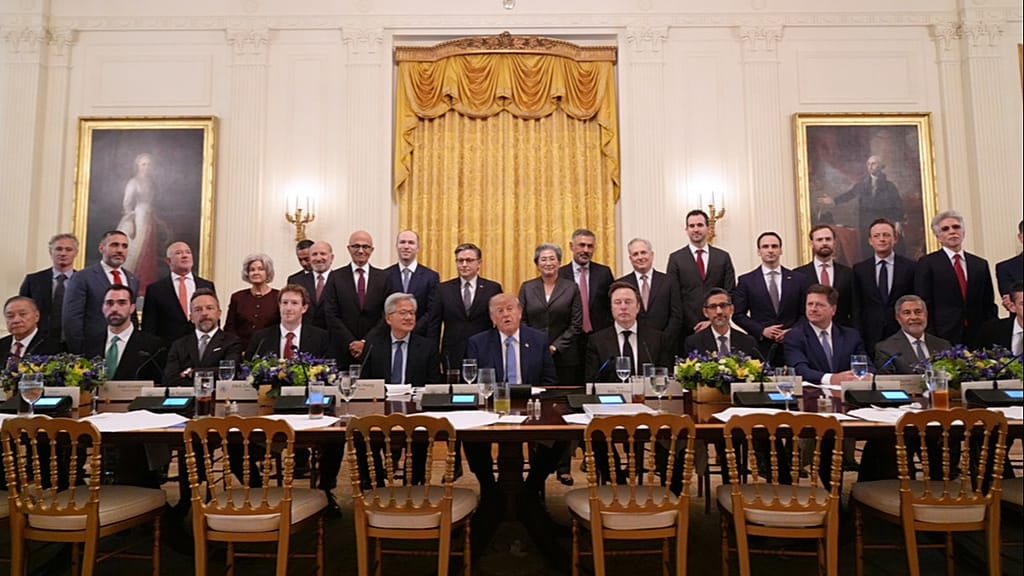
The Cliff News | 30 September 2026
US President Donald Trump announced Tuesday that he, alongside leaders from a significant group of artificial intelligence companies, has signed a voluntary accord. This agreement is designed to address growing public concerns and potential risks associated with the rapidly advancing AI technology, with a focus on fostering internal and external reviews.
Speaking at an impromptu press conference outside the West Wing, Trump stated, "I think I’m seeing tremendous self-policing. And they understand that they have to self-police." The President met with leading executives from major tech and AI firms at the White House. These companies are making substantial investments, reportedly in the hundreds of billions of dollars, to expand AI infrastructure, including the construction of data centers across the nation. These developments have, however, spurred grassroots opposition and bipartisan concerns.
Voluntary Accord Establishes Self-Regulation Framework
The signed accord includes a commitment from Trump, Anthropic CEO Dario Amodei, Google CEO Sundar Pichai, Meta CEO Mark Zuckerberg, OpenAI President Greg Brockman, Nvidia CEO Jensen Huang, and Elon Musk, CEO of Tesla, SpaceX, X, and xAI. The agreement, shared by Trump on his social media platform, Truth Social, outlines four voluntary steps for the participating companies.
These steps involve implementing robust internal controls, engaging an independent external auditor to verify the effectiveness of these controls, and establishing a committee within each company's board of directors to review reports from both internal and external assessments. The accord suggests that these voluntary measures could potentially be codified into laws and regulations over time, signaling an openness to future government oversight.
"Over time, it may make sense to codify these steps into laws and regulations," the accord stated.
Throughout the meeting, Trump expressed strong praise for the executives, highlighting their role in developing a technology he believes will drive "unbelievable growth." He pointed to the significant investment in data centers and related computer equipment as a catalyst for economic acceleration and stock market gains, benefiting higher-income Americans through increased investment accounts and spending.
Concerns Persist Amidst Technological Advancement
Despite the optimistic outlook, notes of caution were present. Dario Amodei, who has been a vocal proponent for a more measured pace in AI development, acknowledged, "The technology has very real risks." He further commented, "And, you know, the mechanism, how we address those risks is still under discussion."
Trump indicated that approximately ten individuals would be appointed to a committee tasked with overseeing the entire AI development enterprise, describing the accord as "morally binding." He also stated his intention to name a specific overseer for the agreement in the coming days, following consultations with the industry. Observers note that some provisions within the accord mirror actions companies are already undertaking or have previously pledged to implement.
Limitations of the Voluntary Agreement
Significantly, the accord does not introduce a comprehensive legal framework or robust regulatory measures. This stands in contrast to concerns raised by some within the industry who have warned of AI's potential to surpass human intelligence and, in a decade, potentially lead to human extinction. Trump, historically opposed to stringent government controls, had previously stated his administration would not limit AI development or support calls for "guardrails" or other restrictions.
"I will never stifle the growth of a technology that will be bigger than the industrial revolution," Trump had remarked previously. "We can’t stifle it, and we’re leading by a lot."
Furthermore, Trump announced that the executives had agreed to help alleviate bipartisan opposition to data centers in local communities. This is to be achieved through increased financial support for local schools and measures aimed at reducing energy costs. Trump emphasized the growing importance of data centers, suggesting that continued opposition might force companies to relocate operations overseas.
Global Competition and US-China Dynamics
President Trump framed the race for AI development as a critical global competition, primarily between the United States and China, asserting there would be a clear "winner and loser, with no 'second place.'" While the US and China recently agreed to establish a communication channel for AI-related incidents during Chinese President Xi Jinping's visit to Washington, Trump expressed reservations about extensive cooperation with China.
"I didn’t want to do anything, because we’re leading. Why would I want to do anything?," Trump stated, underscoring his administration's focus on maintaining American leadership in the AI sector.