
Tiny Galaxies, Giant Secrets: Black Hole Origins Probed by Indian Scientists
IIA researchers explore dwarf galaxies to understand black hole formation.
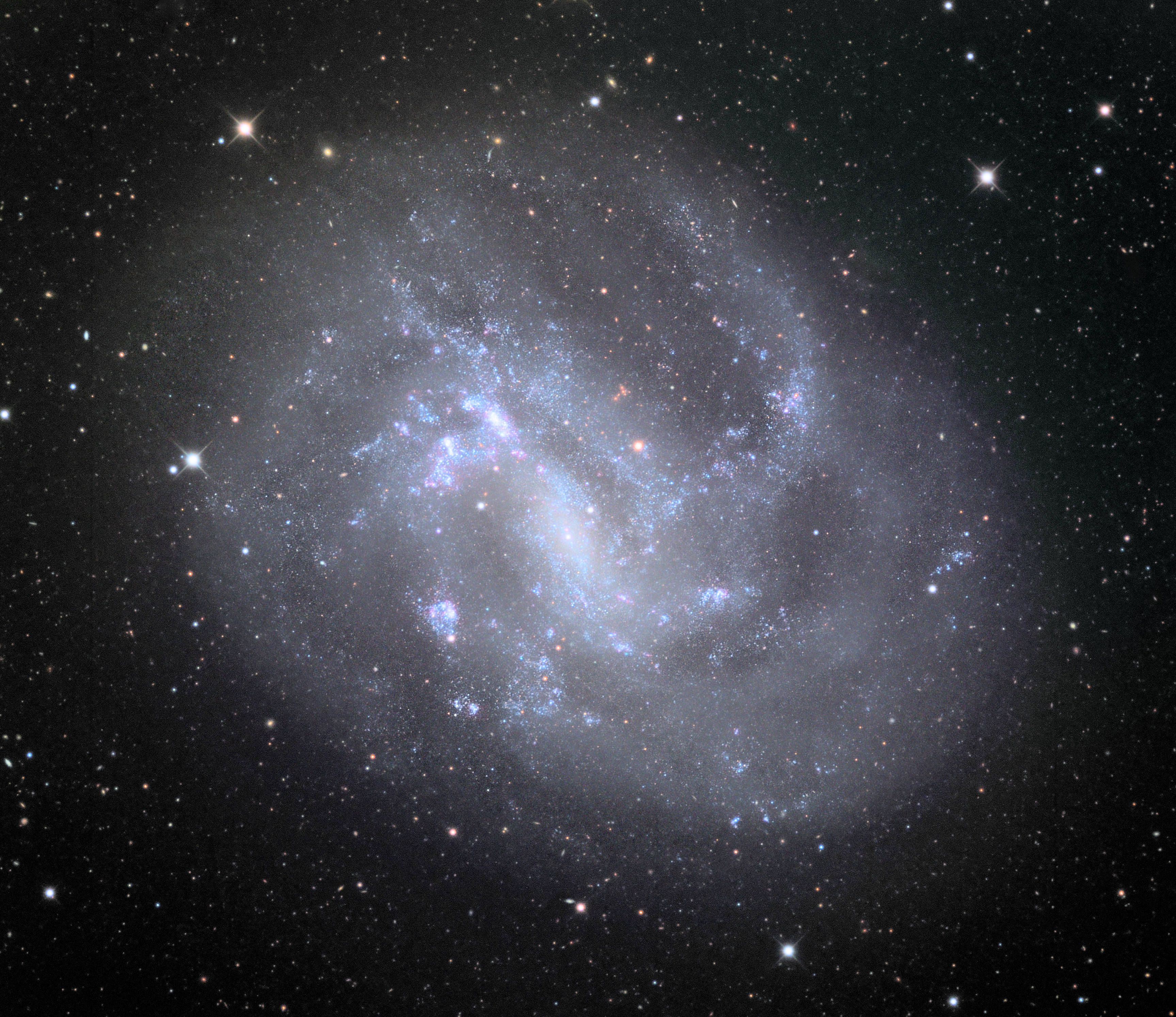
Top Summary
- What happened: Researchers at the Indian Institute of Astrophysics (IIA) modeled dwarf galaxies to study potential black holes at their centers.
- Why it matters: Understanding black holes in small galaxies can reveal how the earliest black holes formed and evolved over cosmic time.
- What changes for people: The research offers new insights into the universe's structure and evolution, potentially impacting future astronomical studies.
- Who is affected: Astronomers, astrophysicists, and space science enthusiasts will benefit from this research.
Dwarf Galaxies: Unlocking Black Hole Mysteries
In the vast cosmos, dwarf galaxies, often overlooked due to their size, may hold crucial clues to understanding black hole origins.
Researchers at the Indian Institute of Astrophysics (IIA) in Bengaluru are studying these faint companions of the Milky Way. Their goal is to determine if dwarf spheroidal galaxies host black holes at their centers.
The Challenge of Studying Small Galaxies
These galaxies present significant observational challenges.
They contain very little gas, emit weak light, and are primarily composed of dark matter. This makes them difficult to study using conventional methods.
Black Holes in Small Galaxies: A Key to the Past
While black holes are common in larger galaxies, their presence in dwarf galaxies is uncertain.
Finding them in these smaller systems could help scientists trace the origins of the earliest black holes and their growth patterns.
IIA's Modeling Approach
The team, led by K Aditya and Arun Mangalam, created detailed models of dwarf galaxies.
These models accounted for stars, dark matter, and the possibility of a central black hole. They used kinematic data to study stellar movement within the galaxies.
Findings: Small Black Holes, Big Implications
The study suggests that if black holes exist in dwarf galaxies, they are relatively small.
Most likely, their masses are below one million times the mass of the Sun, and often much smaller.
"The data do not require the presence of large black holes but remain consistent with smaller, intermediate-mass ones."
Connecting Small and Large Galaxies
The research links small galaxies to their larger counterparts through a known relationship.
This relationship connects a galaxy’s stellar motion to the mass of its central black hole. This link extends across various galaxy sizes.
Black Hole Formation and Growth Scenarios
The work explores how black holes in dwarf galaxies might form and grow.
- Gas accretion models suggest masses around 1,000 Suns.
- Star capture processes could increase this to 10,000 Suns or more.
- Dwarf galaxies might have once been larger systems that lost mass through interactions with the Milky Way.
Future Telescopes: A New Era of Observation
The findings coincide with the development of new telescopes.
Instruments like the proposed National Large Optical Telescope (NLOT) and the Extremely Large Telescope (ELT) promise sharper observations of faint galaxies.
What to Watch Next
Future observations from the NLOT and ELT telescopes will be crucial in confirming the presence and characteristics of black holes in dwarf galaxies. These observations could provide further insights into the early universe and the evolution of black holes.