
Scientists Identify Mysterious Mineral on Mars as Ferric Hydroxysulfate, Revealing Thermal History
For years, a narrow spectral band detected on Mars puzzled scientists, hinting at an iron-rich material that did not match any known mineral. A new...
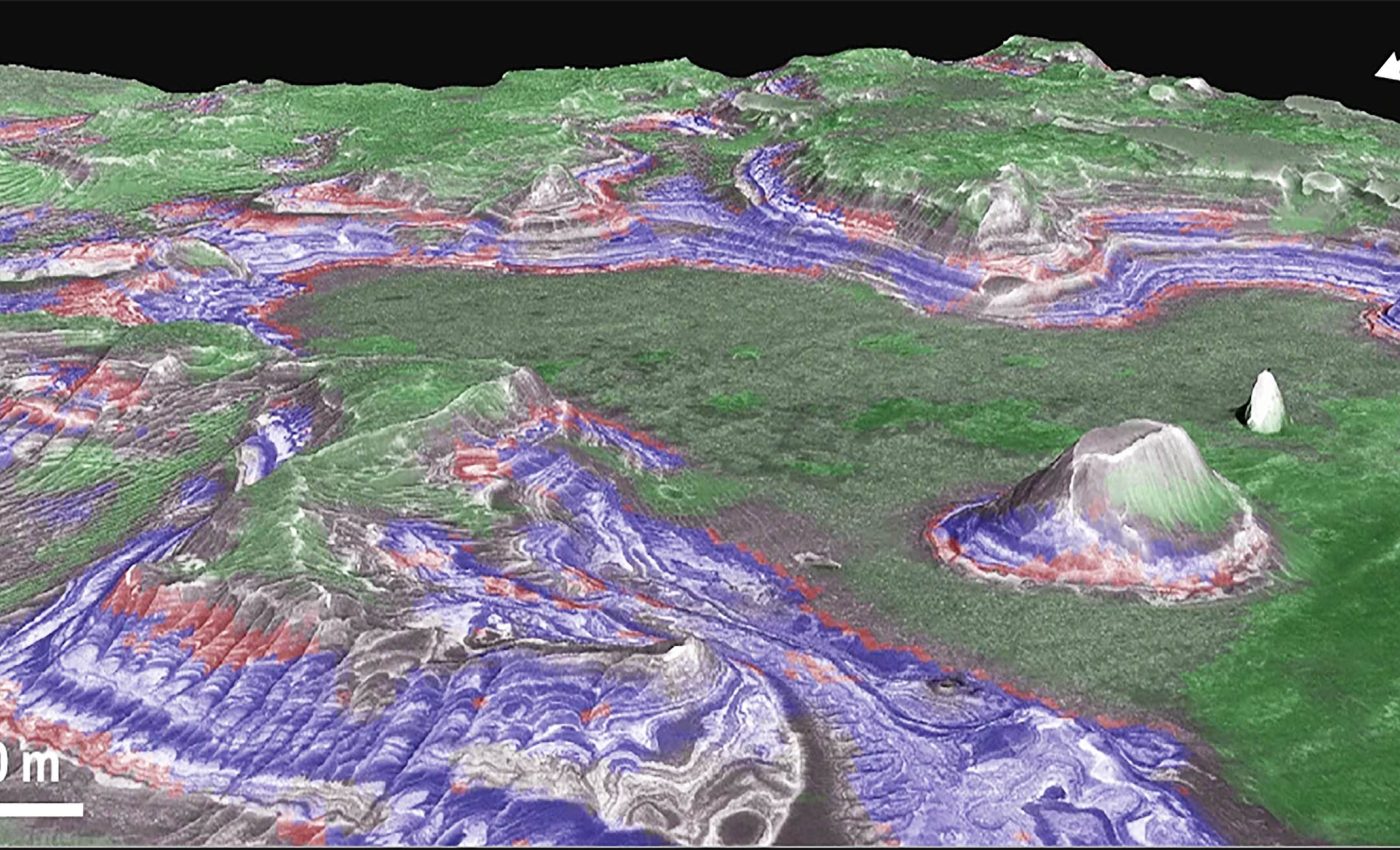
For years, a narrow spectral band detected on Mars puzzled scientists, hinting at an iron-rich material that did not match any known mineral. A new study has identified this signal as ferric hydroxysulfate, a compound formed when hydrated iron sulfates are heated in the presence of oxygen and water at temperatures between 50°C and 100°C. This discovery links orbital observations with laboratory experiments and provides new insights into the Red Planet’s thermal past.
Tracking the Signal from Orbit
The mysterious band was first detected by CRISM, a hyperspectral imager that measures reflected sunlight across many wavelengths to map surface minerals. Minerals produce characteristic absorption features at specific wavelengths, which act as spectral “labels.” The stubborn feature sits at 2.236 micrometers and is found in regions like Aram Chaos and the plateau above Juventae Chasma, areas associated with complex histories involving lava, ash, or heated groundwater.
Matching this specific band helped narrow down the list of potential minerals and the conditions under which they formed. In particular, the identification of a heated iron sulfate suggests past thermal energy sufficient to drive chemical reactions important for habitability.
How the Code Was Cracked
Raw orbital spectra are affected by dust, detector noise, and carbon dioxide in Mars’ thin atmosphere. Researchers applied improved calibrations and mapping algorithms to isolate the unusual material with higher confidence. Sharper images revealed additional patches and layers of the same signal, making the mineral’s identity clearer.
Lab experiments then confirmed the match: when hydrated iron sulfates such as rozenite or szomolnokite were heated to around 100°C (212°F) in the presence of oxygen, ferric hydroxysulfate formed. The reaction happened more quickly with rozenite. Importantly, experiments without oxygen failed to produce the compound, indicating that oxidation was necessary.
Clues About Mars’ Past
The chemistry also points to acidic conditions, implying low pH in the fluids that altered the rocks. This combination of heat and acidity fits a hydrothermal environment, where warm fluids move through rock and chemically modify sulfates. Alternative minerals were tested, but none matched the narrow 2.236-micrometer feature along with the associated overtones and electronic bands seen from orbit.
This discovery not only solves a long-standing Martian mystery but also provides a window into Mars’ hydrothermal activity, which could have implications for the planet’s past habitability.