
Scientists explain why Jupiter and Saturn have radically different polar storms
What happened: Researchers have identified a key reason why Jupiter and Saturn show dramatically different polar weather patterns, despite being similar gas giants. Why it...
-
What happened: Researchers have identified a key reason why Jupiter and Saturn show dramatically different polar weather patterns, despite being similar gas giants.
-
Why it matters now: The findings offer new insight into the hidden interiors of giant planets, improving how scientists model planetary formation and climate systems.
-
What changes for people: The research sharpens our understanding of gas giant physics, influencing future space missions and exoplanet studies.
-
Who is affected: Planetary scientists, astronomers, space agencies, and researchers studying gas giants beyond our solar system.
For decades, scientists have been puzzled by a striking mystery in our solar system. Jupiter and Saturn, planets that are similar in size, mass, and composition, display completely different weather patterns at their poles.
Now, new research suggests the answer lies deep beneath their swirling clouds.
Two planets, two very different poles
Spacecraft observations revealed a sharp contrast.
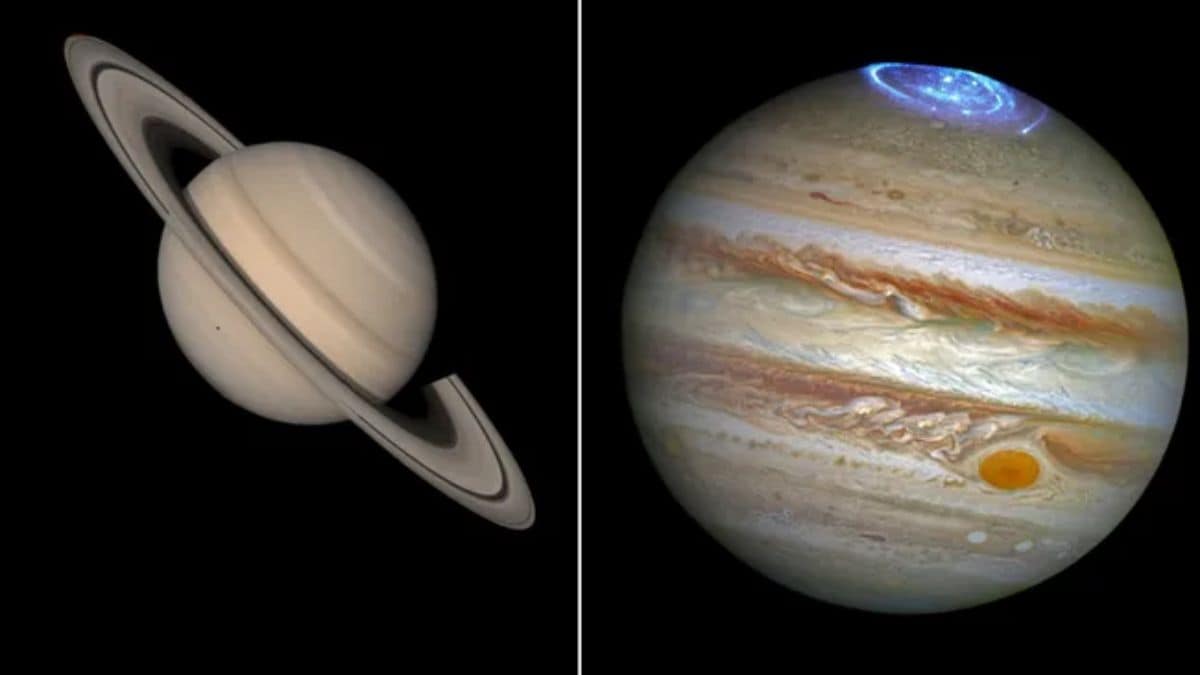
At Saturn’s north pole, data from NASA’s Cassini mission showed a single, enormous storm shaped like a near-perfect hexagon. This vast vortex spans roughly 18,000 miles, dwarfing any individual storm seen on Jupiter.
In contrast, images from NASA’s Juno spacecraft revealed that Jupiter’s poles host multiple cyclones. Each pole features one central storm surrounded by eight smaller vortices, each measuring about 3,000 miles across.
Bold: Same type of planet. Entirely different storm architecture.
Why size and composition were not enough to explain it
Because Jupiter and Saturn are both gas giants, scientists initially expected their atmospheric behavior to be broadly similar.
Both planets:
-
Are composed mainly of hydrogen and helium
-
Rotate rapidly
-
Generate powerful winds and storms
Yet their polar regions evolved in opposite directions, raising a fundamental question: what controls how storms organize at a planet’s poles?
The breakthrough: what lies beneath the storms
A team of researchers at MIT turned to advanced simulations of polar fluid dynamics to find the answer.
Their conclusion points to a subtle but crucial factor: the “hardness” or “softness” of gas deep inside the planet.
According to the study:
-
A softer, less dense interior layer limits how large a single storm can grow, encouraging multiple smaller vortices
-
A denser, harder interior layer allows one storm to dominate, suppressing others
Underline: The storms we see may be shaped by conditions far below the visible atmosphere.
What this means for Jupiter and Saturn
Based on the simulations:
-
Jupiter’s interior may be “softer”, preventing one massive polar storm from taking over
-
Saturn’s interior may be “harder”, allowing a single, stable vortex to form and persist
MIT researcher Wanying Kang noted that one possible explanation is that Saturn’s deeper layers are denser than Jupiter’s, while Jupiter may contain a higher proportion of lighter material.
This difference, though invisible from space, could explain the radically different storm patterns observed at the poles.
Why this discovery matters beyond our solar system
Understanding polar storms is not just about Jupiter and Saturn.
Bold: Storm behavior offers clues to a planet’s interior structure.
That insight helps scientists:
-
Better model gas giant formation
-
Improve predictions of atmospheric dynamics
-
Apply similar principles to exoplanets orbiting distant stars
As astronomers discover more gas giants beyond our solar system, these findings provide a framework for interpreting weather patterns that cannot yet be directly observed.