
Saturn's Moon Titan: No Vast Ocean, Just Deep Slush?
Titan's interior may be slushy, not a vast ocean, impacting life's potential.
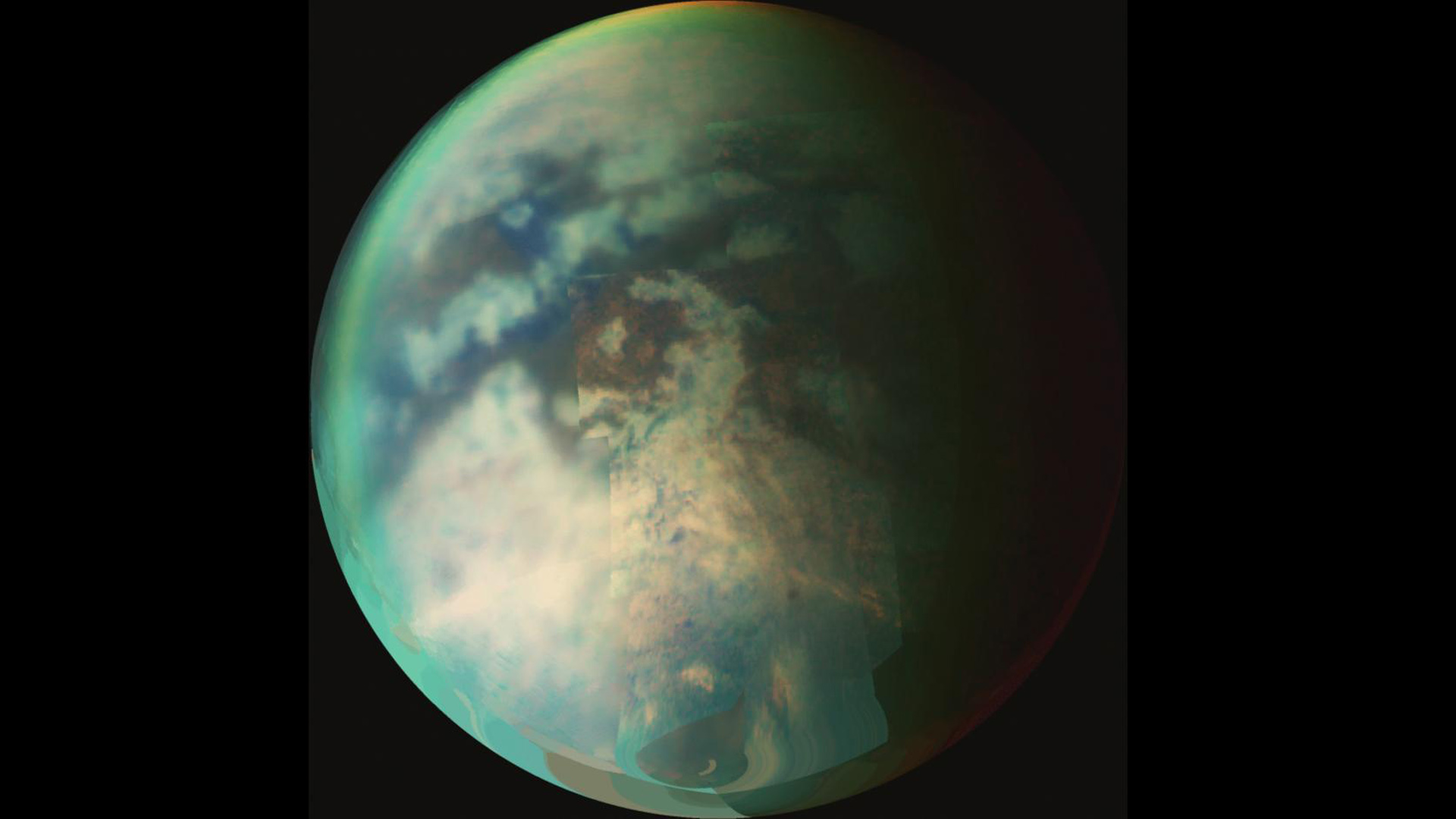
Top Summary
- What happened: Reanalysis of Cassini data suggests Titan's interior is slushy with scattered melt pockets, not a continuous ocean.
- Why it matters: The absence of a vast ocean impacts the potential for life, as nutrient circulation from rock is limited.
- What changes: Challenges previous assumptions about Titan's interior and its habitability.
- Who is affected: Planetary scientists studying Titan, astrobiologists assessing its potential for life, and future mission planning.
Cassini's Data Reinterpreted
Saturn’s moon Titan may not harbor the vast underground ocean scientists once believed. A new analysis of Cassini’s radio-tracking data indicates significant heat loss: roughly 3 to 4 terawatts.
This heat signature points to a slushy interior with small, separated melt pockets. Flavio Petricca at NASA’s JPL led the reanalysis, linking spacecraft data with ice physics from the University of Washington (UW).
Early Ocean Speculation
In 2008, researchers linked Titan’s changing shape to Saturn's tides, suggesting a buried ocean. Tidal flexing, caused by Saturn's gravity, involves repeated squeezing and stretching.
Earlier measurements were ambiguous, requiring further analysis to clarify Titan’s internal structure. Experts compared Titan's gravitational pull to its bulge, noting a misalignment.
Titan's Interior: A Different Picture
Tidal dissipation, the energy lost as heat during flexing, indicates a different interior.
"That was the smoking gun indicating that Titan’s interior is different from what was inferred from previous analyses,"
according to Petricca.
Planetary scientists use a Love number to measure how a body deforms under tides. The reanalysis extracted the missing imaginary part of the Love number, revealing heat loss.
Slush Pockets and Heat Flow
The new model proposes thick ice above a rocky core, with melt in scattered pockets. High-pressure ice can exist near melting, behaving like slush. Convection, a slow churning motion, can carry heat upward.
At UW, researchers recreated Titan-like pressures to map ice softening and melting. These experiments tracked thermodynamics, governing heat and phase changes.
Implications for Life on Titan
The analysis suggests freshwater pockets could reach 68 degrees Fahrenheit. These pockets can concentrate nutrients, potentially supporting simple microbes.
However, isolated spaces limit energy flow and long-term stability for larger organisms. Surface temperatures on Titan hover near -290 degrees Fahrenheit, with methane and ethane forming lakes and rain.
Dragonfly Mission and Future Study
NASA has confirmed a July 2028 launch date for the Dragonfly rotorcraft mission to Titan. Dragonfly will hop between sites, listening for quakes to assess the interior.
If the readings match a slushy interior, the mission can target areas where surface organics meet internal water pathways. Uncertainty remains about the connectivity of melt pockets and the influence of salts or gas-trapping ice cages.
What to Watch Next
Future work must connect micro-scale ice properties to spacecraft data. The Dragonfly mission and future tracking studies may directly test these slush pockets, but laboratory experiments are crucial to replicating Titan-like pressures.