
Ring of Fire Eclipse: Stunning Views from Antarctica, Captured by Satellite
A rare annular solar eclipse graced Antarctica, stunningly captured by satellite.
Top Summary
- What happened: An annular solar eclipse, dubbed the "ring of fire," occurred over Antarctica on February 17, 2026, with the moon blocking 96% of the sun's disk.
- Why it matters: The eclipse offered a unique astronomical spectacle, showcasing international collaboration in space observation.
- What changes for people: While the full eclipse was primarily visible in Antarctica, partial phases were observed in parts of southern Africa and South America.
- Who is affected: Scientists in Antarctica had the best views; observers in southern regions saw partial eclipses; future eclipse enthusiasts can anticipate upcoming events.
Antarctic Eclipse: A Spectacle From Space
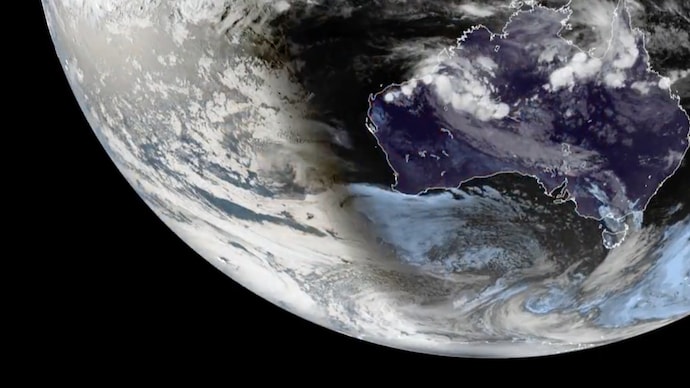
South Korea's GEO-KOMPSAT-2A satellite captured breathtaking footage of the annular solar eclipse that swept across Antarctica.
The National Oceanic and Atmospheric Administration (Noaa) shared the mesmerizing animation, showing the moon's shadow racing across the Earth.
The "ring of fire" eclipse occurred as the moon passed in front of the sun, blocking 96% of its disk.
The Path of Annularity
The path of annularity stretched 4,282 km long and 616 km wide across the continent.
The maximum annularity lasted 2 minutes 20 seconds, with the shadow traversing Earth in approximately 59 minutes.
GEO-KOMPSAT-2A: A Vantage Point
Launched in December 2018, GEO-KOMPSAT-2A (Chollian-2A) orbits at 128.2° East.
It is equipped with the Advanced Meteorological Imager (AMI), offering 16 spectral channels and resolutions up to 0.5 km.
Its full-disk imaging every 15 minutes was perfectly positioned for this southern event.
Limited Viewing on Earth
Few humans saw the full ring, possibly scientists at Concordia Station (2m1s annularity) or Russia's Mirny Station (1m52s).
Partial phases reached 92% at stations like Poland's A.B. Dobrowolski or India's Bharati.
Cruises in the Antarctic Peninsula caught partials up to 21%.
International Collaboration
NOAA's viral clip from the Korean Meteorological Administration satellite highlights international collaboration in space observation.
"You’ll want to see this without a shadow of a doubt!"
The animation vividly showed the umbra darting visibly across the Antarctic landscape.
Future Eclipses
This eclipse previews future annularity in Chile-Argentina (2027) and beyond, captured brilliantly from orbit.
What to Watch Next
As the solar eclipse ends, a total lunar eclipse will occur on March 3, 2026. During this alignment, expect a "Blood Moon," as the Earth's shadow casts a reddish-orange hue on the Moon during the 58 minutes of totality.