
Perseverance Spots Iron-Rich Rock on Mars, Likely a Meteorite from Deep Space
NASA scientists say the unusual formation could be a fragment from the core of an ancient asteroid — offering new clues about the materials that...
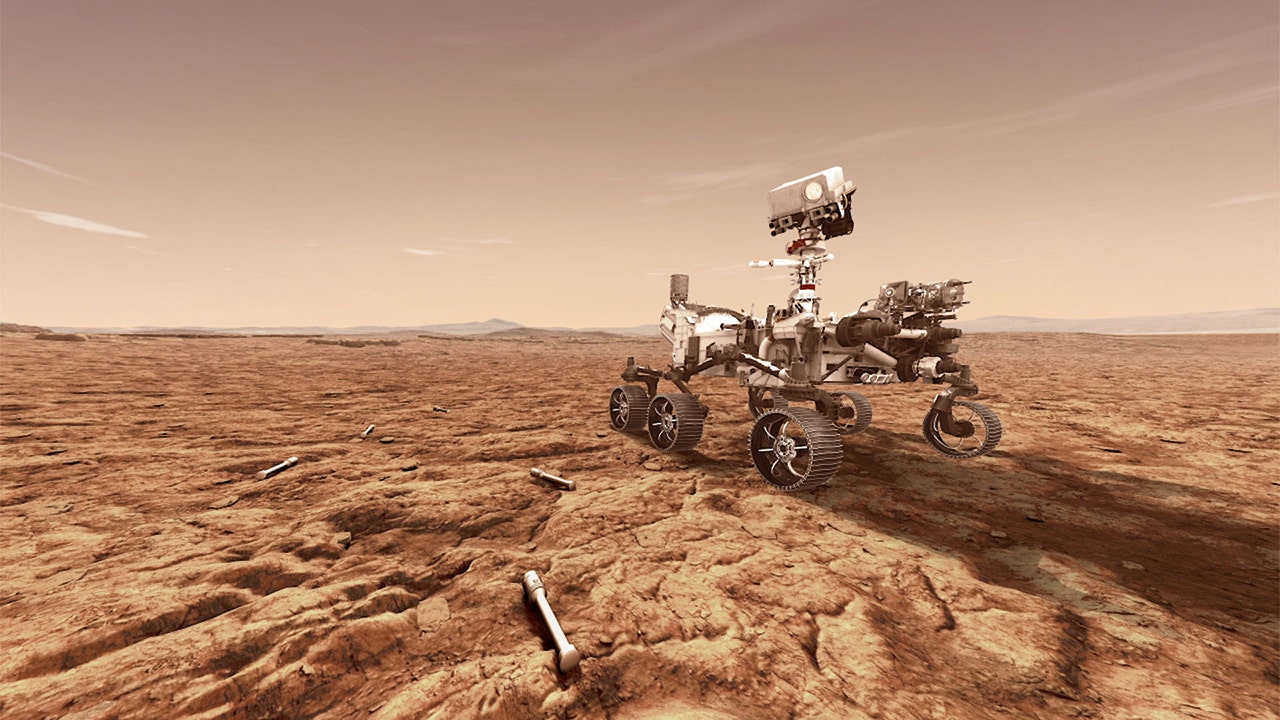
NASA scientists say the unusual formation could be a fragment from the core of an ancient asteroid — offering new clues about the materials that once shaped the solar system.
NASA’s Perseverance rover has detected a striking iron- and nickel-rich rock on the Martian surface, raising the possibility that it is a meteorite that journeyed from elsewhere in the solar system before landing on Mars.
The discovery was made during a recent survey of the “Vernodden” region inside Jezero Crater, where the rover encountered an unusually sculpted boulder named “Phippsaksla.” Measuring roughly 80 centimetres across and carved into a tall, ridged form, the rock stood out sharply against the otherwise level, fractured terrain.
Initial readings from Perseverance’s SuperCam instrument revealed high concentrations of iron and nickel — a chemical signature commonly found in metallic meteorites formed in the cores of large, long-destroyed asteroids. While the origins of the rock are not yet confirmed, NASA scientists say the elemental profile strongly points to an extraterrestrial source.
“Metallic meteorites have a distinct geochemical fingerprint,” mission researchers noted, adding that more observations are underway to understand its composition. If confirmed, Phippsaksla would join a growing list of meteorites identified on the Red Planet by rovers such as Spirit, Opportunity and Curiosity.
Why This Discovery Matters
Meteorites on Mars act as natural clues to the early solar system. Unlike Earth, Mars has a thin atmosphere and minimal weathering, meaning metallic meteorites often remain well-preserved for millions of years. Studying them helps scientists:
-
Understand the types of materials that once existed in early asteroids
-
Compare how meteorites weather on Mars versus Earth
-
Reconstruct the Red Planet’s past atmospheric conditions
A confirmed iron-nickel meteorite on Mars could provide new insights into both planetary history and the evolution of asteroid bodies.
Perseverance: NASA’s Flagship Search for Ancient Life
Perseverance launched on July 30, 2020 and touched down in Jezero Crater on February 18, 2021, carrying seven state-of-the-art scientific instruments. The rover’s mission includes:
-
Searching for signs of ancient microbial life
-
Mapping Mars’ geology and climate history
-
Collecting and caching rock samples for future return to Earth
-
Testing systems that may support eventual human missions
Weighing nearly 1,043 kilograms — about the size of a compact car — Perseverance represents the most ambitious step yet in Mars surface exploration.
A Piece of NASA’s Moon-to-Mars Roadmap
The rover is a crucial part of NASA’s long-term strategy to prepare for human exploration beyond the Moon. Under the Artemis program, the agency aims to establish a sustained presence on and around the lunar surface by 2028, using the Moon as a testbed for technologies required for Mars missions.
Perseverance is jointly managed by NASA’s Science Mission Directorate and the Jet Propulsion Laboratory, which continues to guide the rover through ancient lakebeds, sedimentary layers and now, possibly, the remains of a cosmic traveller from deep space.