
New Zealand PM Backs India FTA Despite Coalition Rift, Hails Economic Promise
New Zealand Prime Minister Christopher Luxon has publicly endorsed the newly announced Free Trade Agreement (FTA) with India, calling it a major achievement of his...
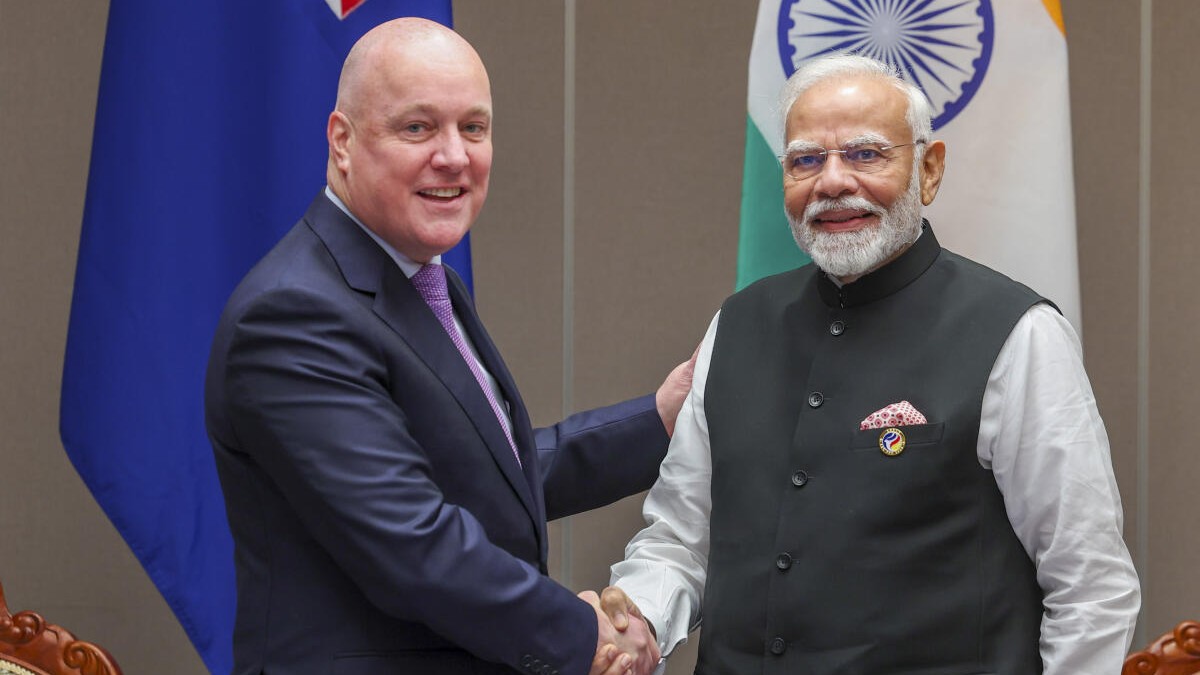
New Zealand Prime Minister Christopher Luxon has publicly endorsed the newly announced Free Trade Agreement (FTA) with India, calling it a major achievement of his government and a cornerstone of its long-term economic strategy. His remarks come amid visible disagreement within New Zealand’s ruling coalition, with Foreign Minister Winston Peters sharply criticising the deal’s scope and substance.
Luxon Calls FTA a “First-Term Promise Kept”
Speaking on Saturday, Luxon said the agreement fulfilled a key election commitment to deepen economic ties with one of the world’s fastest-growing major economies. He framed the pact as an opportunity to expand New Zealand’s export footprint and generate domestic employment.
According to the prime minister, improved access to the Indian market — home to around 1.4 billion consumers — could translate into stronger export growth, rising incomes and job creation. Luxon described the FTA as aligned with his government’s broader policy agenda of stabilising the economy while investing in future growth.
The agreement was announced earlier this week following bilateral talks between Luxon and Indian Prime Minister Narendra Modi in New Delhi. Both leaders said the deal could potentially double bilateral trade within five years and unlock up to $20 billion in new investments in India over the next 15 years, according to official statements.
Internal Coalition Tensions Surface
Despite the prime minister’s endorsement, the deal has exposed divisions within New Zealand’s governing coalition. Winston Peters, who leads the New Zealand First (NZF) party and serves as foreign minister, has openly questioned the agreement’s value, describing it as “neither free nor fair.”
In public comments and a detailed post on social media platform X, Peters argued that negotiations were rushed and that New Zealand conceded too much without securing adequate reciprocal benefits. While stressing his respect for India’s External Affairs Minister S. Jaishankar, Peters said he had formally communicated his party’s concerns to the Indian side.
NZF, Peters said, had urged coalition partners to use the full parliamentary term to negotiate a stronger agreement with broader political consensus, rather than prioritising speed.
Dairy and Agriculture at the Heart of the Dispute
A key source of disagreement is the treatment of New Zealand’s dairy sector — one of the country’s most politically and economically sensitive industries. Peters said the FTA excludes core dairy products such as milk, butter and cheese, making it the first New Zealand trade agreement to do so.
He argued that while New Zealand has offered market access to India, Indian tariff barriers on dairy imports remain largely intact, leaving New Zealand farmers without meaningful gains. Peters said the exclusion would be difficult to justify to rural communities that have traditionally relied on export-driven growth.
Officials familiar with the negotiations have previously acknowledged that agriculture and dairy were contentious areas. To prevent prolonged deadlock, both sides agreed to keep these sectors outside the scope of the current agreement and focus instead on areas where consensus was easier to achieve.
Trade, Migration and Labour Market Concerns
Beyond goods and services, Peters also raised concerns about migration-related provisions in the agreement. He claimed the deal places greater emphasis on facilitating Indian labour mobility and investment into India than on balanced two-way trade.
According to Peters, the agreement creates a new employment visa pathway for Indian nationals — a level of access he said has not been extended to partners such as Australia or the United Kingdom. He warned that such provisions could add pressure to New Zealand’s already tight labour market and undermine domestic employment opportunities.
NZF, he said, evaluates migration policy through the lens of protecting local jobs and maintaining the integrity of the immigration system — a standard he believes the India FTA does not meet.
Why the Deal Matters
India–New Zealand trade in goods and services stood at approximately $2.07 billion in 2024, with Indian exports accounting for about $1.1 billion. Pharmaceuticals form a major part of India’s exports, while New Zealand primarily ships forestry and agricultural products. According to the Indian government, New Zealand is currently India’s second-largest trading partner in the Oceania region.
For India, the agreement strengthens ties with a key Pacific nation and supports its broader strategy of expanding trade partnerships beyond traditional markets. For New Zealand, the deal signals an effort to diversify exports at a time of global economic uncertainty — even as domestic political debate over its costs and benefits continues.
As the agreement moves toward implementation, analysts say its long-term impact will depend on how excluded sectors are addressed in future negotiations and whether labour and migration concerns can be managed without destabilising coalition politics at home.