
NASA’s Webb And Chandra Telescopes Capture Stunning New View Of Cat’s Paw Nebula
NASA has released a breathtaking new image of the Cat's Paw Nebula after combining observations from the James Webb Space Telescope and the Chandra X-ray...
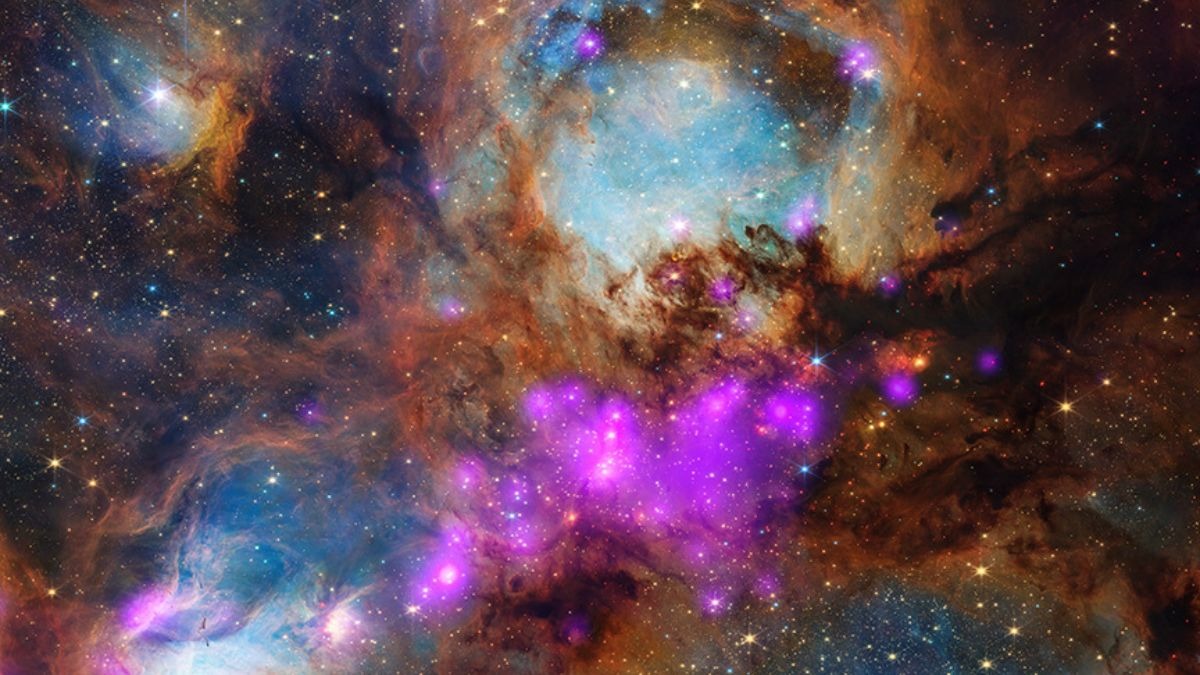
NASA has released a breathtaking new image of the Cat's Paw Nebula after combining observations from the James Webb Space Telescope and the Chandra X-ray Observatory.
The combined observations revealed hidden newborn stars, dense cosmic dust structures and violent stellar activity deep inside one of the Milky Way’s most active star-forming regions.
Top Summary
- What happened: NASA combined Webb and Chandra telescope observations to create a new detailed image of the Cat’s Paw Nebula.
- Why it matters now: The observations provide deeper insight into how stars are born and how stellar nurseries evolve.
- What changes for people: The discovery improves scientific understanding of star formation and cosmic evolution.
- Who is affected: Astronomers, space researchers and astrophysics scientists.
Located roughly:
- 5,500 light-years away
in the constellation:
- Scorpius
the Cat’s Paw Nebula, also known as:
- NGC 6334
is considered one of the galaxy’s most active stellar nurseries.
Webb Reveals Hidden “Toe Bean” Structures
Using Webb’s:
- NIRCam infrared instrument
scientists peered through thick cosmic dust clouds that normally obscure visible-light observations.
The telescope revealed:
- Smaller “toe bean”-like formations
- Dense gas pockets
- Dust filaments
- Newly forming stars
inside the nebula’s iconic rounded structures.
Researchers say many of these regions contain:
- Protostars
- Young stars still wrapped inside dense dust cocoons
that remain difficult to observe even with Webb’s advanced infrared imaging.
Chandra Detects Extremely Young Hot Stars
Meanwhile, Chandra’s X-ray observations identified:
- Extremely hot young stars
- High-energy stellar activity
- Violent radiation zones
The X-ray data, shown in pink and purple in the composite image, highlights stars believed to be roughly:
- One million years old
which is extremely young in astronomical terms.
How Two Telescopes Work Together
Scientists say combining infrared and X-ray observations allows astronomers to study multiple stages of star formation simultaneously.
The image combines:
- Webb’s infrared mapping of gas and dust
- Chandra’s X-ray detection of energetic young stars
to reveal a far more complete picture of the nebula.
Infrared observations helped identify:
- Dust structures
- Gas clouds
- Hidden star-forming regions
while X-rays exposed:
- Stellar heating
- Radiation
- Violent energetic activity
Young Stars Destroying Their Own Nursery
Researchers also observed evidence of:
- Stellar feedback
a process where newly formed massive stars emit powerful radiation that gradually destroys surrounding gas clouds.
Scientists say this process eventually shuts down future star formation inside the nebula.
Webb additionally detected:
- Bow shocks
which are ripple-like structures caused when young stars eject matter at high speeds through surrounding gas.
Nebula Previously Studied By Hubble And Spitzer
The Cat’s Paw Nebula has previously been studied using:
- Hubble Space Telescope
- Spitzer Space Telescope
However, astronomers say the combined Webb-Chandra observations now provide the most detailed view yet of the region’s internal star-forming activity.
Bottom line
NASA’s latest image of the Cat’s Paw Nebula offers a spectacular new glimpse into how stars are born, evolve and reshape their cosmic environments. By combining Webb’s infrared power with Chandra’s X-ray vision, scientists are uncovering hidden processes deep inside one of the Milky Way’s most active stellar nurseries.
What to watch next
- Additional Webb observations of star-forming nebulae
- Future Chandra deep-space X-ray studies
- New discoveries involving protostars and stellar evolution
- Research into stellar feedback processes
- NASA’s upcoming astrophysics missions and telescope projects