
NASA Loses Contact with MAVEN Orbiter, Raising Uncertainty Over Key Mars Atmosphere Mission
NASA engineers are working to re-establish communication with the Mars Atmosphere and Volatile Evolution (MAVEN) spacecraft after the long-serving Mars orbiter unexpectedly went silent earlier...
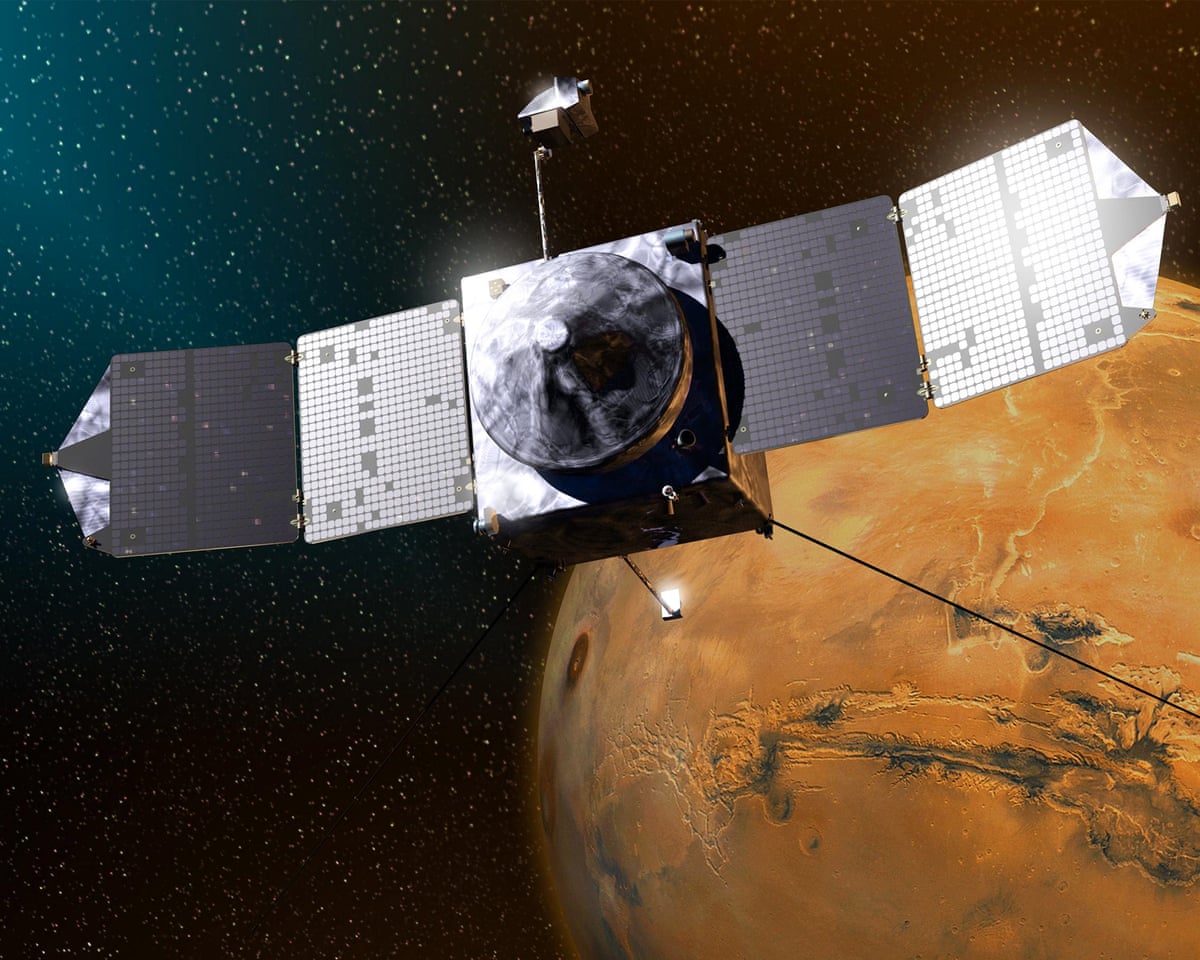
NASA engineers are working to re-establish communication with the Mars Atmosphere and Volatile Evolution (MAVEN) spacecraft after the long-serving Mars orbiter unexpectedly went silent earlier this month. MAVEN, which has been circling the Red Planet for more than a decade, last transmitted routine system data in early December, prompting concern about the status of one of NASA’s most important Mars science missions.
The U.S. space agency confirmed that it is actively investigating the loss of contact and has shifted some critical operations to other Mars orbiters while recovery efforts continue.
What Happened to MAVEN?
According to NASA, MAVEN sent its final complete set of routine “health” telemetry on December 4. Two days later, the spacecraft passed behind Mars relative to Earth — a regular and expected communications blackout that occurs when the planet blocks radio signals.
However, when MAVEN was due to reappear from behind Mars, NASA’s Deep Space Network did not detect its normal signal. The agency publicly acknowledged the issue on December 9, saying engineers were assessing possible causes.
In an update issued on December 15, NASA reported a limited but intriguing development. During a radio science campaign, engineers recovered a short fragment of tracking data from December 6. That brief signal suggested MAVEN was rotating in an unexpected manner when it emerged from behind Mars, and its radio frequency hinted that the spacecraft’s orbit may have changed. NASA has not yet identified what might have triggered these anomalies.
Why MAVEN Matters
MAVEN plays a central role in understanding how Mars transformed from a planet that once had rivers, lakes and possibly oceans into the cold, arid world seen today. Its mission focuses on the planet’s upper atmosphere and ionosphere — regions where charged particles interact directly with sunlight and the solar wind.
By measuring how gases and ions escape into space, MAVEN has helped scientists estimate how Mars gradually lost much of its atmosphere over billions of years. The spacecraft’s highly elliptical orbit allows it to sample different altitudes, times of day, seasons and levels of solar activity, building a long-term picture of atmospheric evolution.
A Critical Communications Link
Beyond its scientific work, MAVEN also serves as an important communications relay. It carries a radio system that receives short ultra-high-frequency transmissions from surface rovers such as Curiosity and Perseverance, then relays those data back to Earth using a high-power antenna.
With MAVEN currently unresponsive, NASA has redistributed relay duties to other spacecraft, including the Mars Reconnaissance Orbiter and Mars Odyssey, and is coordinating with European Mars orbiters when necessary to ensure continued support for surface missions.
A Mission That Outlasted Expectations
NASA launched MAVEN in November 2013 from Cape Canaveral, Florida. After a nearly ten-month journey through interplanetary space, it entered Mars orbit in September 2014. Although the spacecraft was originally designed for a two-year primary mission, it has operated for more than a decade on extended missions, delivering one of the most comprehensive datasets ever collected on Mars’s upper atmosphere.
Planetary scientists say the longevity of MAVEN has been especially valuable, allowing them to observe how Mars responds to changes in the Sun over an entire solar cycle.
Comparisons with India’s Mars Mission
MAVEN arrived at Mars just days before India’s Mars Orbiter Mission (MOM), also known as Mangalyaan, which entered orbit on September 24, 2014. At the time, the two missions were often compared in public discourse, particularly in India, due to their widely cited costs — roughly ₹450 crore for MOM and about $671 million for MAVEN.
Space experts have long noted, however, that the comparison was misleading. MOM was conceived primarily as a technology demonstration with limited scientific instruments, while MAVEN was designed as a far more ambitious and specialised science mission focused on atmospheric loss.
What Comes Next
NASA has not said how long recovery efforts may take or whether MAVEN can be brought back into normal operations. Engineers are continuing attempts to detect signals and assess the spacecraft’s condition.
If contact cannot be restored, the loss would mark the end of a mission that significantly reshaped scientific understanding of Mars and its climate history. For now, NASA says it remains cautiously hopeful as teams analyse every available clue from millions of kilometres away.