
May 2026 New Moon: Witness the Milky Way, Venus, and Mars!
The May 2026 new moon offers prime viewing of the Milky Way, Venus, and Mars.
Top Summary
- What happened: The new moon in May 2026 provides optimal conditions for stargazing, including viewing the Milky Way, Venus, and Mars.
- Why it matters: This celestial alignment offers a rare opportunity to observe multiple planets and deep-sky objects without light interference.
- What changes for people: Stargazers can experience clearer views of the night sky, enhancing their appreciation of astronomy.
- Who is affected: Astronomy enthusiasts, amateur stargazers, and astrophotographers across the Northern Hemisphere.
A Celestial Spectacle
The new moon arrives on May 16, 2026, at 4:01 p.m. EDT (2001 GMT). This ushers in several dark, moonless nights perfect for exploring the cosmos.
Prepare for stunning views of the Milky Way, spring constellations, and planetary alignments.
Planetary Highlights
Look west at sunset to spot Venus. It will appear as a bright “evening star” approximately 20 degrees above the horizon.
Jupiter will be another 20 degrees to the upper left of Venus. Use binoculars to view Jupiter's Galilean moons: Io, Europa, Ganymede, and Callisto.
Early risers can catch Saturn above the eastern horizon before dawn. Mars will be rising to its lower left, before being obscured by the sun.
Constellations in View
May's new moon is an excellent time to observe several constellations. Look for Leo, the great lion, with Regulus at its lowest point above the southwestern horizon after sunset.
Spot Leo Minor, the "little lion," 10 degrees above Leo's sickle head. Created by astronomer Johannes Hevelius in 1690, it lies between Leo and Ursa Major.
To the lower right of Leo Minor, find Alpha Lyncis, part of the constellation Lynx. Dark skies enhance the visibility of Lynx, often obscured by Earth's satellite.
Milky Way Core
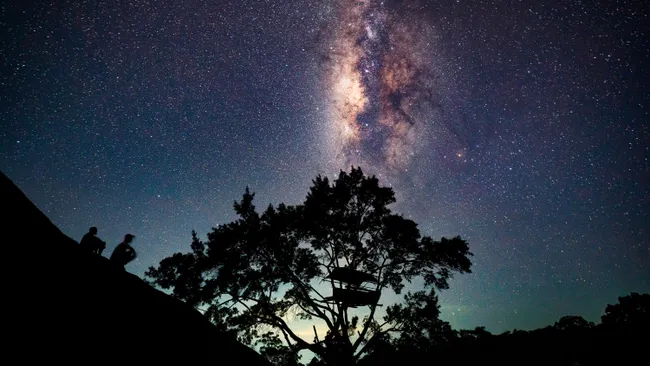
The glowing core of the Milky Way is magnificent between midnight and dawn in mid-May. It arcs high over the southeastern horizon.
Locate the stars Altair, Vega, and Deneb, forming the Summer Triangle asterism above the eastern horizon.
The galactic core appears as a glowing band through Deneb and between Vega and Altair, as it descends toward the horizon.
Maximize Your Viewing
Minimize natural light pollution for the best stargazing experience. Consider heading away from city lights.
Use websites like DarkSky.org to find optimal locations. Smartphone apps like Stellarium or Star Walk 2 can help identify objects.
What to Watch Next
Keep an eye out for future celestial events like meteor showers and planetary conjunctions. Continue to explore and appreciate the wonders of the night sky as our solar system continues its cosmic dance.