
Massive X5.1 Solar Flare Sparks Radio Blackouts Across Europe and Africa — Strongest of 2025 So Far
The Sun unleashed its most powerful flare of the year, disrupting radio signals, GPS, and potentially power grids — as Earth braces for possible geomagnetic...
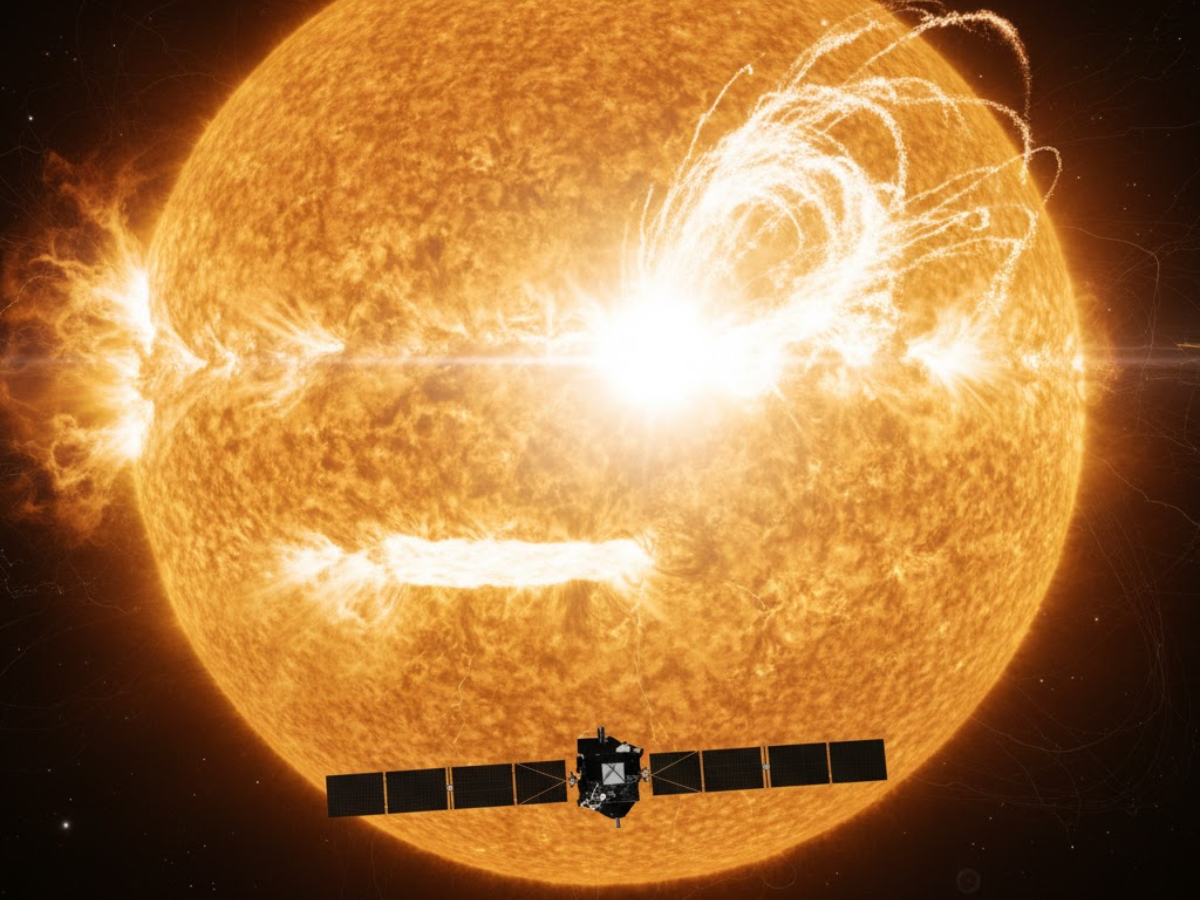
The Sun unleashed its most powerful flare of the year, disrupting radio signals, GPS, and potentially power grids — as Earth braces for possible geomagnetic storms and auroras.
Powerful Solar Blast Disrupts Communications
A massive X5.1-class solar flare erupted from the Sun on November 11, causing widespread radio blackouts across Europe and Africa, according to Space.com and data from the U.S. National Oceanic and Atmospheric Administration (NOAA).
The eruption triggered a severe R3-level radio blackout on the sunlit side of Earth, disrupting high-frequency (HF) communications used by aviation, maritime, and emergency networks. It was the strongest flare of 2025 — and the most intense since October 2024.
Experts warn that such flares can interfere with satellite operations, GPS navigation, and even terrestrial power grids if followed by intense geomagnetic storms.
Linked to Active Sunspot AR4274
The flare originated from sunspot AR4274, a highly active region on the Sun’s surface that has been producing multiple strong eruptions in recent days. This sunspot cluster lies near the solar equator and has shown complex magnetic activity — the kind often associated with large-scale flares and coronal mass ejections (CMEs).
According to NOAA’s Space Weather Prediction Center (SWPC), several CMEs from this region are traveling toward Earth and could merge, potentially triggering strong G3-level geomagnetic storm conditions.
NOAA Forecasts Possible Geomagnetic Storm and Auroras
In an update issued Monday, the SWPC said CMEs are expected to impact Earth between November 11 and 13, prompting storm watches at multiple intensity levels:
-
G2 (Moderate) for November 11
-
G3 (Strong) for November 12
-
G1 (Minor) for November 13
The agency noted that the combination of multiple CMEs makes forecasting challenging.
“There is a moderate level of uncertainty regarding the forecast due to the large range of potential outcomes and how these events may interact upon arrival,” NOAA said in a statement.
If the geomagnetic storm intensifies, skywatchers in higher latitudes could witness spectacular aurora displays — potentially visible farther south than usual.
Experts Call the Event “Rare and Powerful”
Solar physicist Dr. Steph Yardley described the event as “not very common,” noting on X (formerly Twitter) that only 75 such X-class flares have been recorded since 1942.
Meanwhile, Jure Atanackov, a space weather expert, shared that NASA’s M2M SWO (Magnetospheric Multiscale Mission Solar Wind Observatory) estimated the CME’s speed at 1,856 km per second, calling it “a very fast CME… one of the most impressive near-side CMEs of this solar cycle.”
Atanackov added that the animation from NASA’s Cor2 coronagraph showed an “absolutely spectacular” event, underscoring the immense energy directed toward Earth.
Understanding Solar Flare Classifications
Solar flares are categorized into five classes — A, B, C, M, and X, in order of increasing strength. Each class represents roughly a tenfold increase in energy output. Within each class, numerical scales further rank intensity (e.g., X1 to X10).
The X5.1 flare belongs to the highest energy category, with the number indicating that it was over five times more intense than a baseline X1 event.
Why This Matters
The Sun is currently approaching the peak of its 11-year solar cycle, expected around mid-2025, leading to more frequent and intense space weather events.
Strong solar activity can disrupt satellite communications, interfere with aviation signals, and in extreme cases, induce power surges in electrical grids — similar to the 1989 Quebec blackout triggered by a geomagnetic storm.