
M87 Black Hole Image Dynamism Revealed: Not a Static Portrait
First black hole image shows dynamic environment, not static structure, revealing turbulent plasma.
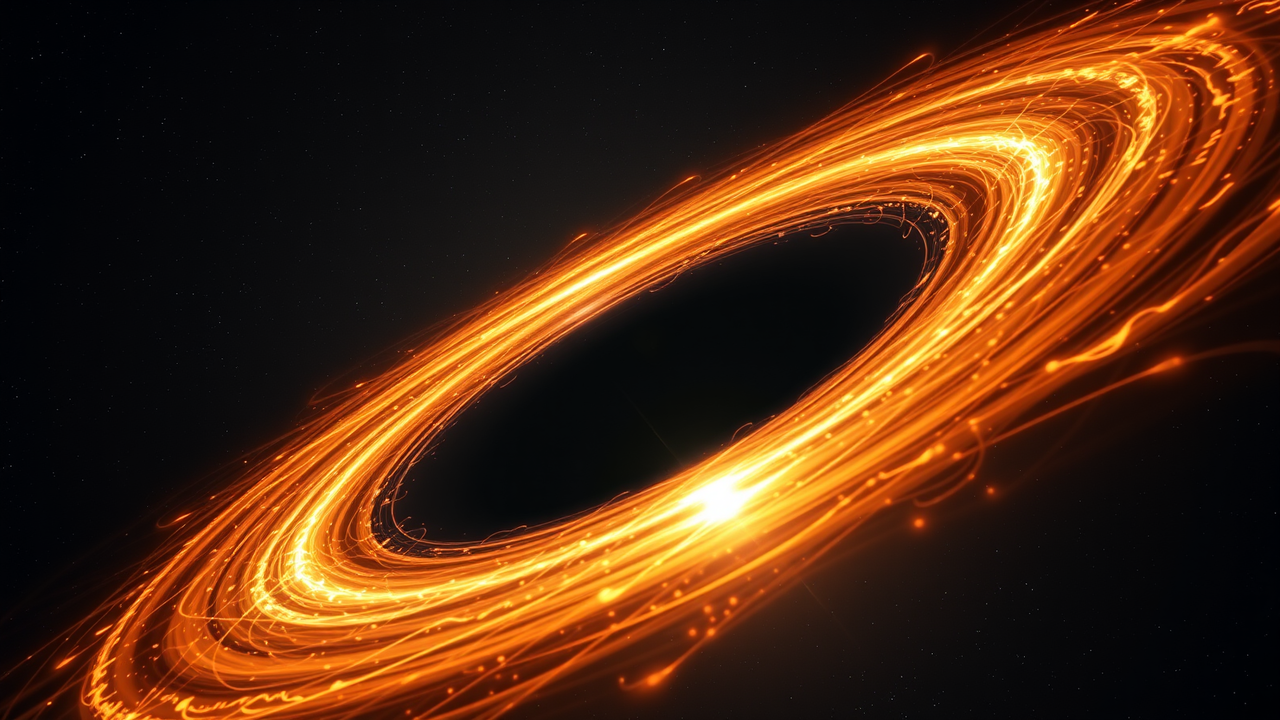
New Look at First Black Hole Image Reveals Dynamic Environment
The iconic 2019 image of the supermassive black hole M87, a landmark in astronomy, has been revisited by scientists. This new analysis offers a surprising revelation about the cosmic object.
Rather than a fixed snapshot, the glowing ring around M87 is far more dynamic than previously understood. Years of observations have painted a picture of a constantly shifting environment.
Revisiting the Iconic Image with Advanced Data
The initial image of M87 was created by the Event Horizon Telescope Collaboration in 2019. It used radio waves to capture the hot plasma orbiting the black hole.
Now, astronomers have combined data from multiple observation periods, including 2012, 2017, 2023, and planned 2025 observations. This has allowed for the creation of the first 'animation' of the black hole's changing environment.
Surprising Discovery: A Turbulent Cosmic Phenomenon
The most significant finding is that the bright ring is not static. Instead, it shifts and flickers over time, much like turbulent weather.
The diameter of the ring remains stable, but the brightest region rotates and moves. This indicates constant motion of material spiraling into the black hole.
Superheated gas, or plasma, swirls at near light speeds around the black hole. Powerful magnetic fields twist this plasma, causing the bright spots to change location.
Einstein's Relativity Confirmed by Black Hole Dynamics
These observed variations closely align with predictions from Albert Einstein's General Theory of Relativity. Sophisticated computer simulations of black hole accretion also support these findings.
The research strengthens the understanding that the 2019 image was a momentary glimpse of an ever-changing system. It provides new evidence for how matter behaves under extreme gravitational conditions.
M87: A Cosmic Laboratory Reshaping Understanding
The black hole at M87's center is immense, possessing 6.5 billion times the mass of our Sun. It is located approximately 55 million light-years away.
Despite its distance, M87 serves as a crucial laboratory for studying gravity and plasma physics. These new observations enhance our knowledge of how black holes consume matter and launch powerful jets.
"These observations open a new window into understanding black hole dynamics."
The Event Horizon Telescope Collaboration anticipates that future, upgraded telescopes will enable scientists to produce higher-resolution time-lapse images. This will offer real-time insights into black hole evolution.
What to Watch Next
Future observations with enhanced resolution will aim to capture the evolution of black holes in real-time. Scientists are eager to see how these celestial giants change and interact with their surroundings over longer periods.