
JWST Spots Unusual Young Galaxies, Reigniting Debate on the True Nature of Dark Matter
NASA’s James Webb Space Telescope (JWST) is once again reshaping our understanding of the cosmos—this time by uncovering unexpected shapes in some of the universe’s...
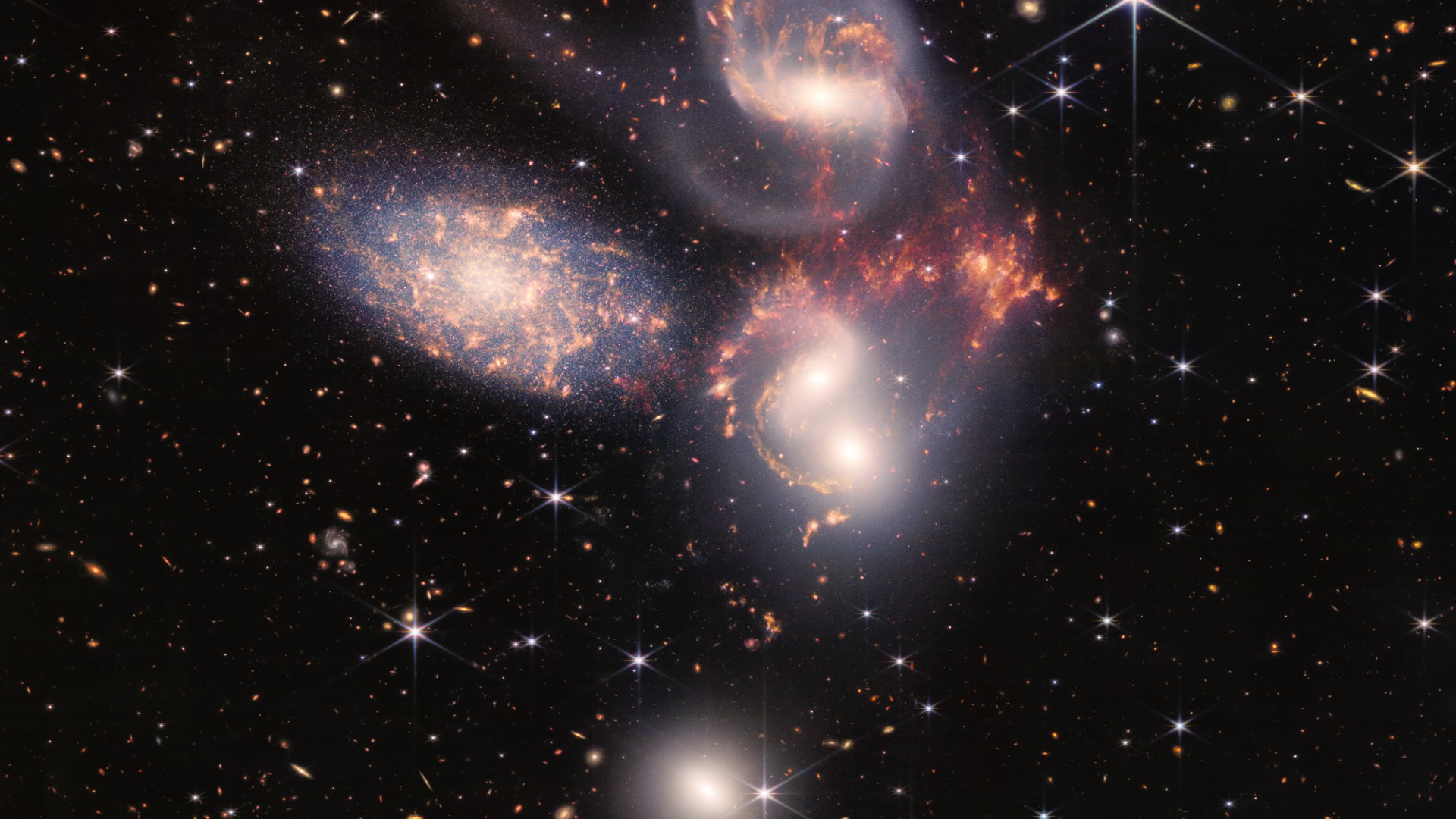
NASA’s James Webb Space Telescope (JWST) is once again reshaping our understanding of the cosmos—this time by uncovering unexpected shapes in some of the universe’s earliest galaxies. New observations suggest that these primordial systems, formed less than a billion years after the Big Bang, are far more elongated than existing cosmological theories predict, potentially pointing toward new physics behind dark matter itself.
The findings, published in Nature Astronomy, are based on a detailed comparison between JWST observations and advanced computer simulations exploring multiple dark matter scenarios. Researchers say the results challenge the long-dominant “cold dark matter” model and open the door to alternatives involving warmer or even wave-like forms of dark matter.
A Surprising Portrait of the Early Universe
JWST’s unprecedented sensitivity has allowed astronomers to detect hundreds of faint, distant galaxies from the universe’s first billion years. Unlike nearby galaxies—which typically appear as disks or rounded spheroids—many of these early systems are strikingly elongated, or prolate, resembling cosmic filaments rather than compact structures.
“These are shapes we simply didn’t expect to see so frequently,” said Rogier Windhorst, Regents Professor at Arizona State University’s School of Earth and Space Exploration and a JWST interdisciplinary scientist. “Standard models predict early galaxies growing from small, clumpy dark matter halos—not stretched structures connected by smooth filaments.”
Why Dark Matter Is Central to the Mystery
Dark matter, which makes up most of the universe’s mass, governs how galaxies form and evolve. For decades, cosmology has relied on the cold dark matter (CDM) model, in which heavy, slow-moving particles clump together to form the scaffolding of galaxies.
However, even the most sophisticated CDM simulations struggle to reproduce the extreme elongation seen in JWST images.
To investigate further, the research team—led by Álvaro Pozo of the Donostia International Physics Center—ran simulations based on alternative theories:
-
Warm dark matter, involving lighter particles such as sterile neutrinos
-
Wave (or fuzzy) dark matter, where ultralight axion particles behave according to quantum mechanics
The simulations revealed a key difference: warm and wave dark matter produce smoother, more coherent cosmic filaments, along which gas and stars can flow steadily. This process naturally forms elongated galaxies—closely matching what JWST is now observing.
Quantum Effects on Cosmic Scales
Wave dark matter simulations are especially demanding, as they must capture tiny quantum interference patterns while simultaneously modeling gas dynamics. Yet these models may explain why early galaxies appear stretched rather than fragmented.
“If dark matter consists of ultralight axions, their wave-like nature suppresses structure on very small scales,” Pozo explained. “That delay allows matter to assemble along smooth filaments, creating the elongated forms Webb is now revealing.”
According to the study, both warm and wave dark matter scenarios produce such shapes in large numbers, whereas cold dark matter does not.
Broader Implications for Cosmology
The results carry major implications for fundamental physics. Dark matter has never been directly detected, and its true nature remains one of science’s biggest unsolved problems. Observational clues from the early universe—where conditions were simpler—may offer the best chance to distinguish between competing theories.
Independent experts note that JWST spectroscopy and larger simulation datasets could soon provide decisive tests, potentially ruling out or supporting specific dark matter candidates.
A Collaborative Global Effort
The research involved scientists from institutions including MIT, Harvard, and Taipei, and was written by the Donostia International Physics Center with contributions from Arizona State University.
The paper is dedicated to physicist George F. Smoot, a Nobel laureate and longtime collaborator, who passed away shortly after the study was accepted. Colleagues noted that Smoot was among the earliest proponents of axion-based dark matter and remained deeply engaged in frontier research spanning cosmology, quantum detectors, and gravitational waves.
What Comes Next
Future JWST observations—particularly detailed spectroscopy—will help determine how stars move within these elongated galaxies and how gas flows along cosmic filaments. Combined with next-generation simulations, scientists believe these studies could finally narrow down what dark matter is—and how it shaped the universe we see today.