
Jupiter's Orbit: A Planet Factory Revealed by Scientists
Researchers discovered a planet-forming region beyond Jupiter's orbit.
Top Summary
- What happened: Scientists identified a ring-shaped area beyond Jupiter's orbit as a highly efficient planetesimal "breeding ground."
- Why it matters: This discovery provides crucial insights into the early Solar System's planet formation processes and conditions.
- What changes for people: It enhances our understanding of meteorite origins and planetary composition.
- Who is affected: Cosmochemists, astrophysicists, and anyone interested in the Solar System's origins.
Cosmic Breeding Ground Discovered
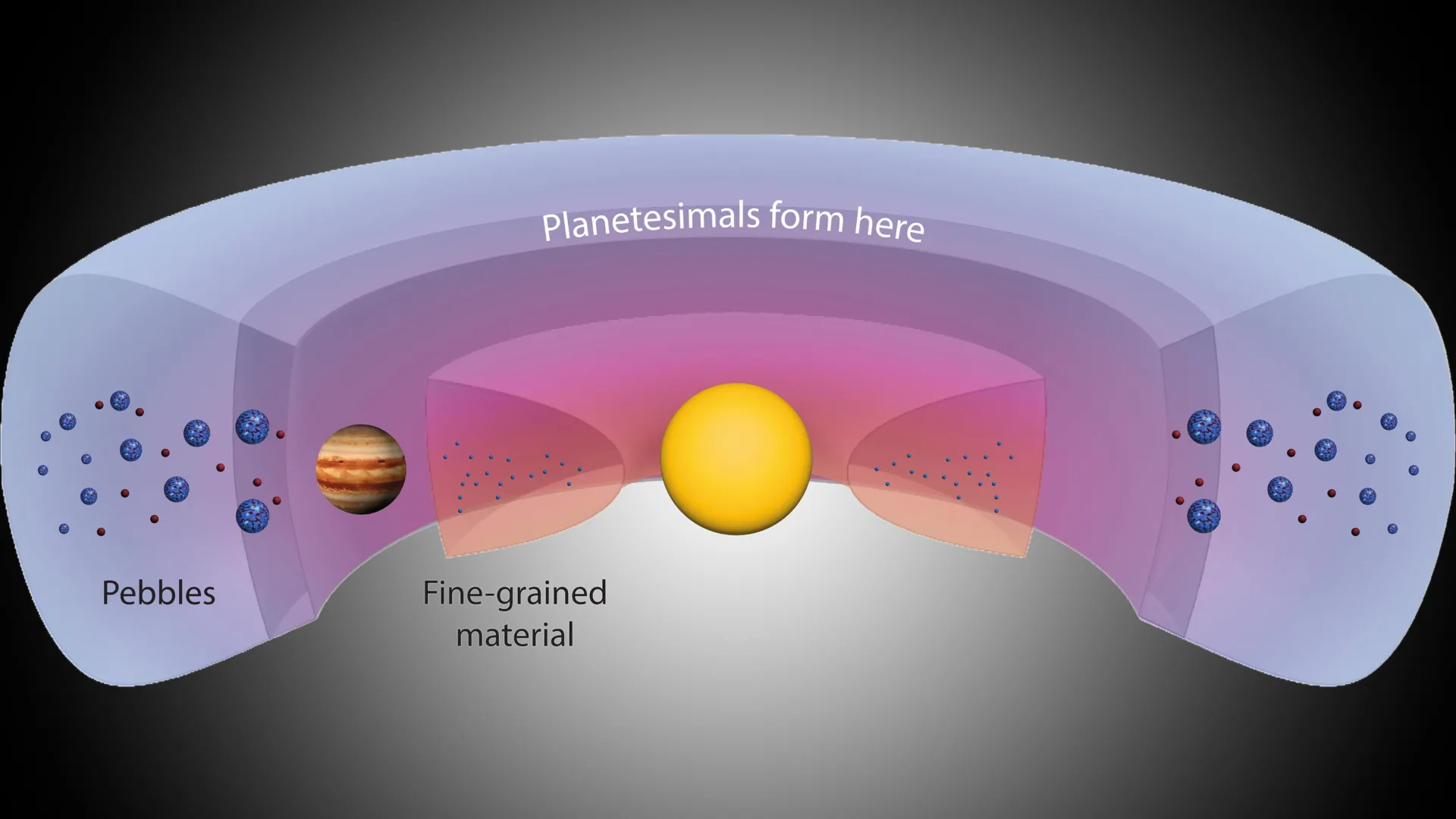
Scientists at the Max Planck Institute for Solar System Research (MPS) have located a key planet-forming region beyond Jupiter. This area acted as a "breeding ground" for planetesimals.
The study, published in The Astrophysical Journal, reveals that this ring-shaped zone produced planetesimals with diverse compositions over two million years.
Jupiter's Role as Cosmic Gatekeeper
Jupiter's formation created a dust trap beyond its orbit. This high-pressure ring captured dust, enabling pebble accumulation and rapid planetesimal formation.
"Different types of planetesimals apparently formed in the same region of the early dust and gas disk, only at different times. The region just outside Jupiter's orbit offered excellent conditions for this," said Joanna Drążkowska, head of the Lise Meitner Group on planet formation.
Meteorites: Time Capsules from the Early Solar System
Meteorites, remnants of ancient planetesimals, offer valuable clues about the early Solar System. Researchers focused on carbonaceous chondrites, meteorites rich in carbon.
These meteorites formed beyond Jupiter and are categorized into six groups based on age and composition.
Simulations Uncover Space Rock Generations
The team's simulations tracked particle collisions and movement within the gas disk. These simulations revealed that Jupiter acted as a barrier, differentiating the distribution of larger and smaller particles.
These simulations accurately reproduced laboratory results, confirming theories of planetary formation.
"For the first time, we have succeeded in accurately reproducing the results of laboratory studies of meteorites using computer simulations of the early Solar System. The meteorites serve, so to speak, as a touchstone for theories of planetary formation," said MPS Director and cosmochemist Thorsten Kleine.
Diverse Planet Formation Timeline
The simulations showed distinct generations of planetesimals forming over millions of years. During the first 500,000 years, the amount of fragile material decreased before increasing again in the following million years.
This process led to two distinct populations of planetesimals. One comprised mostly of fragile material, and another comprised mostly of stable matter.
What to Watch Next
Future research will investigate whether other meteorite types also formed in this dust trap during earlier stages. Scientists aim to further refine their models to understand the precise conditions that led to the formation of our Solar System's diverse planetary bodies.