
Interstellar Comet 3I/ATLAS Unveils Stunning Ion Tail in New Image
A breathtaking new image of interstellar comet 3I/ATLAS (C/2025 N1 ATLAS) has revealed a spectacular transformation, showcasing a brilliant ion tail stretching deep into space...
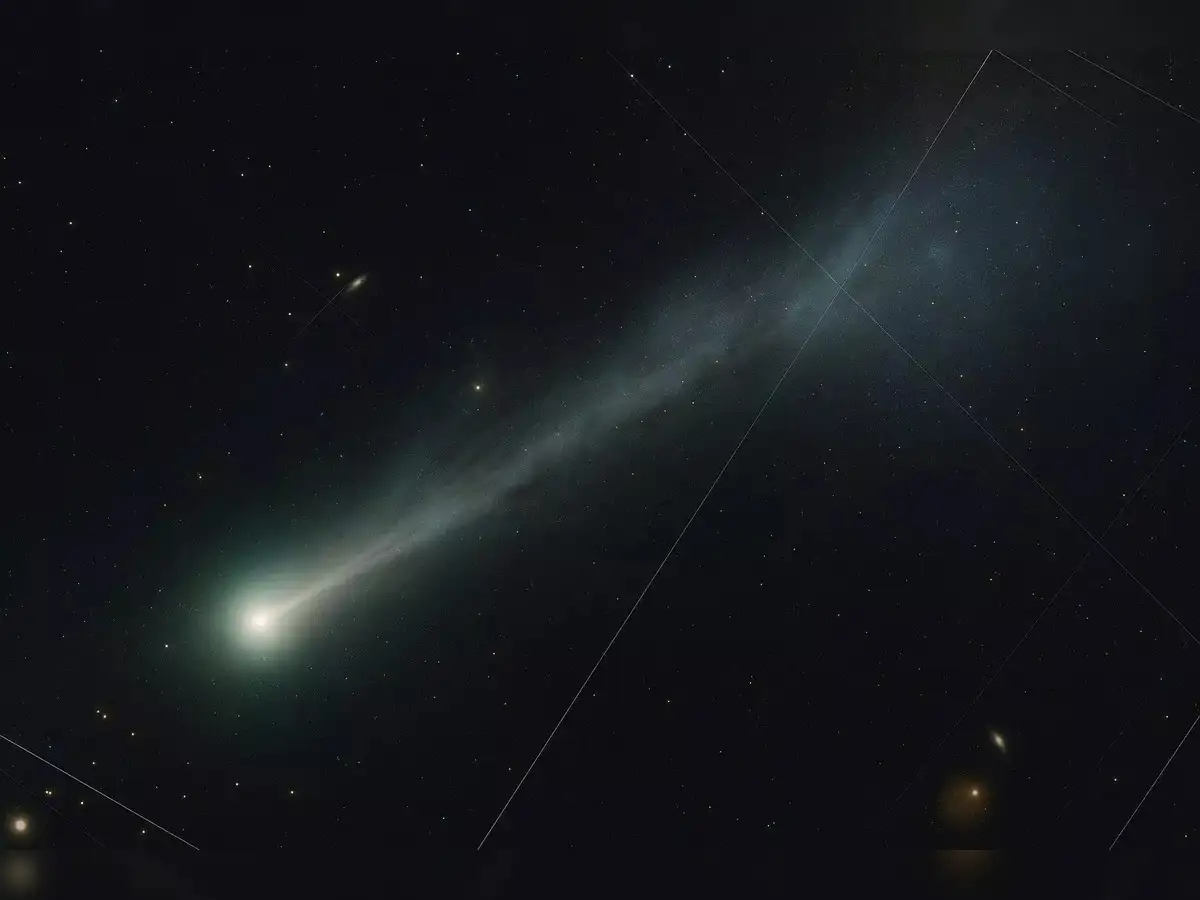
A breathtaking new image of interstellar comet 3I/ATLAS (C/2025 N1 ATLAS) has revealed a spectacular transformation, showcasing a brilliant ion tail stretching deep into space as the comet grows more active on its journey through the inner solar system.
Captured by the Virtual Telescope Project in Manciano, Italy, the composite image is based on 18 long-exposure frames taken under rare clear autumn skies. Despite the comet’s low altitude—just 14° above the eastern horizon—and a bright 61% moon nearby, the photo reveals exceptional detail of the glowing blue tail.
Astronomer Gianluca Masi, founder of the Virtual Telescope Project, said the new observations highlight a “much more developed ion tail,” signalling that the comet’s activity is rapidly intensifying.
An ion tail forms when charged solar particles collide with gases released from a comet’s nucleus, creating glowing streams of ionized particles that always point away from the Sun. The blue coloration is mainly due to carbon monoxide ions interacting with the solar wind.
3I/ATLAS is only the third confirmed interstellar comet, following 1I/‘Oumuamua in 2017 and 2I/Borisov in 2019. It likely originated beyond our solar system, giving scientists a rare glimpse into the chemistry and structure of alien planetary systems.
As 3I/ATLAS nears its perihelion (closest approach to the Sun), astronomers expect its brightness and tail length to increase — potentially making it visible through small telescopes in the coming weeks.
Experts worldwide are monitoring the comet closely, hoping its behaviour will unlock new insights into interstellar matter drifting through the Milky Way.