
India’s First Multi-Wavelength Space Astronomy Observatory
India’s pioneering multi-wavelength space observatory allows astronomers to observe the universe simultaneously in ultraviolet (UV), visible, soft X-ray, and hard X-ray bands. A collaborative initiative...
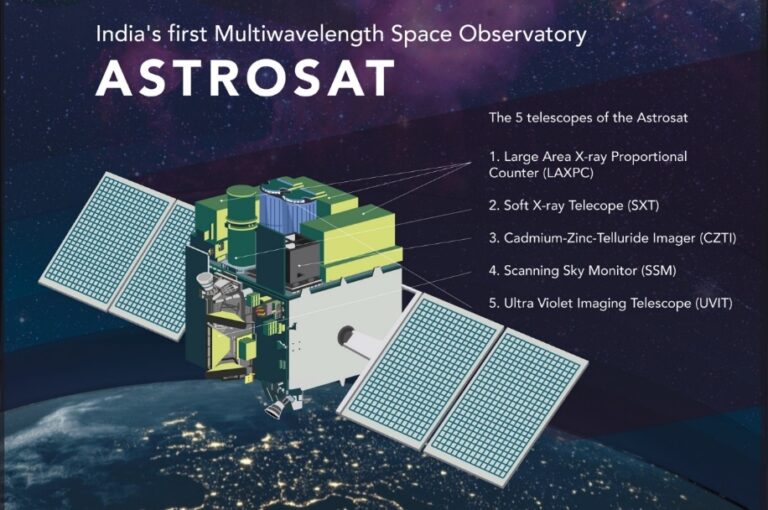
India’s pioneering multi-wavelength space observatory allows astronomers to observe the universe simultaneously in ultraviolet (UV), visible, soft X-ray, and hard X-ray bands. A collaborative initiative led by ISRO alongside premier Indian research institutes, the project also involves international partners from Canada and the UK.
Launch Details
-
Date: 28 September 2015
-
Launch Vehicle: PSLV-C30 (XL configuration)
-
Launch Site: Satish Dhawan Space Centre, Sriharikota
Objectives
-
Enable simultaneous multi-band observations of celestial phenomena.
-
Provide Indian astronomers with space-based capabilities, reducing reliance on foreign observatories.
-
Contribute to global astronomy research via open access to scientists worldwide.
Payloads
-
Ultra Violet Imaging Telescope (UVIT)
-
Large Area X-ray Proportional Counter (LAXPC)
-
Cadmium–Zinc–Telluride Imager (CZTI)
-
Soft X-ray Telescope (SXT)
-
Scanning Sky Monitor (SSM)
Key Discoveries & Contributions
-
Resolved a puzzle about a red giant star’s unusual brightness.
-
Detected far-UV photons from galaxies ~9 billion light years away.
-
Observed extended emission of the Butterfly Nebula.
-
Discovered fast-spinning black holes and studied X-ray binaries.
-
Conducted X-ray polarization studies and captured galaxy mergers.
Significance
-
Scientific Breakthroughs: Provided India with a world-class astronomy platform, advancing research on black holes, neutron stars, and galaxies.
-
Capacity Building: Trained a new generation of Indian astronomers, with half of the observatory’s users being students and researchers from India.