
Indian Stocks Plunge as FIIs Exit Amidst Global Cues
Indian stock markets witnessed a significant sell-off, with foreign investors offloading shares worth over Rs 10,000 crore in a single day.
The Cliff News | 2 October 2026
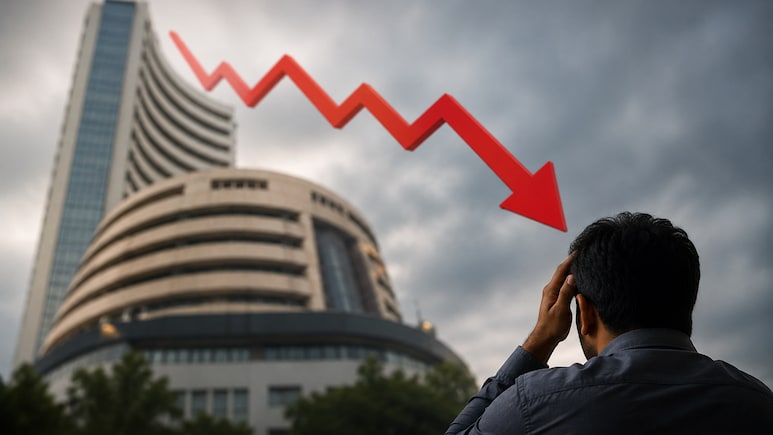
The Indian stock market experienced a substantial downturn on Thursday, with the benchmark Sensex plummeting by over 1,000 points by 2 pm. The Nifty also slipped below the 22,300 mark as foreign institutional investors (FIIs) continued their aggressive selling of Indian equities.
The market's decline was sharp enough to erase approximately Rs 9 lakh crore in market capitalisation from BSE-listed companies within a few hours. The total market capitalisation dropped from Rs 4,71,86,292 crore at the opening to Rs 4,62,71,545 crore by 1:45 pm.
FII Sell-off Fuels Market Crash
The primary driver behind this significant market correction is the continued withdrawal of funds by foreign institutional investors. On September 30 alone, FIIs divested Indian stocks valued at over Rs 10,000 crore. This follows a trend of substantial selling, with their net outflows exceeding Rs 20,000 crore over the preceding two sessions.
Key Triggers Impacting Indian Equities
Several factors are contributing to the increased selling pressure on Indian bourses. A major trigger identified is the rise in US bond yields. The US 10-year Treasury yield has climbed above 5.3 per cent, making US fixed-income assets a more attractive investment destination for global investors. This shift can diminish the appeal of riskier emerging-market equities, such as Indian stocks.
Adding to the pressure is the depreciation of the Indian rupee. The currency weakened beyond Rs 96 against the US dollar on Thursday. A weaker rupee can make dollar-denominated returns from Indian equities less appealing for foreign investors, further encouraging capital outflows.
Oil price uncertainty is another significant concern for the Indian market. Supply disruptions stemming from the conflict with Iran have heightened volatility in energy prices. Elevated crude oil prices pose a particular challenge for India, given its substantial reliance on oil imports.
Market Volatility Escalates
The intensifying sell-off has also led to a surge in market volatility. India VIX, a key gauge of market sentiment, saw a marked increase as the selling pressure mounted, reflecting growing uncertainty among investors.
Divergence in Market Performance for Retail Investors
While headline indices like the Sensex and Nifty reflect a broad market decline, the impact on individual investors may vary. According to Eshaan Lazarus, Founder & CEO of 021 Trade, the Nifty 50 might not fully represent the experience of many retail investors, who are increasingly exposed to mid-cap and small-cap stocks.
Mr. Lazarus highlighted that the Nifty MIDSMALL400 index is only 5 to 6 per cent off its peak. He suggested that the Nifty 50 is not the most accurate benchmark for assessing the overall market sentiment for the average investor, as most retail investors tend to favour mid and small-cap stocks. Data indicates that Systematic Investment Plan (SIP) money has been gradually shifting from large-cap stocks to mid and small-cap segments over the past five years.
This divergence is significant because the Sensex and Nifty are heavily weighted towards large-cap companies. Consequently, a fall in these indices does not necessarily capture the full picture of portfolio performance for retail investors who hold a substantial portion of their investments in smaller-cap stocks.