
Indian Astrophotographer Captures Triangulum Galaxy from Himalayas
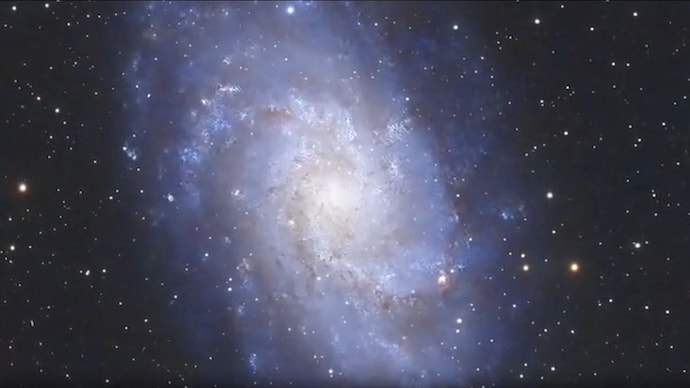
Ramesh Bhadri photographed the Triangulum Galaxy from Uttarakhand.
Top Summary
- What happened: Amateur astrophotographer Ramesh Bhadri photographed the Triangulum Galaxy from Tehri Garhwal, Uttarakhand.
- Why it matters: The image captures light that left the galaxy 2.7 million years ago, providing a glimpse into the distant past.
- What changes for people: It showcases the potential for astronomical observation from locations with minimal light pollution in India.
- Who is affected: Astronomy enthusiasts and researchers interested in the Local Group of galaxies.
A Himalayan View of a Distant Galaxy
Ramesh Bhadri, an amateur astrophotographer, successfully captured an image of the Triangulum Galaxy from a remote village in Tehri Garhwal, Uttarakhand. The galaxy, also known as Messier 33 or NGC 598, is located 2.7 million light-years away.
The image showcases the galaxy's spiral structure and distinctive pink regions. These pink areas are giant clouds of ionised hydrogen gas, indicating active star formation.
Understanding the Triangulum Galaxy
The Triangulum Galaxy is the third-largest galaxy in the Local Group. This group consists of approximately 50 galaxies, including our Milky Way and the Andromeda Galaxy.
It is a spiral galaxy characterized by arms that extend outwards from a central core. Inside M33 is NGC 604, a star-forming region spanning roughly 1,500 light-years.
The galaxy contains an estimated 40 billion stars. The Milky Way, in comparison, contains between 100 and 400 billion.
Capturing Light from the Distant Past
The light captured by Bhadri's camera left the Triangulum Galaxy approximately 2.7 million years ago. At that time, early humans were just beginning to walk upright on Earth.
This makes the image a direct connection to a very distant past. It highlights the immense scale of space and time involved in astronomical observations.
The Equipment and Technique
Bhadri used a Redcat 51 telescope, a compact and portable instrument, for the photograph. He also used a ZWO ASI533MC Pro camera and an L-Pro filter.
The L-Pro filter helps block artificial light, allowing fainter cosmic signals to be captured. The camera accumulates photons over hours to reveal the galaxy’s details.
A Galaxy on a Collision Course
In approximately 4 to 5 billion years, the Milky Way and Andromeda are expected to merge. This merger will create a single massive galaxy, sometimes referred to as Milkomeda.
The Triangulum Galaxy, gravitationally bound to Andromeda, is also likely to be involved in this collision. The stars in Bhadri's photograph are already moving toward us at roughly 1,00,000 kilometres per hour.
What to Watch Next
Scientists will continue to study the Triangulum Galaxy to learn more about star formation and galactic evolution. Future research will focus on understanding how the galaxy will be affected by the eventual collision between the Milky Way and Andromeda.