
ESA's Proba-3 Mission Faces Setback: Spacecraft Loses Contact
Proba-3 mission to study the Sun's corona hit by technical issues.
Top Summary
- What happened: The European Space Agency's Proba-3 Coronagraph spacecraft lost attitude control, interrupting communication with mission control.
- Why it matters: Proba-3 aims to capture detailed images of the Sun's corona, crucial for understanding space weather events.
- What changes: The mission's ability to study the solar corona is temporarily halted, impacting scientific research.
- Who is affected: Scientists, researchers, and potentially satellite and communication systems reliant on space weather predictions.
Proba-3 Mission Encounters Technical Difficulties
The European Space Agency's (ESA) ambitious Proba-3 mission has encountered a major setback. Contact has been lost with one of its two spacecraft, the Coronagraph.
This mission aims to study the Sun's outer atmosphere. It seeks to capture detailed images of the Sun's corona using artificial solar eclipses in space.
Loss of Attitude Control
An anomaly triggered a progressive loss of attitude control in the Coronagraph spacecraft in mid-February 2026. Attitude control is a satellite’s ability to maintain its orientation.
Due to this failure, the spacecraft’s solar panels stopped facing the Sun. This prevented it from generating sufficient power.
As a result, the onboard battery rapidly discharged. The satellite entered survival mode where only essential systems remain active and communication is halted.
Unique Two-Spacecraft Design
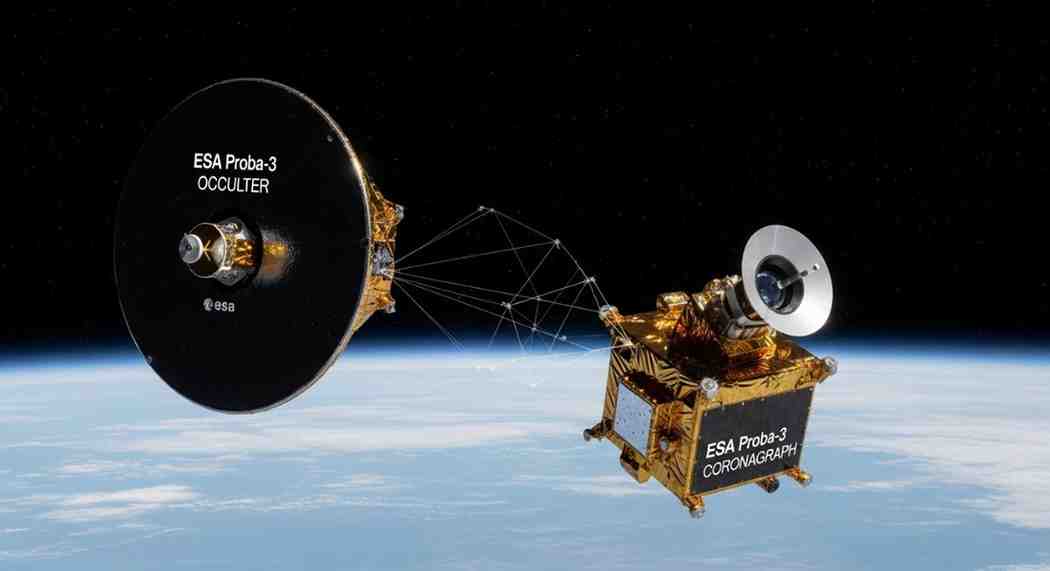
The Proba-3 mission is designed with two spacecraft working together. These are the Coronagraph satellite and the Occulter satellite.
The Occulter blocks the Sun’s bright disc. This allows the Coronagraph to capture detailed images of the faint solar corona.
Both spacecraft must fly in precise formation. They must maintain a separation of around 150 metres while orbiting Earth.
Recovery Efforts Underway
Mission teams are exploring ways to restore communication and control of the Coronagraph spacecraft. The Occulter satellite remains fully operational.
The Occulter may be manoeuvred closer to observe the orientation of the malfunctioning spacecraft. This could help engineers understand its position and design possible recovery strategies.
Mission Achievements So Far
Since its launch in December 2024, Proba-3 has achieved significant milestones. It has successfully completed more than 60 formation-flying orbits.
This demonstrates advanced satellite coordination technologies.
Importance of Studying the Solar Corona
The solar corona is the outermost layer of the solar atmosphere. It is visible during total solar eclipses.
The corona plays a crucial role in space weather phenomena. These include solar winds and coronal mass ejections.
These events can affect satellites, communication systems and power grids on Earth. By studying the corona, scientists hope to improve predictions of space weather.
What to Watch Next
The ESA will continue its efforts to re-establish contact with the Coronagraph spacecraft and determine the cause of the anomaly. The data gathered from the Occulter satellite will be crucial in devising a recovery plan and potentially resuming the mission's scientific objectives.