
ESA Mars Probe Spots Striking ‘Butterfly Crater’ Etched into the Red Planet
A dramatic new image from the European Space Agency’s (ESA) Mars Express spacecraft has unveiled a butterfly-shaped impact crater in the planet’s northern lowlands —...
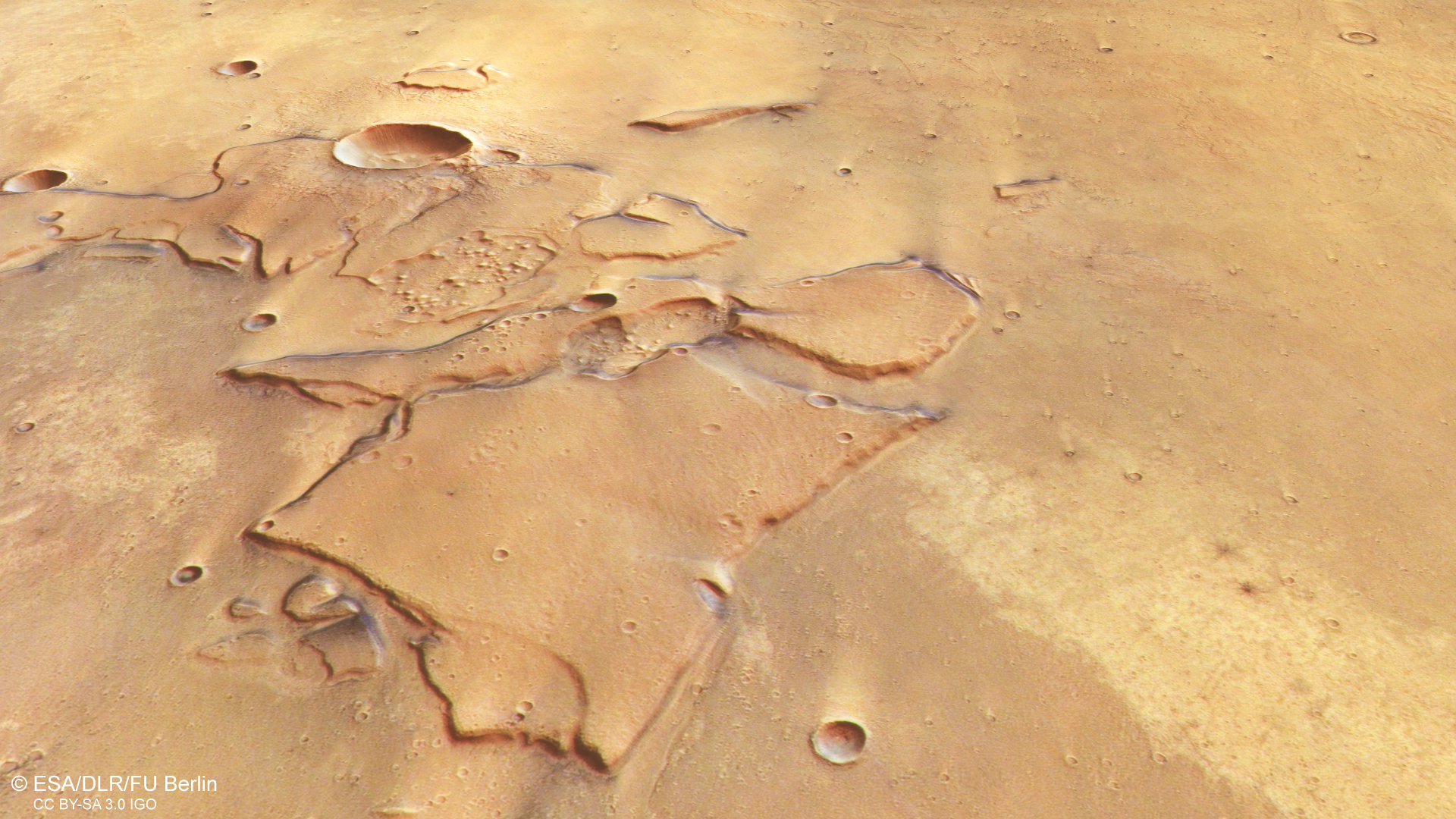
A dramatic new image from the European Space Agency’s (ESA) Mars Express spacecraft has unveiled a butterfly-shaped impact crater in the planet’s northern lowlands — a striking reminder of how cosmic collisions continue to shape Mars’ landscape. The formation, nearly 20 kilometers across, offers scientists fresh insights into the mechanics of low-angle asteroid impacts and the geological history of the region.
A Cosmic Collision Frozen in Time
The crater lies within Idaeus Fossae, a fractured zone marked by deep grooves and faults carved by ancient tectonic shifts. According to ESA’s analysis of the latest high-resolution 3D renderings, the butterfly-like pattern emerged when a space rock grazed the surface at a shallow angle instead of plunging straight down.
This glancing blow pushed debris outward into two sweeping “wings,” while a long central trough marks the primary impact point. Planetary geologists say such asymmetric craters are relatively rare and can reveal valuable clues about the direction, speed, and composition of the incoming object.
ESA researchers noted in a mission update that the new imagery highlights finely layered ridges and channels created as ejected material settled back onto the surface — details that are often erased by erosion on Earth but preserved on Mars’ thin, dry terrain.
A Region With a Turbulent Past
Idaeus Fossae itself has long intrigued scientists. The area’s labyrinth of faults suggests prolonged crustal stretching and collapse, possibly linked to the planet’s ancient volcanic provinces.
Dr. Alice Lefevre, a planetary geologist with ESA, explained in a briefing that “structures like these help reconstruct the mechanical stress Mars experienced as it cooled and hardened,” though she emphasized that the full timeline of the region remains under study.
Mars Express: Two Decades of Discoveries
Launched in 2003 and operational since mid-2004, Mars Express remains ESA’s longest-serving interplanetary mission. Over more than 20 years, it has mapped large portions of the Martian surface, detected minerals linked to ancient water systems, and captured some of the closest views of Mars’ moons, Phobos and Deimos.
The High Resolution Stereo Camera (HRSC), responsible for the new butterfly-crater renderings, continues to be one of the spacecraft’s most productive instruments. ESA officials say the camera’s ability to generate precise elevation models is essential for understanding how Mars’ landscapes formed and evolved.
Why This Discovery Matters
While visually arresting, the butterfly crater is more than a geological curiosity. Low-angle impacts, though rare, may have played a significant role in distributing water-bearing minerals or reshaping regional topography in Mars’ early history. They also help researchers refine impact-simulation models used to assess potential hazards to planets — including Earth.
Planetary-defense specialists say that studying such craters deepens our understanding of how shallow-trajectory objects behave, information vital for crafting future mitigation strategies.
Looking Ahead
ESA plans to continue releasing new data from Mars Express as it enters its third decade of operations. Combined with upcoming missions from Europe, the U.S., and Asia, scientists expect a more complete reconstruction of Mars’ ancient environment — and perhaps clues to whether the planet ever hosted conditions suitable for life.