
Defunct NASA Satellite Van Allen Probe A to Re-enter Earth's Atmosphere in 2026
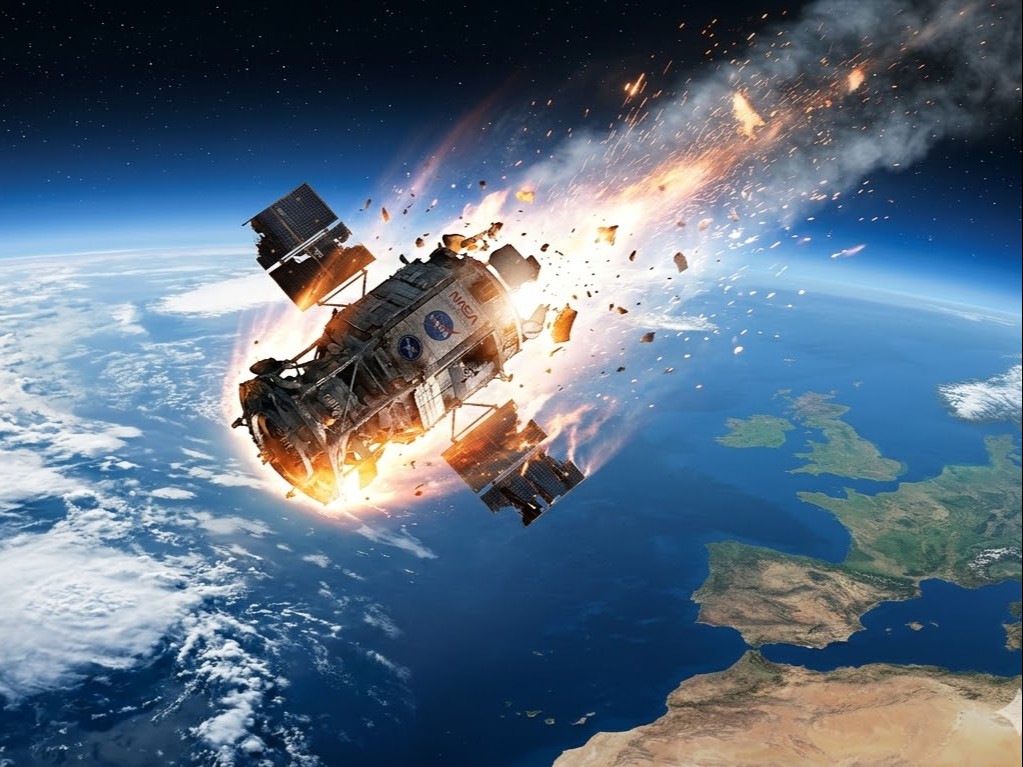
NASA's Van Allen Probe A, after a decade in space, will re-enter Earth's atmosphere in March 2026.
Top Summary
- What happened: The defunct NASA satellite, Van Allen Probe A, is predicted to re-enter Earth's atmosphere in March 2026 after 14 years in space.
- Why it matters: The satellite's re-entry marks the end of a mission that significantly contributed to our understanding of space radiation.
- What changes for people: While the re-entry is uncontrolled, the risk of debris causing harm is very low due to the satellite's expected disintegration.
- Who is affected: Scientists studying space weather and the general public, who may witness a fiery trail in the sky.
Van Allen Probe A's Fiery Return
NASA's Van Allen Probe A, weighing around 1,323 pounds (600 kilograms), is slated for an uncontrolled re-entry in March 2026. The United States Space Force predicts re-entry around 7:45 p.m. EDT.
Launched 14 years ago, the probe studied space radiation around the planet. Due to its defunct status, NASA cannot control its descent.
The intense heat generated during re-entry should cause most of the satellite to burn up, creating a dramatic spectacle.
Minimal Risk from Falling Debris
NASA scientists assure that the risk of debris causing harm is exceedingly low.
Most of the spacecraft will disintegrate during re-entry due to intense atmospheric heating.
Even if fragments survive, the vast expanse of Earth's oceans (71 percent) makes it highly probable that debris will land harmlessly in the water.
Predicting the Unpredictable
Predicting the exact time and location of re-entry remains a challenge for scientists.
Factors such as atmospheric density, solar activity, and space weather conditions all play a role.
Currently, predictions for Van Allen Probe A's re-entry carry a timing uncertainty of plus or minus 24 hours.
A Mission to Understand Radiation Belts
The Van Allen Probe mission, launched on August 30, 2012, involved two identical spacecraft: Van Allen Probe A and Van Allen Probe B.
The mission's primary goal was to study the Van Allen radiation belts.
These belts are zones of high-energy charged particles trapped by Earth’s magnetic field, impacting space weather.
Space Debris: A Constant Phenomenon
The re-entry of Van Allen Probe A is part of a broader phenomenon: space debris re-entry.
Thousands of satellites, rocket stages, and other debris orbit Earth.
Space agencies report that small pieces of space debris re-enter Earth's atmosphere almost daily, usually burning up harmlessly.
Van Allen Radiation Belts Explained
The Van Allen radiation belts, discovered in 1958 by American physicist James Van Allen, are zones of energetic charged particles.
These particles are trapped by Earth's magnetic field.
They primarily consist of high-energy electrons and protons originating from the solar wind and cosmic radiation.
What to Watch Next
Scientists will continue to refine their predictions regarding the exact re-entry time and location of Van Allen Probe A. The event serves as a reminder of the ongoing challenges and opportunities associated with managing space debris and understanding our planet's space environment.