
Cosmic Laser: Most Distant Megamaser Ever Detected by Astronomers
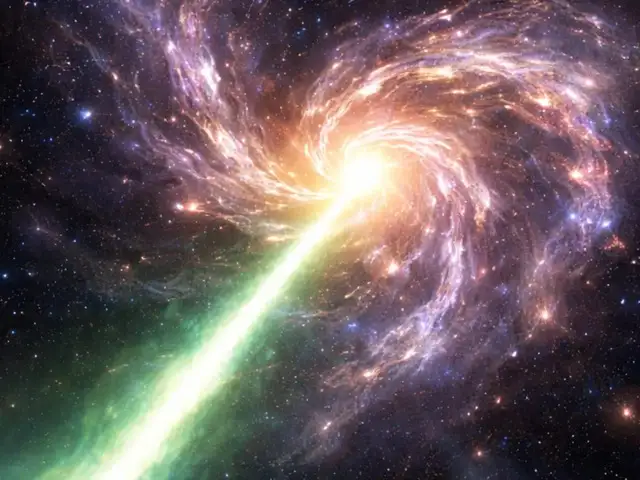
Astronomers discovered the most distant and brightest 'space laser' ever observed.
Top Summary
- What happened: Astronomers detected the most distant and brightest megamaser, or 'space laser,' ever observed.
- Why it matters: It provides new insights into extreme cosmic conditions and how signals are amplified across vast distances.
- What changes: This discovery helps scientists understand galactic collisions in the early universe.
- Who is affected: The astronomical community and researchers studying the early universe.
Distant Galactic Collision Reveals Cosmic Secrets
Astronomers have detected the most distant and brightest "space laser," known as a megamaser, ever observed.
The megamaser originated from a galactic collision that occurred when the universe was just half its current age.
The discovery offers new insights into the extreme conditions that can amplify cosmic signals across vast distances.
MeerKAT Telescope Spots Ancient Signal
The signal was detected by South Africa's MeerKAT radio telescope.
It originates from a hydroxyl megamaser, a natural amplifier of microwave radiation formed during a galaxy merger.
This occurs when hydroxyl molecules absorb and re-emit energy, according to National Today.
Understanding Hydroxyl Megamasers
HATLAS J142935.3–002836 is the galaxy system emanating light that traveled for about 8 billion years before reaching the MeerKAT radio telescope in South Africa.
The "space laser" is specifically a hydroxyl megamaser similar to a laser, but emits energy in microwave or radio wavelengths rather than visible light, according to Space.com.
"The term "hydroxyl" reflects its origin: it forms when hydroxyl molecules, each made of one oxygen and one hydrogen atom, collide with the dense gas of merging galaxies,"
What to Watch Next
Scientists will continue to study this megamaser to further understand the conditions of the early universe. Future research will likely focus on similar galactic collisions and their impact on cosmic signal amplification.